Environment: DynamicRealtimeEnvironment
At the heart of every simulation run is the DynamicRealtimeEnvironment, which extends SimPy's core environment. It is responsible for controlling the logical clock, managing simulated process tasks, and coordinating temporal synchronization. It holds the registry at env.registry, and runs the ingress and egress connectors on background threads. Time and Pacing describes the clock and its pacing.
Threading and Asynchronous I/O
Standard SimPy environments are single-threaded and synchronous. Performing heavy network operations (like writing to a Kafka broker or reading from S3) directly inside a SimPy process would block the entire simulation loop.
To resolve this, the DynamicRealtimeEnvironment runs the simulation on one thread and the connectors on two others, with queues between them. Records flow left to right from the processes to the sinks, and parameter changes flow right to left from the sources to the registry:
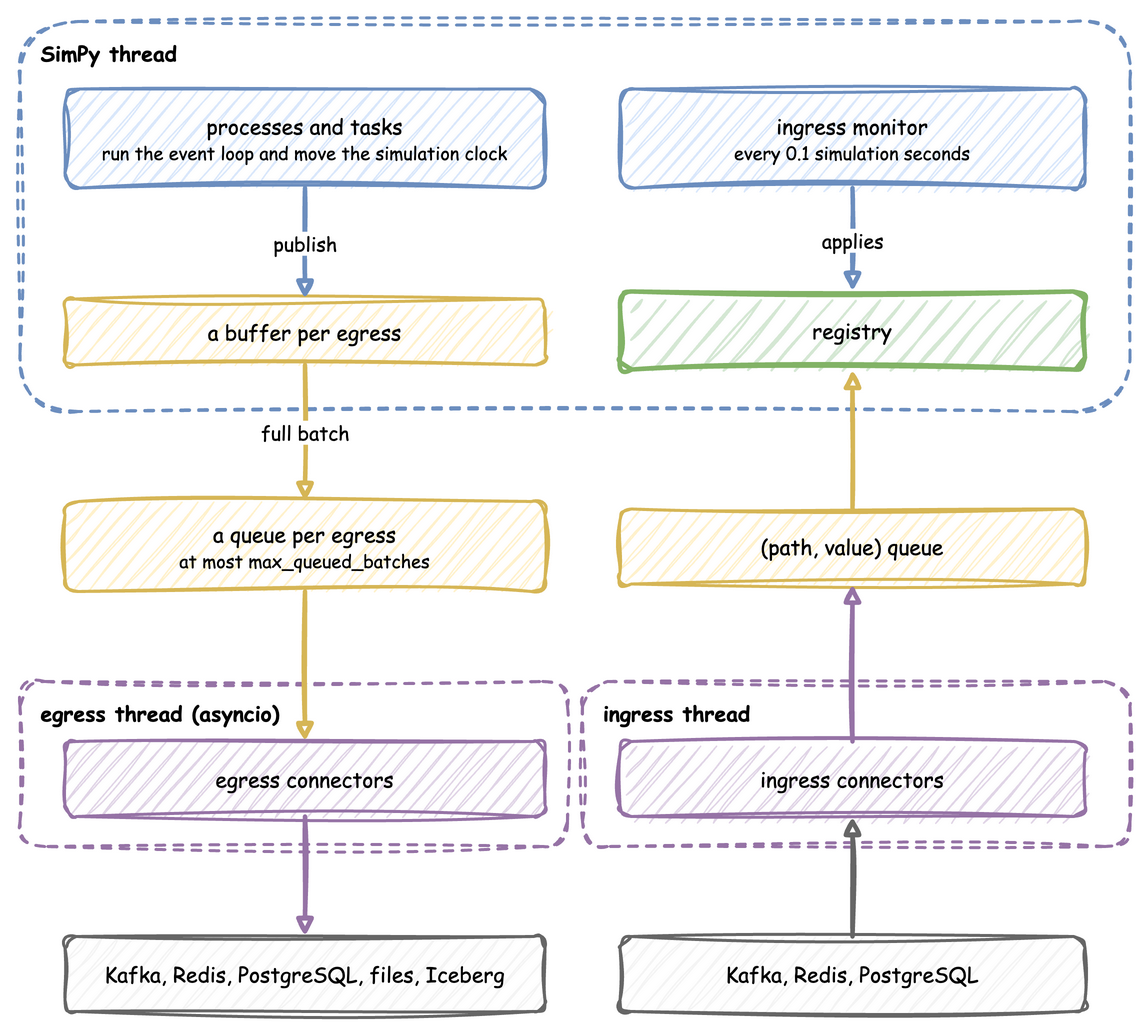
- SimPy thread: Executes SimPy processes and yields timeouts. When a process publishes an event or telemetry, the record is appended to a buffer for each egress provider. A buffer is handed to that provider's thread-safe queue when it reaches
batch_size, or whenflush_intervalpasses on a paced run. - Background asyncio thread: Automatically spawned on simulation startup. It drains the queues, and handles socket-level communication asynchronously, so socket latency does not stall each simulation step. Ingress providers run on a second background thread of their own. The egress queues are bounded by
max_queued_batches, so a sink that cannot keep up slows the simulation rather than building a backlog, and a sink that stops consuming raises an error once the queue has been full fordrain_stall_seconds.