Dynamic Topology: Resources Changed Mid-run
Sometimes the layout itself changes during a run: a dock opens a new bay, or a shop adds a gift wrapping station. Here a supervisor process adds gift wrappers at 12 seconds, and from then on new jobs go to the wrappers as well as the packers.
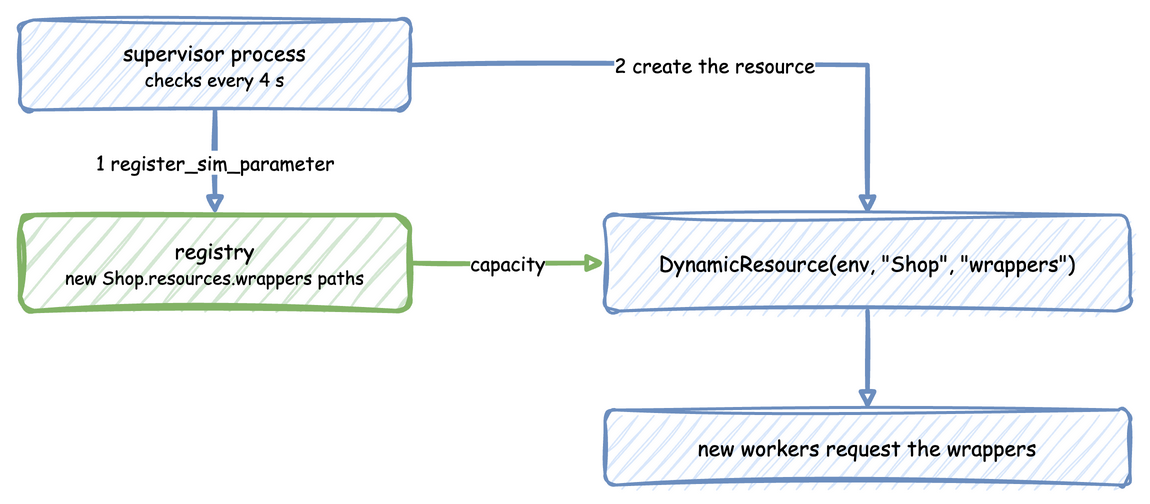
The builder (SimulationContext) creates every resource before the clock starts and has no call to add one later. A resource added during the run is written with the low-level API: register its parameters, then create the DynamicResource that reads them.
Example
import logging

from desflow import (
    CapacityConfig,
    ConsoleEgress,
    DynamicRealtimeEnvironment,
    DynamicResource,
    SimParameter,
)

logging.basicConfig(level=logging.INFO)

WORK = 3.0  # seconds each job takes
NEW_JOBS_EVERY = 4.0  # seconds between rounds of new jobs
ADD_WRAPPERS_AT = 12.0  # simulation time at which the gift wrappers are added

PARAMS = SimParameter(
    sim_id="Shop",
    resources={"packers": CapacityConfig(current_cap=1, max_cap=5)},
)


def worker(env, resources, name, job_id):
    resource = resources[name]
    key = f"{name}-{job_id}"
    env.publish_event(key, {"resource": name, "status": "queued"})
    with resource.request() as req:
        yield req
        env.publish_event(key, {"resource": name, "status": "started"})
        yield env.timeout(WORK)
        env.publish_event(key, {"resource": name, "status": "finished"})


def supervisor(env, resources):
    job_id = 0
    while True:
        yield env.timeout(NEW_JOBS_EVERY)

        if env.now >= ADD_WRAPPERS_AT and "wrappers" not in resources:
            # Give the gift wrappers their registry paths, then create the resource
            # that reads its capacity from them.
            env.registry.register_sim_parameter(
                SimParameter(
                    sim_id="Shop",
                    resources={"wrappers": CapacityConfig(current_cap=2, max_cap=5)},
                )
            )
            resources["wrappers"] = DynamicResource(env, "Shop", "wrappers")
            env.publish_event(
                "supervisor",
                {
                    "status": "wrappers_added",
                    "capacity": resources["wrappers"].capacity,
                },
            )

        # One new job for every resource that exists now.
        for name in list(resources):
            env.process(worker(env, resources, name, job_id))
        job_id += 1


def run(until=20.0, factor=1.0):
    env = DynamicRealtimeEnvironment(factor=factor)
    env.registry.register_sim_parameter(PARAMS)
    env.setup_egress([ConsoleEgress()])

    resources = {"packers": DynamicResource(env, "Shop", "packers")}
    env.process(supervisor(env, resources))
    try:
        env.run(until=until)
    finally:
        env.teardown()  # flushes the buffers and stops the threads
    return resources


if __name__ == "__main__":
    run()
Save it as dynamic_topology.py and run python dynamic_topology.py. It runs for 20 seconds in real time (factor=1.0) and prints each event.
How It Works
PARAMSregisters only the packers when the run starts.supervisorwakes everyNEW_JOBS_EVERYseconds. AtADD_WRAPPERS_ATit callsenv.registry.register_sim_parameterwith aSimParameterthat holds only the wrappers, which adds the pathsShop.resources.wrappers.current_capandShop.resources.wrappers.max_cap. It then createsDynamicResource(env, "Shop", "wrappers"), which reads its capacity from those paths, and publisheswrappers_added.- New jobs are started for every resource in
resources, so the wrappers get jobs from the round in which they are added. workeris one job: it publishesqueued,startedandfinishedwith the resource it used.runcreates the environment, starts the supervisor and callsenv.teardown()at the end, which writes the records still in the buffers.
The wrappers' capacity is live like any other. A scenario, a connector or a process can change Shop.resources.wrappers.current_cap once the path exists, as Live Parameters describes.