First Simulation
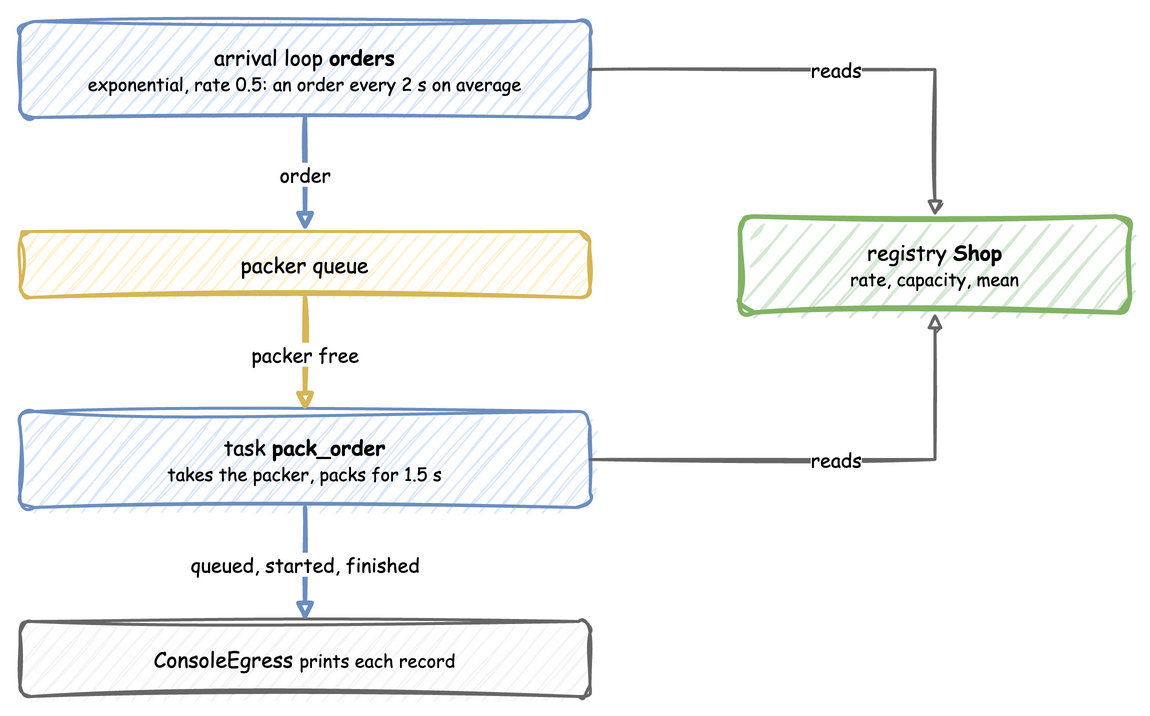
This tutorial builds an online shop that packs orders: one packer, orders arriving about every 2 seconds, and 1.5 seconds of packing per order. It then adds random packing times and capacity changes, and connects the shop to Kafka.
Each step shows the code three ways, in tabs: a YAML blueprint, the Builder (SimulationContext) and the Low-level API (DynamicRealtimeEnvironment and SimPy processes). Pick the tab of the way you write; every tab on the page switches with it. The three build the same simulation, so the records are the same. Ways to Write a Simulation explains how they relate.
Install
The core package includes the desflow command:
Describe the Shop
A simulation has a sim_id, here Shop, and its parameters: a resource called packers with one unit, a service called packing that sets how long an order takes, and an arrival stream called orders that sets how often an order arrives.
simulation:
  sim_id: Shop
  factor: 1.0  # 1 simulated second takes 1 real second

resources:
  packers: {current_cap: 1, max_cap: 1}

services:
  # With no std, a normal distribution returns its mean every time
  packing: {dist: normal, mean: 1.5}

arrivals:
  # One order every 2 seconds on average; each arrival spawns pack_order
  orders: {dist: exponential, rate: 0.5, spawn: pack_order}
app = (
    # 1 simulated second = 1 real second
    SimulationContext(sim_id="Shop", factor=1.0)
    .add_resource("packers", current_cap=1, max_cap=1)
    # With no std, a normal distribution returns its mean every time
    .add_service("packing", dist="normal", mean=1.5)
    # One order every 2 seconds on average
    .add_arrival("orders", dist="exponential", rate=0.5)
)
Each value gets a path in the registry, such as Shop.arrival.orders.rate or Shop.resources.packers.current_cap. A connector or a scenario changes a value through its path while the run continues; Live Parameters explains how.
Say What an Order Does
An order asks for a packer, waits until it gets one, is packed for a time drawn from packing, and releases the packer. It publishes a queued event when it asks, started when it gets the packer, and a finished event at the end.
@app.task(service_id="packing", resource_id="packers")
def pack_order(order_id: int):
# Requests a packer, waits the packing time, releases the packer.
# The returned dictionary is the finished event's value.
return {"order_id": order_id}
@app.arrival_loop("orders")
def order_generator(context: SimulationContext):
order_id = 0
while True:
yield context.wait_for_arrival("orders")
context.spawn(pack_order(order_id))
order_id += 1
def pack_order(env, sampler, packers, order_id):
"""One order: wait for a packer, pack it, release the packer."""
key = f"task-{order_id}"
path_id = "Shop.service.packing"
env.publish_event(key, {"path_id": path_id, "status": "queued"})
with packers.request() as request:
yield request
env.publish_event(key, {"path_id": path_id, "status": "started"})
service = env.registry.get_config(path_id)
yield env.timeout(sampler.sample(service))
env.publish_event(key, {"order_id": order_id})
def order_generator(env, sampler, packers):
"""Starts one pack_order for every arrival."""
arrival = env.registry.get_config("Shop.arrival.orders")
order_id = 0
while True:
yield env.timeout(sampler.sample(arrival))
env.process(pack_order(env, sampler, packers, order_id))
order_id += 1
The YAML task and the builder's @app.task publish the three events and handle the packer for you; the low-level process does each step itself. The arrival loop starts one order for every arrival: spawn in YAML, @app.arrival_loop in the builder, and order_generator in the low-level API.
Print the Records
A sink, called an egress, receives every record the simulation publishes. ConsoleEgress prints them; Connectors lists the others.
Run It
def run(until=10.0, factor=1.0):
env = DynamicRealtimeEnvironment(factor=factor)
env.registry.register_sim_parameter(PARAMS)
env.setup_egress(SINKS)
packers = DynamicResource(env, "Shop", "packers")
sampler = Sampler(rng=np.random.default_rng())
env.process(order_generator(env, sampler, packers))
try:
env.run(until=until)
finally:
env.teardown()
if __name__ == "__main__":
print("Starting simulation...")
run()
Start it from a terminal:
At factor=1.0 one simulated second takes one real second, so the run takes 10 seconds. [EVT] lines are events and [TEL] lines are telemetry:
[TEL] {'sim_ts': 0.0, 'timestamp': '...', 'path_id': 'system.simulation.lag_seconds', 'value': 0.0}
[EVT] {'sim_ts': 0.171, 'timestamp': '...', 'key': 'task-0', 'value': {'path_id': 'Shop.service.packing', 'status': 'queued'}}
[EVT] {'sim_ts': 0.171, 'timestamp': '...', 'key': 'task-0', 'value': {'path_id': 'Shop.service.packing', 'status': 'started'}}
[EVT] {'sim_ts': 1.671, 'timestamp': '...', 'key': 'task-0', 'value': {'order_id': 0}}
The only telemetry is system.simulation.lag_seconds, which every run with an egress publishes once per simulation second: how far the simulation is behind the wall clock. The arrival times are random, so each run shows different values.
Add Randomness and Capacity Changes
Real packing times vary. packing now takes 3 seconds on average, give or take 0.5, and a seed makes the draws the same on every run. The packers get room for up to 5 units:
simulation:
sim_id: Shop
factor: 1.0
random_seed: 42 # the same draws on every run
resources:
packers: {current_cap: 1, max_cap: 5} # room for up to 5 packers
services:
# Packing takes 3 seconds on average, give or take 0.5
packing: {dist: normal, mean: 3.0, std: 0.5}
app = (
# Same draws every run
SimulationContext(sim_id="Shop", factor=1.0, random_seed=42)
.add_resource("packers", current_cap=1, max_cap=5) # room for up to 5 packers
# Packing takes 3 seconds on average, give or take 0.5
.add_service("packing", dist="normal", mean=3.0, std=0.5)
.add_arrival("orders", dist="exponential", rate=0.5)
.add_egress(ConsoleEgress())
)
PARAMS = SimParameter(
sim_id="Shop",
arrival={"orders": DistributionConfig(dist="exponential", rate=0.5)},
# Packing takes 3 seconds on average, give or take 0.5
service={"packing": DistributionConfig(dist="normal", mean=3.0, std=0.5)},
resources={"packers": CapacityConfig(current_cap=1, max_cap=5)}, # up to 5 packers
)
SEED = 42 # Sampler(rng=np.random.default_rng(SEED)) in run: same draws every run
Now change the capacity while the shop runs: three packers from 10 seconds, two from 20. The YAML scenario and the process in the other two tabs both act on the simulation clock, so the changes land at exactly those times on every run, at any factor:
def capacity_plan(context: SimulationContext):
"""Three packers from t=10, two from t=20, on the simulation clock."""
path = "Shop.resources.packers.current_cap"
yield context.env.timeout(10.0)
context.env.registry.update(path, 3)
yield context.env.timeout(10.0)
context.env.registry.update(path, 2)
app.add_process(capacity_plan)
def capacity_plan(env):
"""Three packers from t=10, two from t=20, on the simulation clock."""
path = "Shop.resources.packers.current_cap"
yield env.timeout(10.0)
env.registry.update(path, 3)
yield env.timeout(10.0)
env.registry.update(path, 2)
In the first 10 seconds orders arrive faster than one packer finishes them, so the queue grows. At 10 seconds three packers drain it. At 20 seconds the capacity drops to two; an order already with a third packer finishes, and no new order starts until two or fewer packers are busy, as Resources shows.
Connect to Kafka
Install the Kafka extra and start a broker with odctl, a separate command-line tool installed once with pip install "odctl>=1.0,<2":
Replace the console sink with Kafka, and add a Kafka ingress so the run takes parameter changes from the sim-config topic. The rest of the step 2 shop stays as it is:
Run it, and while it runs, send a capacity change from another terminal. The broker's own tools are inside its container:
echo '{"path_id": "Shop.resources.packers.current_cap", "value": 3}' | docker exec -i kafka \
/opt/kafka/bin/kafka-console-producer.sh --bootstrap-server broker-1:19092 --topic sim-config
The ingress applies the change to the registry, and the packers grow to three units without stopping the run. Stop the run with Ctrl+C, and the broker with odctl down kafka-lite --volumes.
Full Files
The complete first shop, which the documentation tests run:
# The First Simulation tutorial: the shop as a blueprint.
# Run it with: desflow run first_shop.yaml
simulation:
sim_id: Shop
factor: 1.0 # 1 simulated second takes 1 real second
resources:
packers: {current_cap: 1, max_cap: 1}
services:
# With no std, a normal distribution returns its mean every time
packing: {dist: normal, mean: 1.5}
arrivals:
# One order every 2 seconds on average; each arrival spawns pack_order
orders: {dist: exponential, rate: 0.5, spawn: pack_order}
tasks:
pack_order:
service: packing
resource: packers
# The finished event's value; id_field adds the task id as order_id
payload: {}
id_field: order_id
egress:
- type: Console
run:
until: 10
"""The First Simulation tutorial: the shop, with the SimulationContext builder.
One packer, orders arriving about every 2 seconds, and 1.5 seconds of packing per
order. Every record is printed to the terminal.
"""
import logging
from desflow import ConsoleEgress, SimulationContext
logging.basicConfig(
level=logging.INFO, format="%(levelname)s [%(asctime)s] %(message)s"
)
app = (
# 1 simulated second = 1 real second
SimulationContext(sim_id="Shop", factor=1.0)
.add_resource("packers", current_cap=1, max_cap=1)
# With no std, a normal distribution returns its mean every time
.add_service("packing", dist="normal", mean=1.5)
# One order every 2 seconds on average
.add_arrival("orders", dist="exponential", rate=0.5)
)
@app.task(service_id="packing", resource_id="packers")
def pack_order(order_id: int):
# Requests a packer, waits the packing time, releases the packer.
# The returned dictionary is the finished event's value.
return {"order_id": order_id}
@app.arrival_loop("orders")
def order_generator(context: SimulationContext):
order_id = 0
while True:
yield context.wait_for_arrival("orders")
context.spawn(pack_order(order_id))
order_id += 1
app.add_egress(ConsoleEgress())
if __name__ == "__main__":
app.run(until=10.0)
"""The First Simulation tutorial: the shop, on the low-level API.
One packer, orders arriving about every 2 seconds, and 1.5 seconds of packing per
order. Every record is printed to the terminal.
"""
import logging
import numpy as np
from desflow import (
CapacityConfig,
ConsoleEgress,
DistributionConfig,
DynamicRealtimeEnvironment,
DynamicResource,
Sampler,
SimParameter,
)
logging.basicConfig(
level=logging.INFO, format="%(levelname)s [%(asctime)s] %(message)s"
)
PARAMS = SimParameter(
    sim_id="Shop",
    arrival={"orders": DistributionConfig(dist="exponential", rate=0.5)},
    service={"packing": DistributionConfig(dist="normal", mean=1.5)},
    resources={"packers": CapacityConfig(current_cap=1, max_cap=1)},
)
def pack_order(env, sampler, packers, order_id):
    """One order: wait for a packer, pack it, release the packer."""
    key = f"task-{order_id}"
    path_id = "Shop.service.packing"
    env.publish_event(key, {"path_id": path_id, "status": "queued"})

    with packers.request() as request:
        yield request
        env.publish_event(key, {"path_id": path_id, "status": "started"})
        service = env.registry.get_config(path_id)
        yield env.timeout(sampler.sample(service))
        env.publish_event(key, {"order_id": order_id})


def order_generator(env, sampler, packers):
    """Starts one pack_order for every arrival."""
    arrival = env.registry.get_config("Shop.arrival.orders")
    order_id = 0
    while True:
        yield env.timeout(sampler.sample(arrival))
        env.process(pack_order(env, sampler, packers, order_id))
        order_id += 1
SINKS = [ConsoleEgress()] # passed to env.setup_egress in run below
def run(until=10.0, factor=1.0):
    env = DynamicRealtimeEnvironment(factor=factor)
    env.registry.register_sim_parameter(PARAMS)
    env.setup_egress(SINKS)

    packers = DynamicResource(env, "Shop", "packers")
    sampler = Sampler(rng=np.random.default_rng())

    env.process(order_generator(env, sampler, packers))
    try:
        env.run(until=until)
    finally:
        env.teardown()


if __name__ == "__main__":
    print("Starting simulation...")
    run()
Next, Ways to Write a Simulation compares the three APIs, and the examples show each connector.