Resources: DynamicResource, DynamicContainer and DynamicStore
Standard SimPy objects are static. Dynamic DES wraps SimPy objects so their capacity follows the registry in real time.
Discrete Resources (DynamicResource)
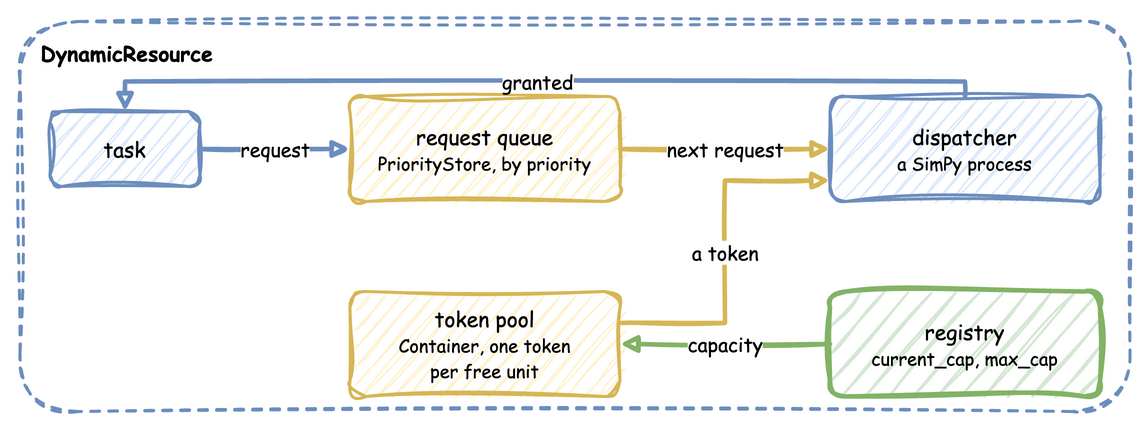
DynamicResource is built from a SimPy PriorityStore request queue and a Container token pool, and represents discrete assets that process individual tasks (such as machines, bays, or operators).
A task's request waits in the queue. The dispatcher takes the next request by priority, waits for a token from the pool, and grants it; the registry decides how many tokens the pool may hold:
lathe = DynamicResource(env, "Line_A", "lathe")  # capacity from the registry: 2


def part(env, part_id, priority=1):
    with lathe.request(priority=priority) as request:  # a lower number goes first
        yield request  # waits until a unit is free
        yield env.timeout(10.0)  # holds the unit for 10 s
    # leaving the with block releases the unit
Shrinking Safety Guarantee
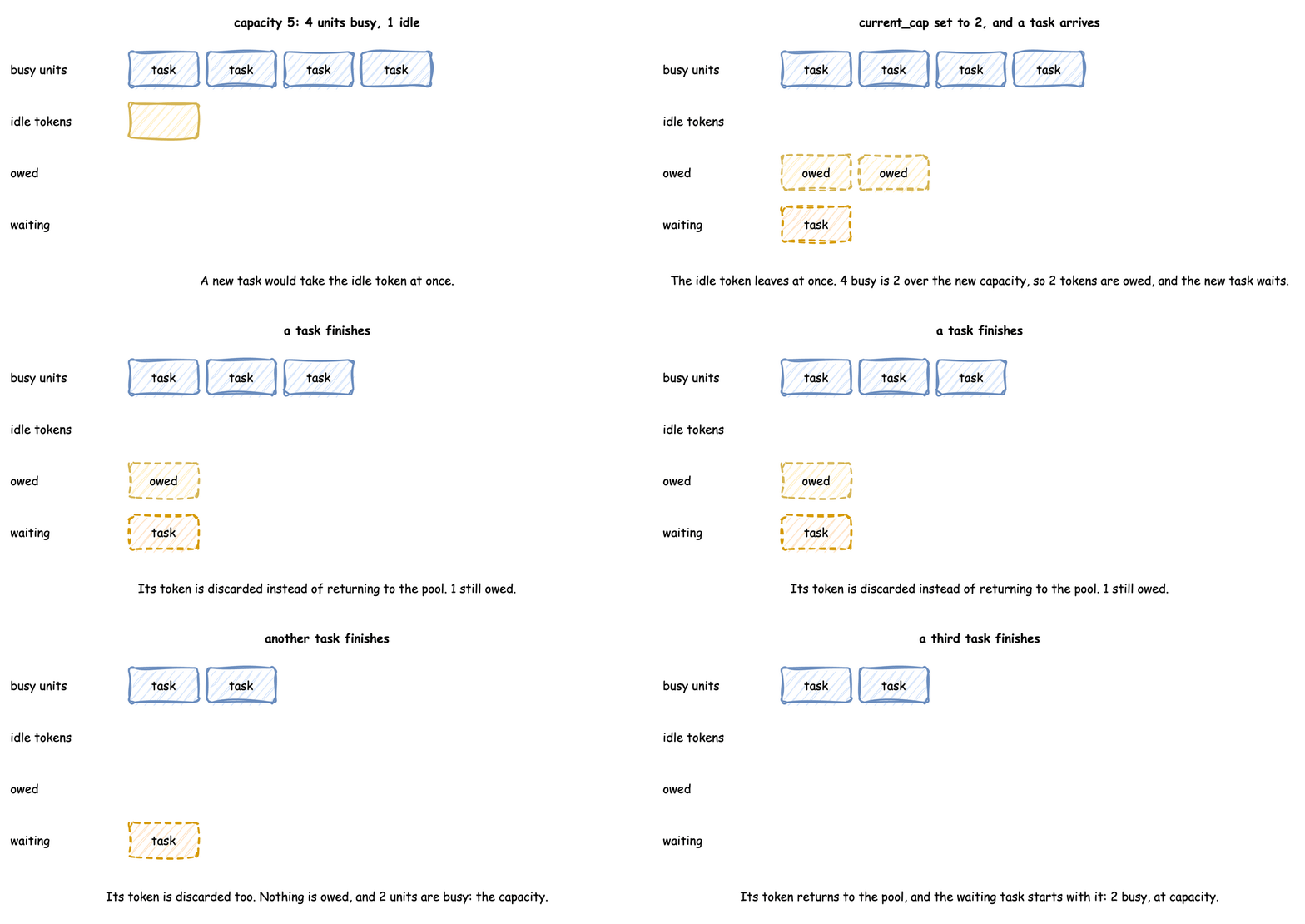
When capacity increases, tokens are immediately added to the pool. When capacity shrinks (for example, from 5 to 2 due to an unexpected machine breakdown):
* If 4 machines are currently processing tasks, Dynamic DES will not terminate active processes.
* Idle tokens leave the pool at once. The units still busy above the new capacity are owed: while tokens are owed, each released token is discarded instead of returning to the pool.
* No waiting task starts until the busy units are within the new capacity (2). in_use counts the busy units, so it can be above capacity until they finish.
* A capacity raised again before the owed tokens arrive first cancels them, then adds any remaining difference to the pool.
The animation steps through a drop from 5 to 2 with 4 units busy:
def breakdown(env):
    """Takes 3 of 5 lathes out of service at t=5 s. Running parts are not stopped."""
    env.registry.update("Line_A.resources.lathe.max_cap", 5)
    env.registry.update("Line_A.resources.lathe.current_cap", 5)
    yield env.timeout(5.0)
    env.registry.update("Line_A.resources.lathe.current_cap", 2)
    yield env.timeout(0.1)  # the resource applies the change in its own process
    print(f"capacity {lathe.capacity}, in use {lathe.in_use}")  # capacity 2, in use 4
Continuous Containers (DynamicContainer)
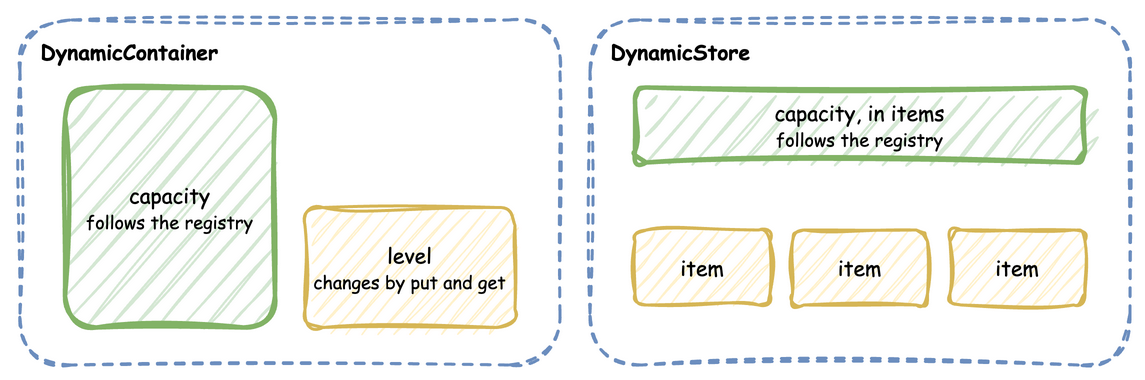
DynamicContainer wraps a SimPy Container and represents continuous quantities (such as fuel tank levels, conveyor queues, or concept drift/physical wear).
- Capacity: The physical size limit of the tank or container. It follows the registry.
- Level: The current fluid level or quantity of material. It changes only through
putandget.
coolant = DynamicContainer(env, "Line_A", "coolant", init=80.0)  # 80 of 100 litres


def cool(env):
    yield coolant.get(5.0)  # takes 5 litres, waiting if fewer are left
    yield coolant.put(5.0)  # puts them back, waiting if the tank is full
    print(f"coolant level {coolant.level}")
Dynamic Stores (DynamicStore)
DynamicStore wraps a SimPy Store, or a PriorityStore when priorities are needed, and represents item-based collections (such as warehouses, buffer areas, or order books).
A container holds a quantity up to its capacity, and a store holds items up to its capacity. Both capacities follow the registry:
goods = DynamicStore(env, "Line_A", "finished_goods")  # at most 50 items


def pack(env, part_id):
    yield goods.put({"part_id": part_id})  # waits while the store is full
    item = yield goods.get()  # waits while the store is empty
    print(f"shipped {item['part_id']}")
SimPy and Dynamic DES
SimPy's Resource, Container and Store take their capacity when they are created and keep it: the capacity property has no setter, so assigning a new value raises AttributeError (checked with SimPy 4.1.1). A SimPy model that needs a machine to break down has to model it some other way, such as a process that holds the resource.
Dynamic DES builds each one from SimPy parts and lets the capacity follow the registry. DynamicResource keeps requests in a SimPy PriorityStore and free units as tokens in a SimPy Container, and a dispatcher process gives tokens to requests; a change of capacity adds tokens, or removes idle ones at once and the rest as busy units finish. DynamicContainer and DynamicStore wrap SimPy's Container and Store and apply a new capacity in the same way. The request, put and get calls are SimPy's, so code written for SimPy resources works unchanged.
Creating Them
SimulationContext.run() creates a DynamicResource for every add_resource. It does not create containers or stores: add_container registers the capacity paths only. A process that needs a container builds it from the registered paths. DynamicContainer and DynamicStore are imported from dynamic_des, like DynamicResource. Stores have no builder method; register them with SimParameter(stores=...) on the low-level API.
from dynamic_des import DynamicContainer, SimulationContext

# run() creates the lathe; the container is only registered
app = (
    SimulationContext(sim_id="Line_A")
    .add_resource("lathe", current_cap=2, max_cap=5)
    .add_container("fuel_tank", current_cap=100.0, max_cap=500.0)
)


def refuel(context):
    # The container reads its capacity from Line_A.containers.fuel_tank
    tank = DynamicContainer(context.env, "Line_A", "fuel_tank", init=50.0)
    while True:
        yield context.env.timeout(10.0)
        yield tank.put(25.0)
        context.publish("fuel_tank.level", tank.level)


app.add_process(refuel)