The shop of Changing Demand, without the rush, packs orders for an hour. It has one packer, which takes 1.5 seconds to pack an order, and an order arrives every 2.5 seconds on average (24 a minute, rate: 0.4). A team downstream wants a file of the finished orders. This page asks: which records reach the team's files, how does the team find every record of one order, and when are the files complete?
Decision: what the file sink receives, and when the team's job may read the folder.
Measures: the records each sink receives, the files the file sink writes and the rows in each.
Runs: one unpaced run (factor: 0) of the hour with the seed 42.
Assumptions: the default batch of 500 records.
What You Will Learn
This page shows how to:
send every record to the terminal and only some of them to a file;
find every record of one order by its key;
know when the files are complete.
What You Add
This page adds two sinks: ConsoleEgress, which prints every record to the terminal, and JsonlStorageEgress, which writes JSON Lines files. The file sink has a when predicate that passes only the finished orders. The file sink needs the parquet extra, so install desflow[parquet] (pip install "desflow[parquet]"). Without it, the run logs that pyarrow is required and writes no file. Egress, Batching and Delivery describes every sink.
Choose What Each Sink Gets
Every sink receives every event and every telemetry record, unless its when says otherwise. when is a test of one record that is true when the record goes to that sink. This one passes the events whose value says order_packed:
A blueprint writes when as an expression over the record. It reads record.stream_type (event or telemetry), record.key, record.task and record.value.<field>. A name the record lacks reads as nothing, so the test is false for a telemetry record and for an event without that field:
egress:# Every event and every telemetry record-{type:Console}# The finished orders only, one flat row each-type:Jsonlconfig:{default_path:packed/orders.jsonl}when:{expr:"record.value.event_type=='order_packed'"}
when: events and when: telemetry pass every record of that stream. A function of your own is written as when: !python module.function, as Call Python from YAML shows.
defpacked_only(record:dict)->bool:"""Keeps the finished orders: events whose value says order_packed."""return(record["stream_type"]=="event"andrecord["value"].get("event_type")=="order_packed")
# Every event and every telemetry record.add_egress(ConsoleEgress())# The finished orders only, one flat row each.add_egress(JsonlStorageEgress(default_path=f"{out}/packed/orders.jsonl"),when=packed_only,)
env.setup_egress([# Every event and every telemetry recordConsoleEgress(),# The finished orders only, one flat row eachJsonlStorageEgress(default_path=f"{out}/packed/orders.jsonl"),],predicates=[None,packed_only],)
predicates takes one entry per sink, in the order of the list, and None passes every record. packed_only is the same function as in the Builder tab.
The test sees the record as published, so an event's payload is still under value. A telemetry record's value is a single number, so a function checks stream_type first. A record that no sink passes is written nowhere.
Find One Order's Records
Save the files from Full Files in one folder and run the commands there: desflow run streaming_out.yaml, python streaming_out.py or python streaming_out_low_level.py. Every event carries three names. key names the entity, here the order, and the arrival names the orders orders-1, orders-2, and so on. task names the task, and instance names this run of it. The terminal shows the three events of orders-12, each with the same three names:
The file sink receives only the last of the three, the order_packed event. Without a router it writes one flat row per event, with the payload's fields beside the record's own:
To find one order's records among the 4,392 of the hour, print the records as JSON lines with --stdout and keep the lines with its key. --stdout sends the records to the terminal in place of the sinks, so this run writes no files:
It prints the three events of orders-12 above, each as the whole record. In the builder and the low-level API, ConsoleEgress(format="json") as the sink prints the same lines.
A reader that joins the files with another source uses key, and one that follows a task through its states uses task and instance. Records and Telemetry lists every field, and What Each Sink Writes shows how each sink lays them out.
Read the Files
The file sink writes one file per batch, named after default_path with 8 random hexadecimal digits, such as packed/orders_1a2b3c4d.jsonl. A file sink with neither a default_path nor a path_router writes only the records that carry a __path__, and each flush logs a warning that says how many records it skipped. A file, once written, is never changed:
defread_files(folder:Path)->dict:"""The rows of each file the sink wrote to folder, by file name."""return{path.name:[json.loads(line)forlineinpath.read_text().splitlines()]forpathinsorted(folder.glob("*.jsonl"))}
The names are random, so the order of the files is not the order of the records. Sort by sim_ts when the order matters. A second run in the same folder adds new files beside the old ones, so the scripts empty packed/ before they run.
Know When the Files Are Complete
The model and the sinks finish at different times. The model stops at until. A sink receives records in batches. At factor: 0, a batch is handed over only when it holds 500 records, and the records left over are handed over at teardown, after the model has stopped. Teardown hands over what each sink still holds, then waits until every sink has written it:
desflow run tears the run down when it reaches run.until, and returns once the sinks have finished.
app.run(until="1 h") tears the run down when it reaches the end, and returns once the sinks have finished.
try:env.run(until=3600)# the model stops at 1 hourfinally:env.teardown()# the sinks receive the rest and finish writing
env.run runs SimPy's event loop and stops at until, as SimPy and desflow describes. env.teardown() is desflow's step that hands over the rest and waits for the sinks.
A job that reads the folder while the run is going therefore sees only the full batches. The terminal can show the same effect. On a fast machine the model can finish before the console sink prints its first line, and then every line appears after the log says Tearing down egress connectors. Teardown waits for the sinks to finish writing, and gives up only when they have made no progress for drain_stall_seconds, as Egress describes. Records not written by then are lost, with a warning.
What You Get and Why
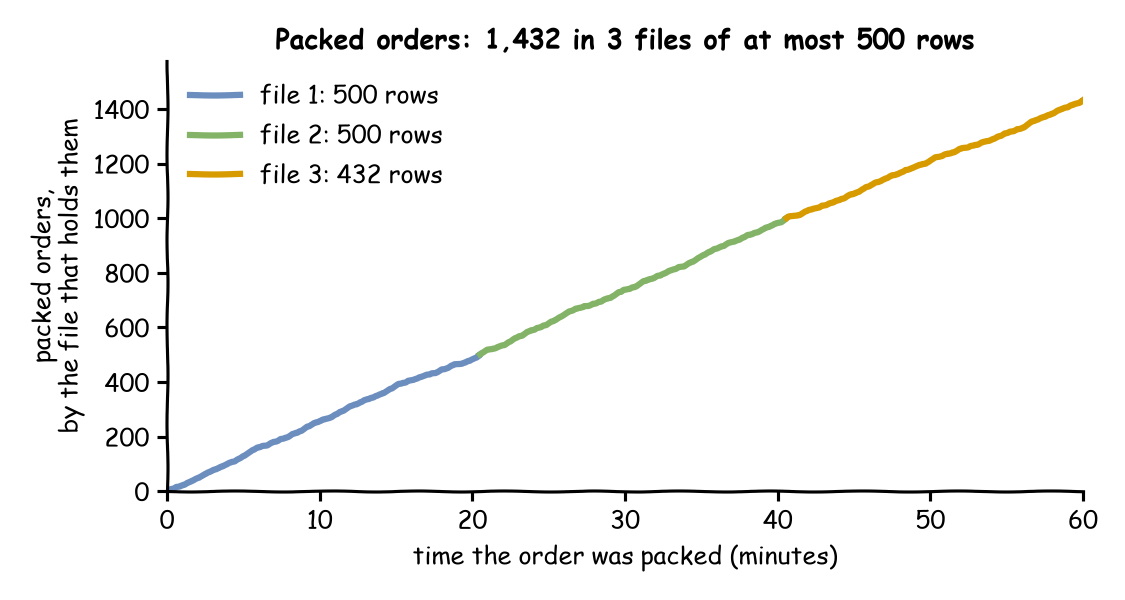
The rows the file sink writes over the hour, counted by the time each order was packed:
Which records reach the team's files? These figures come from one unpaced run of the hour with the seed 42.
The terminal receives every record: 4,362 events (1,454 orders queued, 1,454 started and 1,454 packed) and 30 telemetry records, five statistics read every 10 minutes.
The file sink receives only the 1,454 packed orders, one row each, in 3 files of 500, 500 and 454 rows. The two files of 500 were handed over while the model ran. The file of 454 was handed over at teardown, after the model stopped.
The run returns only when teardown has finished, so the team's job should start only after the run has returned. One order's records share its key: orders-12 was queued at 33.9733 seconds, started at 34.3281 and packed at 35.8281, rounded to four places.
Each tab gives the files' rows and the records of orders-12:
Run the blueprint in an empty folder, then count the rows of each file it wrote, smallest first:
A record goes from publish_event to each sink's when test, then into that sink's buffer, then to a queue that a separate thread writes from. The model only fills buffers, so it can finish while the threads are still writing. Teardown is the step that waits for them. Writing records on background threads is one of the things desflow adds to SimPy, as What desflow Changes sets out. Egress, Batching and Delivery shows each stage of that path. Finding one order's records by its key is also how a run is checked by hand, as Read the Trace shows.
Key Takeaways
Each sink has its own when test, so one run can send different records to different places.
A file sink writes in batches, on a separate thread, and the last batch is written at teardown.
Read the files only after the run has returned, when teardown has finished.
# The Streaming Out tutorial: the shop's records, to the terminal and to a file.# Run it with: desflow run streaming_out.yaml# Every record is printed; the finished orders are written to packed/.simulation:{sim_id:Shop, factor:0, random_seed:42}resources:packers:{current_cap:1, max_cap:1}services:packing:{dist:constant, value:1.5 s}arrivals:orders:{dist:exponential, rate:0.4, spawn:pack_order}tasks:pack_order:service:packingresource:packerspayload:{event_type:order_packed}# The packers' and the packing task's readings every 10 minutes, as telemetrystats:{level:minimal, interval:10 min}egress:# Every event and every telemetry record-{type:Console}# The finished orders only, one flat row each-type:Jsonlconfig:{default_path:packed/orders.jsonl}when:{expr:"record.value.event_type=='order_packed'"}run:{until:1 h}
"""The Streaming Out tutorial: the shop's records, to the terminal and to a file, builder.One packer takes 1.5 seconds to pack an order, and an order arrives every 2.5 secondson average (rate 0.4), for an hour. Every record is printed to the terminal, and thefinished orders are written to packed/. The script then prints the files the sinkwrote and one order's row. To see only those lines, run:python streaming_out.py 2>/dev/null"""importjsonimportloggingimportshutilfrompathlibimportPathfromdesflowimportConsoleEgress,JsonlStorageEgress,SimulationContextlogging.basicConfig(level=logging.INFO,format="%(levelname)s [%(asctime)s] %(message)s")defpacked_only(record:dict)->bool:"""Keeps the finished orders: events whose value says order_packed."""return(record["stream_type"]=="event"andrecord["value"].get("event_type")=="order_packed")defshop(out:Path)->SimulationContext:"""The shop of Changing Demand, without the rush, writing under out."""app=(SimulationContext(sim_id="Shop",factor=0,random_seed=42).add_resource("packers",current_cap=1,max_cap=1).add_service("packing",dist="constant",value=1.5).add_arrival("orders",dist="exponential",rate=0.4)# The packers' and the packing task's readings every 10 minutes, as telemetry.with_stats("minimal",interval=600)# Every event and every telemetry record.add_egress(ConsoleEgress())# The finished orders only, one flat row each.add_egress(JsonlStorageEgress(default_path=f"{out}/packed/orders.jsonl"),when=packed_only,))@app.task(service_id="packing",resource_id="packers")defpack_order(task_id:int):return{"event_type":"order_packed"}@app.arrival_loop("orders")deforder_generator(context:SimulationContext):task_id=0whileTrue:order=yieldcontext.wait_for_arrival("orders")context.spawn(pack_order(task_id,entity=order))task_id+=1returnappdefread_files(folder:Path)->dict:"""The rows of each file the sink wrote to folder, by file name."""return{path.name:[json.loads(line)forlineinpath.read_text().splitlines()]forpathinsorted(folder.glob("*.jsonl"))}defoutcomes(out:Path)->dict:"""Runs the hour; returns the rows in each file and the row of orders-12."""shutil.rmtree(out/"packed",ignore_errors=True)# a run adds files; start emptyshop(out).run(until="1 h")files=read_files(out/"packed")rows=[rowforfile_rowsinfiles.values()forrowinfile_rows]return{"file_rows":sorted(len(file_rows)forfile_rowsinfiles.values()),"row":next(rowforrowinrowsifrow["key"]=="orders-12"),}if__name__=="__main__":r=outcomes(Path("streaming_out_output"))print(f"{len(r['file_rows'])} files, with {r['file_rows']} rows")row={k:vfork,vinr["row"].items()ifk!="timestamp"}print(f"orders-12: {row}")
"""The Streaming Out tutorial: the shop's records, to the terminal and to a file, low-level.One packer takes 1.5 seconds to pack an order, and an order arrives every 2.5 secondson average (rate 0.4), for an hour. Every record is printed to the terminal, and thefinished orders are written to packed/. The script then prints the files the sinkwrote and one order's row. To see only those lines, run:python streaming_out_low_level.py 2>/dev/null"""importitertoolsimportjsonimportloggingimportshutilfrompathlibimportPathfromdesflowimport(CapacityConfig,ConsoleEgress,DistributionConfig,DynamicRealtimeEnvironment,DynamicResource,JsonlStorageEgress,Sampler,SimParameter,)logging.basicConfig(level=logging.INFO,format="%(levelname)s [%(asctime)s] %(message)s")PARAMS=SimParameter(sim_id="Shop",arrival={"orders":DistributionConfig(dist="exponential",rate=0.4)},service={"packing":DistributionConfig(dist="constant",value=1.5)},resources={"packers":CapacityConfig(current_cap=1,max_cap=1)},)defpacked_only(record:dict)->bool:"""Keeps the finished orders: events whose value says order_packed."""return(record["stream_type"]=="event"andrecord["value"].get("event_type")=="order_packed")defpack_order(env,sampler,packers,key,task_id):path_id="Shop.service.packing"defpublish(value):# The key names the order; task and instance name this run of the taskenv.publish_event(key,value,task="pack_order",instance=task_id)publish({"path_id":path_id,"sim_id":"Shop","service":"packing","status":"queued"})env.stats.task_queued("pack_order",task_id)withpackers.request()asrequest:yieldrequestpublish({"path_id":path_id,"sim_id":"Shop","service":"packing","status":"started",})env.stats.task_started("pack_order",task_id)yieldenv.timeout(sampler.sample(env.registry.get_config(path_id)))publish({"event_type":"order_packed"})env.stats.task_finished("pack_order",task_id)deforder_generator(env,sampler,packers):arrival=env.registry.get_config("Shop.arrival.orders")fortask_idinitertools.count():yieldenv.timeout(sampler.sample(arrival))key=f"orders-{task_id+1}"env.process(pack_order(env,sampler,packers,key,task_id))defrun(out:Path):env=DynamicRealtimeEnvironment(factor=0)env.registry.register_sim_parameter(PARAMS)env.setup_egress([# Every event and every telemetry recordConsoleEgress(),# The finished orders only, one flat row eachJsonlStorageEgress(default_path=f"{out}/packed/orders.jsonl"),],predicates=[None,packed_only],)# The packers' and the packing task's readings every 10 minutes, as telemetryenv.setup_stats("Shop","minimal",interval=600)packers=DynamicResource(env,"Shop","packers")env.process(order_generator(env,Sampler(seed=42),packers))try:env.run(until=3600)# the model stops at 1 hourfinally:env.teardown()# the sinks receive the rest and finish writingreturnenvdefread_files(folder:Path)->dict:"""The rows of each file the sink wrote to folder, by file name."""return{path.name:[json.loads(line)forlineinpath.read_text().splitlines()]forpathinsorted(folder.glob("*.jsonl"))}defoutcomes(out:Path)->dict:"""Runs the hour; returns the rows in each file and the row of orders-12."""shutil.rmtree(out/"packed",ignore_errors=True)# a run adds files; start emptyrun(out)files=read_files(out/"packed")rows=[rowforfile_rowsinfiles.values()forrowinfile_rows]return{"file_rows":sorted(len(file_rows)forfile_rowsinfiles.values()),"row":next(rowforrowinrowsifrow["key"]=="orders-12"),}if__name__=="__main__":r=outcomes(Path("streaming_out_output"))print(f"{len(r['file_rows'])} files, with {r['file_rows']} rows")row={k:vfork,vinr["row"].items()ifk!="timestamp"}print(f"orders-12: {row}")
Experiments describes every setting of an experiment, its files and its report, and the rest of the User Guide describes each part of desflow in full. The Kafka Digital Twin example takes live changes from Kafka and sends its records to Kafka.