Records and Telemetry
Everything a simulation publishes is a record of one of three kinds: a telemetry record for a single value, an event record for something that happened to an entity, and a label record for the ground truth of a scenario step. The records have the shape of the TelemetryPayload, EventPayload and LabelPayload models, and they are the same whichever way the simulation was written.
All three share stream_type, sim_ts and timestamp. Telemetry names its value in path_id; an event names its entity in key and its task in task and instance; a label carries what a step changed:
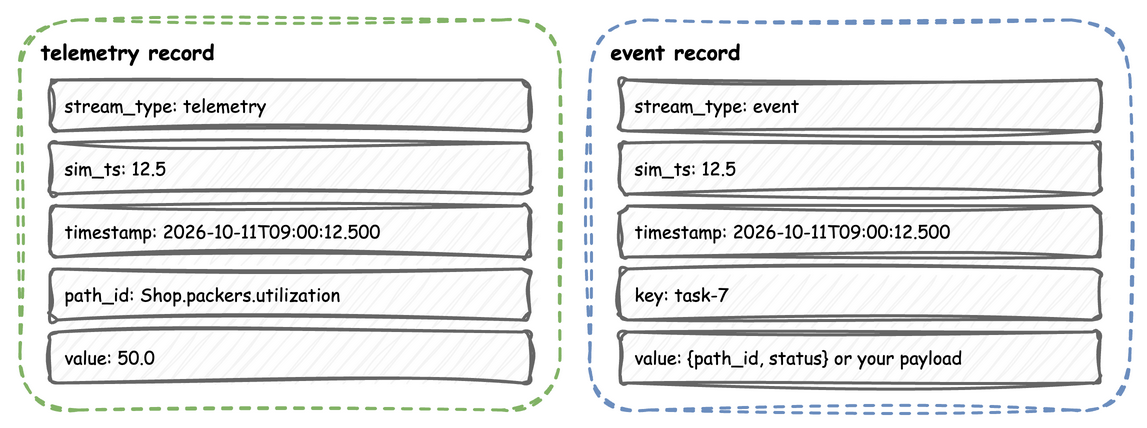
Record Shape
Every sink, router and when predicate receives records as plain dictionaries, with these keys in this order:
| Field | Telemetry | Event | Label |
|---|---|---|---|
stream_type |
"telemetry" |
"event" |
"label" |
sim_ts |
simulation seconds | simulation seconds | simulation seconds |
timestamp |
logical time | logical time | logical time |
path_id |
the name of the value | ||
key |
the entity's key, such as orders-1 |
||
task |
the task's name, or None |
||
instance |
the task's instance id, or None |
||
path |
the registry path the step changed, or None |
||
old, new |
the value before and after, or None |
||
label |
the step's record mapping |
||
value |
a single value | the event's value |
As ConsoleEgress prints them, a statistic and the three events of one task:
[TEL] {'sim_ts': 10.0, 'timestamp': '...', 'path_id': 'Shop.stats.resources.packers.in_use', 'value': 0}
[EVT] {'sim_ts': 3.672, 'timestamp': '...', 'key': 'orders-1', 'task': 'pack_order', 'instance': 0, 'value': {'path_id': 'Shop.service.packing', 'status': 'queued'}}
[EVT] {'sim_ts': 3.672, 'timestamp': '...', 'key': 'orders-1', 'task': 'pack_order', 'instance': 0, 'value': {'path_id': 'Shop.service.packing', 'status': 'started'}}
[EVT] {'sim_ts': 5.369, 'timestamp': '...', 'key': 'orders-1', 'task': 'pack_order', 'instance': 0, 'value': {'event_type': 'order_packed'}}
And two labels, as a JSON Lines sink writes them:
{"stream_type":"label","sim_ts":30.0,"timestamp":"...","path":"Shop.arrival.orders.rate","old":0.5,"new":1.5,"label":{"fault":"order_surge","cause":"flash sale"}}
{"stream_type":"label","sim_ts":45.0,"timestamp":"...","path":null,"old":null,"new":null,"label":{"fault":"label_printer_offline"}}
sim_ts is simulation seconds. timestamp is logical_start_time plus sim_ts, as an ISO string with milliseconds, with no time zone unless logical_start_time has one.
Field Values
sim_tsis rounded to three decimal places and is always a float, so simulation time 0 is0.0.keyandpath_idare strings.bytesandbytearrayare decoded to strings; any other type, such as anint, raises a PydanticValidationErrorat the call.value,old,newandlabelare converted to plain JSON values before any sink sees them. A Pydantic V2 model becomes a dictionary, a datetime an ISO string, and a NaN or an infinityNone, in a model at any depth as in a plain dictionary.
class Reading(BaseModel):
    sensor: str
    celsius: float
    taken_at: datetime


def readings(context: SimulationContext):
    while True:
        yield context.env.timeout(30.0)
        reading = Reading(
            sensor="spindle", celsius=float("nan"), taken_at=datetime.now()
        )
        # The model becomes a dict, taken_at an ISO string, and NaN becomes None
        context.env.publish_event("sensor-spindle", reading)
Task Events
@app.task and a YAML task publish three events for each run, all with the entity's key, the task's name and its instance id:

| Event | value |
|---|---|
| queued | {"path_id": "<sim_id>.service.<service>", "status": "queued"} |
| started | {"path_id": "<sim_id>.service.<service>", "status": "started"} |
| finished | exactly what the task returns, or the YAML payload |
A task with no service has {"status": ...} without path_id. A timed step, with a service and no resource, publishes no queued. A task with no service, resource or get publishes only the finished event, as soon as it starts. The key is the arrival's name and a counter from 1, such as orders-1, on every event of every task the entity passes through; Task Flow describes it. A low-level process publishes whatever it passes to env.publish_event(key, value, task=..., instance=...).
Telemetry Names
| Published by | path_id |
|---|---|
| the built-in statistics | <sim_id>.stats.<kind>.<name>.<statistic>, such as Shop.stats.resources.packers.in_use; Reference, Statistics lists every name |
context.publish(name, value) and a YAML telemetry function |
<sim_id>.<name> |
env.publish_telemetry(path_id, value) |
path_id, as given |
| the lag monitor | system.simulation.lag_seconds, once per simulation second |
@app.telemetry_loop(interval=10.0)
def report(context: SimulationContext):
    # path_id is Shop.packers_free: the sim_id is added in front
    packers = context.get_resource("packers")
    context.publish("packers_free", packers.capacity - packers.in_use)
env = DynamicRealtimeEnvironment(factor=0.0)
env.setup_egress([ConsoleEgress()])
env.publish_telemetry("plant.power_kw", 412.5)  # path_id exactly as given
# key, task, instance and value as given; task and instance are optional
env.publish_event("orders-17", {"status": "shipped"}, task="ship", instance=16)
# A ground-truth label, which only a when: labels sink receives
env.publish_label({"fault": "slow_packing"}, path="Shop.service.packing.scale")
What Each Sink Writes
Every sink receives the events and telemetry above, and a when: labels sink receives the labels instead. What each writes differs:
| Sink | Writes |
|---|---|
ConsoleEgress |
one log line per record, [TEL], [EVT] or [LBL] followed by the record without stream_type |
KafkaEgress |
the record as JSON, without stream_type unless include_stream_type=True; the message key is path_id for telemetry and key for an event. A label goes to event_topic with no key |
RedisEgress |
the record as JSON in one payload field, with any __stream__ key removed |
ParquetStorageEgress, JsonlStorageEgress, IcebergStorageEgress |
without a router, one flat row per event or label, with an event's value mapping unpacked into columns, and no telemetry; with a router, each record as the router leaves it |
PostgresEgress |
an event or telemetry record whose value is a mapping, with sim_ts, timestamp, key as event_id, task and instance, or path_id, added to it, as Egress describes; a label as the columns sim_ts, timestamp, path, old, new and label, the last three as JSON text |