Competing Resources
The shop now picks each order from the shelves before packing it. One picker fetches the order in a second and carries it to the one packing bench, where packing takes 2 seconds on average. The picker could put the order down by the bench and go back for the next one, or stay with it until the bench is free, so the order is never left unattended. This page asks: what does holding one resource while waiting for another cost?
- Decision: whether the picker stays with each order until the bench is free.
- Measures: the mean wait for the picker and for the bench, and the share of time the picker is busy.
- Runs: two runs of the hour, one for each way of working, each with the seed 42.
- Assumptions: orders arrive at random, one every 2.5 seconds on average (24 a minute), picking always takes exactly one second, and packing times follow an exponential distribution.
What You Will Learn
This page shows how to:
- give a task two resources, a picker and a packing bench;
- keep the first resource for the next task with a handoff;
- measure what holding one resource while waiting for another costs.
What You Add
This page adds a second resource, the bench, and a handoff. The picking task keeps the picker for the packing task, which gives the picker back once the order is on the bench.
Hold One While Waiting for Another
In SimPy a process holds a resource from the moment its request is granted until it releases the resource. It can request a second resource while it holds the first, with nested with blocks. A desflow task does the same in two ways. It can list several resources, resource: [picker, bench], and hold them all while it works. Or it can hand a unit to the next task of its flow with keep, as Several Resources describes. Save the files from Full Files in one folder and run the commands there:
| docs/snippets/yaml/competing_resources.yaml:handoff | |
|---|---|
Remove keep: [picker] to run it without the handoff: pick_order then gives the picker back when it finishes, as every task does.
Without keep, pick_order gives the picker back when it finishes, as every task does.
The picker's request is not in a with block, because the next process releases it.
While the order waits for the bench it holds the picker: a partial holding. Nothing grants the picker and the bench together. Each is acquired in turn, and the units already held stay held while the task waits for the next. The picker's busy share includes that waiting time:
One Order of Acquisition
Two orders that each hold one resource and wait for the other wait for ever: a deadlock. If a picking task held the picker and waited for the bench while a wrapping task held the bench and waited for the picker, both could stop. desflow prevents a deadlock by refusing such a model when it is built. Every task, handoffs included, must acquire shared resources in one order, and the error names the two tasks that disagree. Here every order goes picker first, then bench.
What You Get and Why
What does holding the picker while waiting for the bench cost? Each figure here is a mean from one run of the hour with the seed 42.
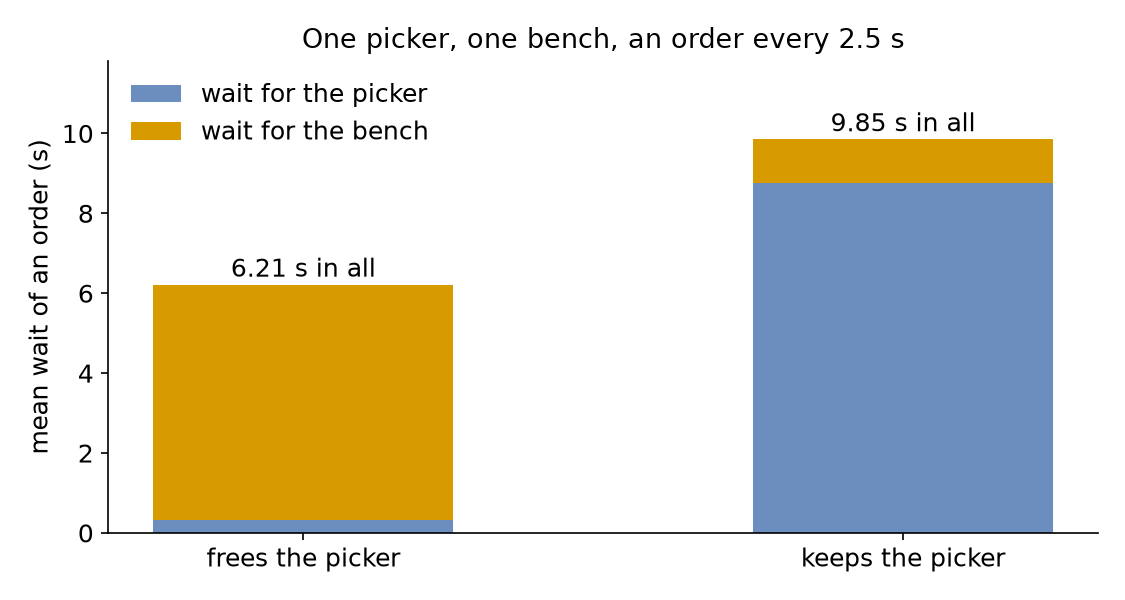
- When the picker puts the order down and goes back, orders wait 0.32 seconds for the picker and 5.89 seconds for the bench, 6.21 seconds in all.
- When the picker stays with the order, the wait moves to the picker. Orders wait 8.77 seconds for it and only 1.09 seconds for the bench, 9.85 seconds in all. The picker is then busy 82.7% of the time instead of 39.8%, most of it standing by the bench:
Each tab prints both: the picker's busy share and the mean waits, first with the picker freed, then with it kept.
The first run is the shop without the handoff. Copy competing_resources.yaml to competing_resources_free.yaml and remove its keep: [picker] line.
Each order brings 2 seconds of packing on average and arrives every 2.5 seconds on average, so the bench is busy 2 ÷ 2.5 = 80% of the time and the picker 1 ÷ 2.5 = 40%. The bench is the busier of the two, the bottleneck. When the picker waits at the bench, it spends its own time in the bench's queue. So the picker is busy longer than its work needs, and the next order waits for it. Releasing a resource as soon as it is no longer needed keeps the waits where the work is.
Queueing Basics explains utilisation. Several Resources describes several resources, handoffs and the order rule.
Key Takeaways
- A task that holds a resource while it waits for another keeps that resource busy without work.
- The wait then moves to the resource that is held, and the next order waits for it.
- Release a resource as soon as it is no longer needed, unless the work requires it to stay.
Full Files
Full files
| docs/snippets/tutorials/competing_resources_low_level.py | |
|---|---|
1 2 3 4 5 6 7 8 9 10 11 12 13 14 15 16 17 18 19 20 21 22 23 24 25 26 27 28 29 30 31 32 33 34 35 36 37 38 39 40 41 42 43 44 45 46 47 48 49 50 51 52 53 54 55 56 57 58 59 60 61 62 63 64 65 66 67 68 69 70 71 72 73 74 75 76 77 78 79 80 81 82 83 84 85 86 87 88 89 90 91 92 93 94 95 96 97 98 99 100 101 102 103 104 105 106 107 108 109 110 111 112 113 114 115 116 117 118 119 120 121 122 123 124 125 126 127 128 129 130 131 132 133 134 135 | |