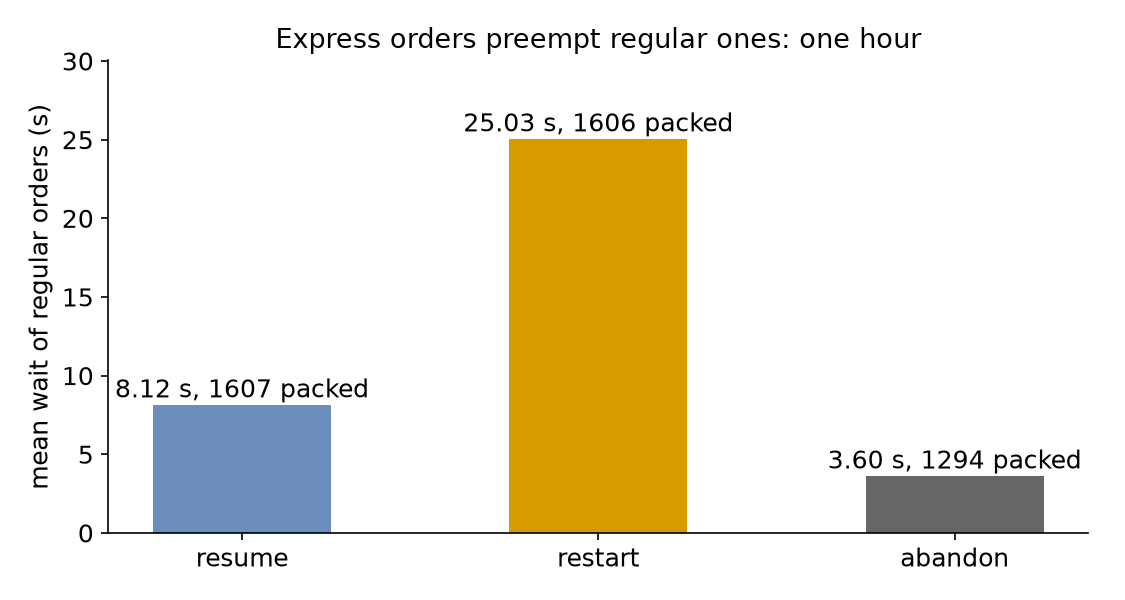
A quarter of the shop's orders are express, as in Priorities, but now an express order does not wait for the regular order being packed: it takes the packer at once. This page asks: what remains of a regular order's packing when an express order takes its packer, and which way of carrying on keeps regular orders waiting least?
Decision: which of three policies a regular order follows when it loses the packer.
Measures: the number of preemptions, the mean wait of regular orders, and the orders packed and lost.
Runs: three runs of the hour, one for each policy, each with the seed 42.
Assumptions: both kinds of order arrive at random, and every order takes the same time to pack.
What You Will Learn
This page shows how to:
let express orders take the packer from regular ones;
choose what a preempted order does: resume, restart or abandon;
interrupt the orders in the shop from outside.
What You Add
This page adds a packer that can be preempted, as Preemption explains, and an on_interrupt policy on regular orders: resume, restart or abandon. It also recalls the regular orders once: every regular order in the shop receives an interrupt and follows its policy, and the packer stays available. Under resume and restart a recalled order queues for the packer again with the same priority, so it waits behind the express orders and behind the regular orders that queued again before it. Under abandon it is lost. Model Breakdowns shows a packer that is out of use for a time. The shop is the one from Priorities: one packer and 1.5 seconds of packing. A regular order arrives every 2.22 seconds on average (rate: 0.45), and an express order every 6.67 seconds (rate: 0.15).
Preemption
Priority so far decided only who goes next. Preemption also stops the work in progress. In SimPy, a request may find every unit of a PreemptiveResource busy. A lower priority value is more urgent. When the request is more urgent than a process holding a unit, the resource takes the unit from the least urgent holder, the one with the highest priority value, and that process receives an Interrupt. In desflow it is preempt: true on a resource whose queue is priority. Save the files from Full Files in one folder and run the commands there:
# An express order takes the packer from a regular one being packed"packers":DynamicResource(env,"Shop","packers",queue="priority",preempt=True),
preempt=True gives the resource SimPy's preemption, and the process that holds a unit receives an interrupt when it is preempted. The code below uses three more SimPy names:
request.cancel() takes a request that has not been granted out of the queue.
Equal priorities do not preempt, so one express order does not take the packer from another.
Resume, Restart or Abandon
A preempted or interrupted task stops waiting for anything. A preemption takes its packer, so it gives that up. A plain interrupt leaves a packer it already holds with it, as a SimPy process that keeps its request does. A packer it was still waiting for depends on how the task asks for it. With resource:, the request goes back to the end of the line. With seize or a request in a wait, the request keeps its place under resume, and asks again at the back of the line under restart. A packer granted at the instant of the interrupt stays held. A breakdown takes the unit too. Its on_interrupt then says what it does:
resume, the default: it goes on at once with a packer it still holds, or queues again and, once it has the packer back, packs for the time it had left;
restart: it does the same but packs for a new time, drawn from the same seeded stream, as if the work were spoiled;
abandon: it gives back every unit and ends, and its flow with it, unless on_interrupt_next names a task to go to. A task that names a task which asks for the packer again queues behind the orders already waiting.
A task can also do work of its own when the interrupt arrives, without giving up its place in the flow. on_interrupt_run names a task that runs as a child flow of the same entity after each interrupt or preemption under resume or restart. The task then goes on with the time it had left, or with a new time under restart. An interrupt that arrives while the child runs reaches the child, and a child that fails fails the task. on_interrupt_run is refused with abandon, with resource and with a request in a wait, because it is for work that holds no unit of its own.
An order that is abandoned when it loses its packer, and goes to be packed by hand:
@app.task(service_id="packing",resource_id="packers",priority=1,# An order that loses its packer to a rush order is packed by hand insteadon_interrupt="abandon",on_interrupt_next="pack_by_hand",)defpack(task_id:int):return{"event_type":"packed"}
defpack(env,sampler,packers,counts):request=packers.request(priority=1)try:yieldrequestyieldenv.timeout(sampler.sample(env.registry.get_config("Shop.service.packing")))counts["packed"]+=1exceptsimpy.Interrupt:# An order that loses its packer to a rush order is packed by hand insteadyield frompack_by_hand(env,sampler,counts)finally:packers.release(request)
In the low-level API the process catches the Interrupt and packs by hand with yield from, in the same process.
The task publishes preempted (or interrupted) when it loses the packer, and resumed when it is served again, also when it never gave the packer up. A preempted request is marked as preempted, so the packer is never given back to it by mistake. If the order that lost the packer has already ended, the preemption fails the flow that asked, with SimPy's RuntimeError. A seize unit is asked for again under resume and restart. A preempted record names the express order that took the packer (preempted_by, its entity key) and the time the regular order had held it (usage_since). In a blueprint, a task that on_interrupt_next names reads the same facts as cause.by, cause.usage_since and cause.left (the service time that was left). An expression reads who holds a unit and who waits as held(packers) and waiting(packers), lists with each entity and its rank and time:
pack_order:service:packingresource:packerspriority:1# What a regular order does when it loses the packeron_interrupt:${POLICY:-resume}payload:{event_type:order_packed}
${POLICY:-resume} reads the environment variable POLICY, so POLICY=restart desflow run interruptions.yaml runs the second policy.
@app.task(service_id="packing",resource_id="packers",priority=1,# What a regular order does when it loses the packeron_interrupt=policy,)defpack_order(task_id:int):return{"event_type":"order_packed"}
defpack(env,sampler,shop,arrival,key,task_id,policy):"""Packs one order; when it loses the packer, it follows `policy`."""task,priority=TASKS[arrival]path_id="Shop.service.packing"defpublish(value):env.publish_event(key,value,task=task,instance=task_id)publish({"path_id":path_id,"sim_id":"Shop","service":"packing","status":"queued"})env.stats.task_queued(task,task_id)shop["running"].setdefault(task,[]).append(env.active_process)shop["keys"][env.active_process]=keyremaining,started=None,Falserequest=NonewhileTrue:ifrequestisNone:request=shop["packers"].request(priority=priority)since=Nonetry:ifnotrequest.processed:yieldrequeststatus="resumed"ifstartedelse"started"publish({"path_id":path_id,"sim_id":"Shop","service":"packing","status":status,})ifstarted:env.stats.task_resumed(task,task_id)else:env.stats.task_started(task,task_id)started=TrueifremainingisNone:remaining=sampler.sample(env.registry.get_config(path_id))since=env.nowyieldenv.timeout(remaining)publish({"event_type":"order_packed"ifpriorityelse"express_packed"})env.stats.task_finished(task,task_id)shop["packers"].release(request)breakexceptsimpy.Interruptasinterrupt:ifpolicy=="abandon"orrequestnotinshop["packers"].users:# Ask again if queued or preempted; abandon gives a held unit backrequest.cancel()shop["packers"].release(request)request=NoneifsinceisnotNone:# resume serves what is left; restart draws a new packing timeremaining=(remaining-(env.now-since)ifpolicy=="resume"elseNone)preempted=isinstance(interrupt.cause,Preempted)ifpreempted:value={"status":"preempted","resource":"packers","preempted_by":shop["keys"].get(interrupt.cause.by),"usage_since":interrupt.cause.usage_since,}else:value={"status":"interrupted","cause":interrupt.cause}publish({"path_id":path_id,"sim_id":"Shop","service":"packing",**value})env.stats.task_interrupted(task,task_id,preempted=preempted)ifpolicy=="abandon":env.stats.task_dropped(task,task_id)shop["running"][task].remove(env.active_process)delshop["keys"][env.active_process]returnshop["running"][task].remove(env.active_process)delshop["keys"][env.active_process]env.stats.flow_finished(arrival)
The process catches simpy.Interrupt. For a preemption, its cause is SimPy's Preempted. A preempted process, or one whose request still waits, cancels its request and requests the packer again. An interrupted process that holds the packer keeps its request. on_interrupt writes that loop for you. SimPy delivers an interrupt as an URGENT event, which End Conditions explains.
The statistics count each preempted, interrupted and resumed. A resumed order's wait is the sum of its waits, and its packing time is the total time it was packed:
# Counts of preemptions and resumptions, and the mean wait and service, at the endenv.setup_stats("Shop","typical",interval=3600)
Interrupt a Task
Preemption is one source of interrupts, and a model can send others. An interrupt names a task. Every instance of that task that is running, waiting or being served receives an interrupt with the given cause, and follows its on_interrupt. A where condition, such as attr.order == 3, is read in the scope of each instance, and limits the interrupt to the instances for which it holds. It reads what the instance's own expressions read. wait.<branch>.done is false until the instance's wait has ended. Here a recall at 31 minutes interrupts every regular order:
scenario:# A recall at 31 minutes: every regular order in the shop,# waiting or being packed, is interrupted-at:31 mininterrupt:{task:pack_order, cause:recalled}
A task can carry the same interrupt, applied when it finishes.
defrecall_orders(context:SimulationContext):"""A recall at 31 minutes: every regular order in the shop, waiting or being packed, is interrupted."""yieldcontext.env.timeout(1860)context.interrupt("pack_order",cause="recalled")app.add_process(recall_orders)
context.interrupt(task, where=None, cause=None) returns how many instances it reached. It never reaches the instance that calls it.
defrecall_orders(env,shop):"""A recall at 31 minutes: every regular order in the shop, waiting or being packed, is interrupted."""yieldenv.timeout(1860)forprocessinlist(shop["running"].get("pack_order",[])):process.interrupt("recalled")
process.interrupt(cause) is SimPy's. The model keeps its own list of the processes it may interrupt.
What You Get and Why
What remains of a regular order's packing when an express order takes its packer? Each figure here comes from one run of the hour with the seed 42.
With resume, the time it had left remains. After 349 preemptions, regular orders wait 8.17 seconds on average.
With restart, nothing remains: each preempted order packs again from the start. Preemptions rise to 389, and the mean wait rises more than fivefold to 44.11 seconds.
With abandon, the order is lost. 313 orders are lost, 311 to preemption and 2 to the recall at 31 minutes. The 1,328 packed orders wait only 3.64 seconds on average, because every interrupted order leaves the queue.
The recall at 31 minutes reaches every regular order in the shop at that moment: 3 under resume, 24 under restart, whose longer queue holds more orders, and 2 under abandon:
Each tab prints all three policies: the orders packed, preempted and recalled (interrupted), the mean wait and the mean packing time.
# The resume policy: orders preempted, recalled and packed, mean wait and packing timedesflowruninterruptions.yaml--stdout|grep-E'pack_order\.(preempted|interrupted|finished|wait_mean|service_mean)"'|tail-5
# The restart policyPOLICY=restartdesflowruninterruptions.yaml--stdout|grep-E'pack_order\.(preempted|interrupted|finished|wait_mean|service_mean)"'|tail-5
# The abandon policyPOLICY=abandondesflowruninterruptions.yaml--stdout|grep-E'pack_order\.(preempted|interrupted|finished|wait_mean|service_mean)"'|tail-5
resume : 349 preempted, 3 recalled, 1640 packed, mean wait  8.17 s, mean packing 1.50 s
restart: 389 preempted, 24 recalled, 1640 packed, mean wait 44.11 s, mean packing 1.67 s
abandon: 311 preempted, 2 recalled, 1328 packed, mean wait  3.64 s, mean packing 1.50 s
Under restart the packer spends part of its time on packing that is thrown away, so it does more work for the same orders. The mean time packed rises from 1.50 to 1.67 seconds, and the load nears what one packer can do. Waits then grow fast, as Queueing Basics explains. resume loses no work, so its waits are close to those of plain priority. abandon looks best only because the mean leaves out the orders it lost. So report the count of lost orders beside its mean wait. The decision is resume: it loses no order and its mean wait, 8.17 seconds, is the lowest of the two policies that keep every order. Priority and Preemption describes preemption, and Tasks and Processes the task's steps.
Key Takeaways
Preemption gives an urgent task the resource at once, and the task it takes it from must wait.
resume loses no work. restart throws work away and adds load, so waits grow fast near full use.
abandon looks best only because the mean leaves out the lost orders, so report their count beside it.
# The Interruptions tutorial: express orders take the packer from regular ones.# Run it with: desflow run interruptions.yaml# With restart instead of resume: POLICY=restart desflow run interruptions.yamlsimulation:{sim_id:Shop, factor:0, random_seed:42}resources:# An express order takes the packer from a regular one being packedpackers:{current_cap:1, max_cap:4, queue:priority, preempt:true}services:packing:{dist:constant, value:1.5 s}arrivals:# An order every 1.67 s on average in all (0.6 a second), one in four expressorders:{dist:exponential, rate:0.45, spawn:pack_order}express:{dist:exponential, rate:0.15, spawn:pack_express}tasks:pack_order:service:packingresource:packerspriority:1# What a regular order does when it loses the packeron_interrupt:${POLICY:-resume}payload:{event_type:order_packed}pack_express:service:packingresource:packerspriority:0payload:{event_type:express_packed}scenario:# A recall at 31 minutes: every regular order in the shop,# waiting or being packed, is interrupted-at:31 mininterrupt:{task:pack_order, cause:recalled}# Counts of preemptions and resumptions, and the mean wait and service, at the endstats:{level:typical, interval:1 h}egress:-{type:Console}run:{until:1 h}
"""The Interruptions tutorial: express orders take the packer from regular ones.One packer and 1.5 seconds of packing. A regular order arrives every 2.22 seconds onaverage (rate 0.45), and an express order every 6.67 seconds (rate 0.15). Every recordis printed to the terminal, and the script prints what preemption did to regular ordersunder each policy at the end. To see only those lines, run:python interruptions.py 2>/dev/null"""importloggingfromdesflowimportConsoleEgress,SimulationContextlogging.basicConfig(level=logging.INFO,format="%(levelname)s [%(asctime)s] %(message)s")defshop(policy:str="resume")->SimulationContext:"""The shop, where a regular order follows `policy` when it loses the packer."""app=(SimulationContext(sim_id="Shop",factor=0,random_seed=42)# An express order takes the packer from a regular one being packed.add_resource("packers",current_cap=1,max_cap=4,queue="priority",preempt=True).add_service("packing",dist="constant",value=1.5)# An order every 1.67 s on average in all (0.6 a second), one in four express.add_arrival("orders",dist="exponential",rate=0.45).add_arrival("express",dist="exponential",rate=0.15)# Counts of preemptions and resumptions, and the mean wait and service, at the end.with_stats("typical",interval=3600).add_egress(ConsoleEgress()))@app.task(service_id="packing",resource_id="packers",priority=1,# What a regular order does when it loses the packeron_interrupt=policy,)defpack_order(task_id:int):return{"event_type":"order_packed"}@app.task(service_id="packing",resource_id="packers",priority=0)defpack_express(task_id:int):return{"event_type":"express_packed"}forarrival,task,namein(("orders",pack_order,"pack_order"),("express",pack_express,"pack_express"),):defloop(context:SimulationContext,arrival=arrival,task=task,name=name):whileTrue:entity=yieldcontext.wait_for_arrival(arrival)context.spawn(task(context.next_instance(name),entity=entity))app.arrival_loop(arrival)(loop)defrecall_orders(context:SimulationContext):"""A recall at 31 minutes: every regular order in the shop, waiting or being packed, is interrupted."""yieldcontext.env.timeout(1860)context.interrupt("pack_order",cause="recalled")app.add_process(recall_orders)returnappdefoutcomes(policy:str)->dict:"""Runs one hour and returns what preemption did to regular orders."""app=shop(policy)app.run(until="1 h")readings=app.env.stats.readings()name="Shop.stats.tasks.pack_order.{}".formatreturn{"preempted":readings[name("preempted")],"interrupted":readings.get(name("interrupted"),0),"finished":readings[name("finished")],"wait_mean":readings[name("wait_mean")],"service_mean":readings[name("service_mean")],}if__name__=="__main__":forpolicyin("resume","restart","abandon"):r=outcomes(policy)print(f"{policy:<7}: {r['preempted']} preempted, {r['interrupted']} recalled, "f"{r['finished']} packed, "f"mean wait {r['wait_mean']:5.2f} s, mean packing {r['service_mean']:4.2f} s")
"""The Interruptions tutorial: express orders take the packer from regular ones.One packer and 1.5 seconds of packing. A regular order arrives every 2.22 seconds onaverage (rate 0.45), and an express order every 6.67 seconds (rate 0.15). Every recordis printed to the terminal, and the script prints what preemption did to regular ordersunder each policy at the end. To see only those lines, run:python interruptions_low_level.py 2>/dev/null"""importitertoolsimportloggingimportsimpyfromsimpy.resources.resourceimportPreemptedfromdesflowimport(CapacityConfig,ConsoleEgress,DistributionConfig,DynamicRealtimeEnvironment,DynamicResource,Sampler,SimParameter,)logging.basicConfig(level=logging.INFO,format="%(levelname)s [%(asctime)s] %(message)s")PARAMS=SimParameter(sim_id="Shop",arrival={# An order every 1.67 s on average in all (0.6 a second), one in four express"orders":DistributionConfig(dist="exponential",rate=0.45),"express":DistributionConfig(dist="exponential",rate=0.15),},service={"packing":DistributionConfig(dist="constant",value=1.5)},resources={"packers":CapacityConfig(current_cap=1,max_cap=4)},)TASKS={"orders":("pack_order",1),"express":("pack_express",0)}defpack(env,sampler,shop,arrival,key,task_id,policy):"""Packs one order; when it loses the packer, it follows `policy`."""task,priority=TASKS[arrival]path_id="Shop.service.packing"defpublish(value):env.publish_event(key,value,task=task,instance=task_id)publish({"path_id":path_id,"sim_id":"Shop","service":"packing","status":"queued"})env.stats.task_queued(task,task_id)shop["running"].setdefault(task,[]).append(env.active_process)shop["keys"][env.active_process]=keyremaining,started=None,Falserequest=NonewhileTrue:ifrequestisNone:request=shop["packers"].request(priority=priority)since=Nonetry:ifnotrequest.processed:yieldrequeststatus="resumed"ifstartedelse"started"publish({"path_id":path_id,"sim_id":"Shop","service":"packing","status":status,})ifstarted:env.stats.task_resumed(task,task_id)else:env.stats.task_started(task,task_id)started=TrueifremainingisNone:remaining=sampler.sample(env.registry.get_config(path_id))since=env.nowyieldenv.timeout(remaining)publish({"event_type":"order_packed"ifpriorityelse"express_packed"})env.stats.task_finished(task,task_id)shop["packers"].release(request)breakexceptsimpy.Interruptasinterrupt:ifpolicy=="abandon"orrequestnotinshop["packers"].users:# Ask again if queued or preempted; abandon gives a held unit backrequest.cancel()shop["packers"].release(request)request=NoneifsinceisnotNone:# resume serves what is left; restart draws a new packing timeremaining=(remaining-(env.now-since)ifpolicy=="resume"elseNone)preempted=isinstance(interrupt.cause,Preempted)ifpreempted:value={"status":"preempted","resource":"packers","preempted_by":shop["keys"].get(interrupt.cause.by),"usage_since":interrupt.cause.usage_since,}else:value={"status":"interrupted","cause":interrupt.cause}publish({"path_id":path_id,"sim_id":"Shop","service":"packing",**value})env.stats.task_interrupted(task,task_id,preempted=preempted)ifpolicy=="abandon":env.stats.task_dropped(task,task_id)shop["running"][task].remove(env.active_process)delshop["keys"][env.active_process]returnshop["running"][task].remove(env.active_process)delshop["keys"][env.active_process]env.stats.flow_finished(arrival)deforder_generator(env,sampler,shop,arrival,policy):config=env.registry.get_config(f"Shop.arrival.{arrival}")fortask_idinitertools.count():yieldenv.timeout(sampler.sample(config))key=f"{arrival}-{task_id+1}"env.process(pack(env,sampler,shop,arrival,key,task_id,policy))defrecall_orders(env,shop):"""A recall at 31 minutes: every regular order in the shop, waiting or being packed, is interrupted."""yieldenv.timeout(1860)forprocessinlist(shop["running"].get("pack_order",[])):process.interrupt("recalled")defrun(policy="resume",until=3600,factor=0.0):env=DynamicRealtimeEnvironment(factor=factor)env.registry.register_sim_parameter(PARAMS)env.setup_egress([ConsoleEgress()])# Counts of preemptions and resumptions, and the mean wait and service, at the endenv.setup_stats("Shop","typical",interval=3600)shop={# An express order takes the packer from a regular one being packed"packers":DynamicResource(env,"Shop","packers",queue="priority",preempt=True),"running":{},# The key of the order each process packs, for the `preempted_by` of a record"keys":{},}sampler=Sampler(seed=42)env.process(order_generator(env,sampler,shop,"orders",policy))env.process(order_generator(env,sampler,shop,"express",policy))env.process(recall_orders(env,shop))try:env.run(until=until)finally:env.teardown()returnenvdefoutcomes(policy:str)->dict:"""Runs one hour and returns what preemption did to regular orders."""readings=run(policy).stats.readings()name="Shop.stats.tasks.pack_order.{}".formatreturn{"preempted":readings[name("preempted")],"interrupted":readings.get(name("interrupted"),0),"finished":readings[name("finished")],"wait_mean":readings[name("wait_mean")],"service_mean":readings[name("service_mean")],}if__name__=="__main__":forpolicyin("resume","restart","abandon"):r=outcomes(policy)print(f"{policy:<7}: {r['preempted']} preempted, {r['interrupted']} recalled, "f"{r['finished']} packed, "f"mean wait {r['wait_mean']:5.2f} s, mean packing {r['service_mean']:4.2f} s")