Tasks and Processes: SimulationContext
A task is what one entity does: an order being packed, a return being logged. A process is anything else that runs over time: packers going on a break every hour, a speed that drifts, a shift plan. This page shows how to write each, what run() does with them, and what a task does step by step.
What It Is
Both are SimPy generators: functions that yield to wait. The builder and YAML write the common ones for you, and the low-level API writes them by hand. A task waits for what it needs, does its work for a sampled time, publishes an event at each step, and may lead to the next task. A process can do anything a generator can: wait, change values in the registry, publish records or start tasks.
How to Use It
A Task
A task with a service and a resource asks for a unit of the resource, holds it for a time drawn from the service, and releases it. A task with neither takes no time and holds nothing: it publishes its payload at once, which suits an entity that only records that it happened, such as a return logged.
tasks:
  pack_order:
    service: packing  # how long the work takes
    resource: packers  # what it holds while it works
    payload: {event_type: order_packed}  # the finished event's value
    next: print_label  # the task that follows; Task Flow has the other forms
  return_logged:
    # No service and no resource: publishes its payload at once
    payload: {event_type: return_logged}
payload is a fixed mapping. A payload that changes per entity is a Python function, called as function(task_id, context):
@app.task(service_id="packing", resource_id="packers", next="print_label")
def pack_order(task_id: int):
    # Runs when the order gets a packer, before the packing time.
    # The returned dict is the finished event's value.
    return {"event_type": "order_packed"}


@app.task()  # no service and no resource: publishes at once
def return_logged(task_id: int):
    return {"event_type": "return_logged"}
The function is called with the task id and whatever the caller passes. It also receives entity, upstream and item by keyword when it declares a parameter of that name: the entity, what the previous task handed on, and what a store get took. A function that declares none of them works as before.
def pack_order_process(env, sampler, packers, key, task_id, label_ids):
    """What @app.task does, by hand."""
    path_id = "Shop.service.packing"

    def publish(value):
        env.publish_event(key, value, task="pack_order", instance=task_id)

    publish({"path_id": path_id, "status": "queued"})
    with packers.request() as request:
        yield request
        publish({"path_id": path_id, "status": "started"})
        payload = {"event_type": "order_packed"}
        yield env.timeout(sampler.sample(env.registry.get_config(path_id)))
        publish(payload)
    # next: print_label, a new instance for the same order
    env.process(print_label_process(env, sampler, key, next(label_ids)))
This is ordinary SimPy: packers.request() waits for a unit, env.timeout waits the service time, and leaving the with block releases the unit. env.publish_event at each step is what makes it produce records.
A task can also take from or add to a store or container (get, put), rank its requests (priority), and name the task that follows it (next); Stores and Containers, Resources and Task Flow describe each.
A Timed Step
A task with a service and no resource is a timed step: work that takes time but needs nothing that can be busy, such as printing a label or waiting for a supplier. It publishes started at once, with no queued event, waits the sampled time, and publishes its finished event. Its wait is 0.
def print_label_process(env, sampler, key, task_id):
    """A timed step: started at once, with no queued event."""
    path_id = "Shop.service.labelling"

    def publish(value):
        env.publish_event(key, value, task="print_label", instance=task_id)

    publish({"path_id": path_id, "status": "started"})
    yield env.timeout(sampler.sample(env.registry.get_config(path_id)))
    publish({"event_type": "label_printed"})
Arrivals Start Tasks
An arrival starts one task per arrival. The loop draws a gap from the arrival's distribution, waits it, starts a task for the new entity, and repeats; the task runs on its own while the loop waits for the next arrival.
@app.arrival_loop("orders")
def orders(context: SimulationContext):
    task_id = 0
    while True:
        # Draws the next gap, waits it, and returns the new entity, keyed orders-1, ...
        order = yield context.wait_for_arrival("orders")
        context.spawn(pack_order(task_id, entity=order))  # the loop goes on at once
        task_id += 1
context.wait_for_arrival returns the new Entity, whose key is the arrival name and a counter: orders-1, orders-2. Pass it to the task with entity=. A task called without one starts an entity of its own, keyed by the task's name and a counter, such as pack_order-1. The task_id becomes the record's instance. When next or a second arrival also starts the task, take the id from context.next_instance("pack_order") instead: it is the task's one counter, which next uses too, so no two runs of the task share an id.
def orders_process(env, sampler, packers):
    """What @app.arrival_loop does, by hand."""
    gap = env.registry.get_config("Shop.arrival.orders")
    label_ids = itertools.count()
    task_id = 0
    while True:
        yield env.timeout(sampler.sample(gap))
        key = f"orders-{task_id + 1}"
        env.process(pack_order_process(env, sampler, packers, key, task_id, label_ids))
        task_id += 1
In the low-level API every loop is started once, before the run:
A Process
A process runs alongside the tasks. This one sends the packers on a 5-second break every 50 seconds:
def breaks(context: SimulationContext, resource: str, every: float, duration: float):
    """Takes every packer off for a break of `duration` seconds every `every` seconds."""
    path = f"{context.sim_id}.resources.{resource}.current_cap"
    registry = context.env.registry
    while True:
        yield context.env.timeout(every)
        normal = registry.get(path).value
        registry.update(path, 0)
        yield context.env.timeout(duration)
        registry.update(path, normal)


app.add_process(breaks, resource="packers", every=50, duration=5)
def breaks_process(env, resource: str, every: float, duration: float):
    """What add_process starts, by hand: a plain SimPy generator."""
    path = f"Shop.resources.{resource}.current_cap"
    while True:
        yield env.timeout(every)
        normal = env.registry.get(path).value
        env.registry.update(path, 0)
        yield env.timeout(duration)
        env.registry.update(path, normal)
Setting current_cap to 0 stops new work but not the work in progress: Resources explains what happens to busy units when a capacity drops.
Records of a Task
Every event of a task carries three fields beside its value: key, the entity's key; task, the task's name; and instance, the number of this run of the task, counted from 0 for each task. The first order of the blueprint above, packed and then labelled:
[EVT] {'sim_ts': 3.672, 'timestamp': '...', 'key': 'orders-1', 'task': 'pack_order', 'instance': 0, 'value': {'path_id': 'Shop.service.packing', 'status': 'queued'}}
[EVT] {'sim_ts': 3.672, 'timestamp': '...', 'key': 'orders-1', 'task': 'pack_order', 'instance': 0, 'value': {'path_id': 'Shop.service.packing', 'status': 'started'}}
[EVT] {'sim_ts': 5.369, 'timestamp': '...', 'key': 'orders-1', 'task': 'pack_order', 'instance': 0, 'value': {'event_type': 'order_packed'}}
[EVT] {'sim_ts': 5.369, 'timestamp': '...', 'key': 'orders-1', 'task': 'print_label', 'instance': 0, 'value': {'path_id': 'Shop.service.labelling', 'status': 'started'}}
[EVT] {'sim_ts': 7.369, 'timestamp': '...', 'key': 'orders-1', 'task': 'print_label', 'instance': 0, 'value': {'event_type': 'label_printed'}}
All five events share the key orders-1, so an order can be followed through every task it passes. The finished event's value is exactly the payload. Records and Telemetry describes every field.
How It Works
What run() Does
run() builds everything the context describes and runs it, in this order:
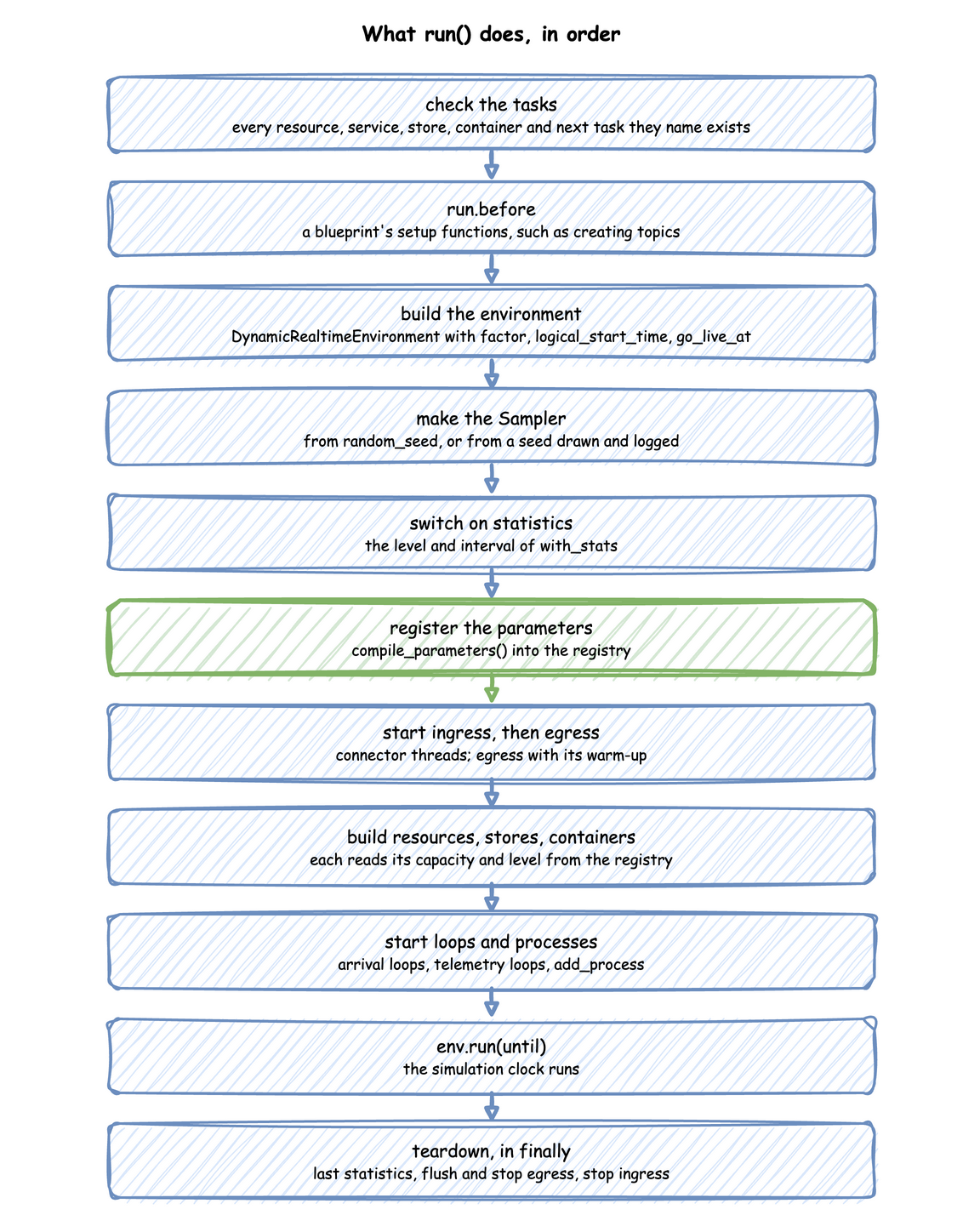
Until run() is called nothing exists but the description: context.env, context.spawn and context.get_resource raise RuntimeError before it. Teardown runs in a finally block, so the last statistics are published and every sink is flushed even when the run stops with an error or Ctrl+C.
What @app.task Does
@app.task turns your function into a SimPy process that does these steps, publishing a record at three of them:
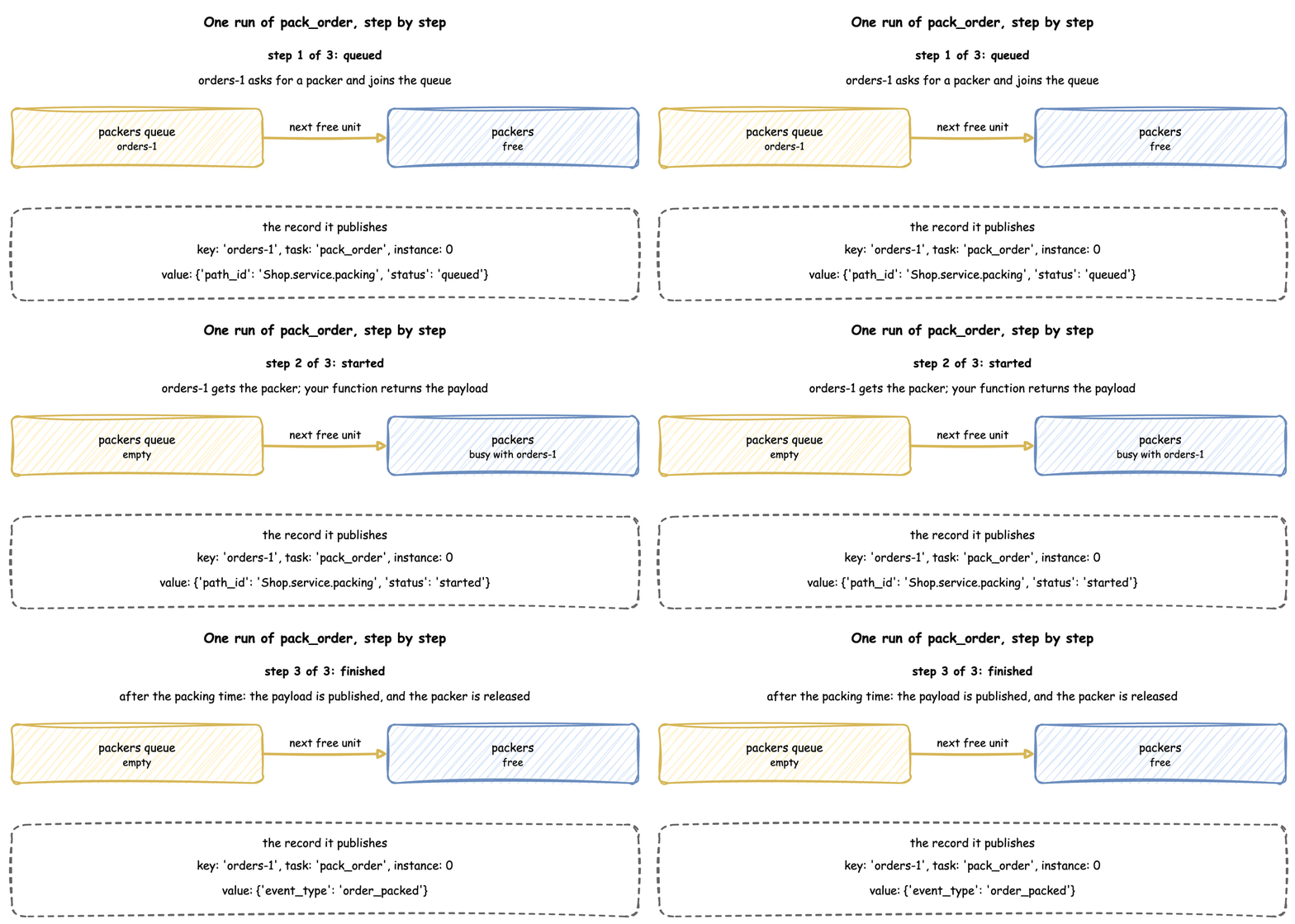
- If it has a resource or a
get, it publishesqueuedand asks for the resource, in the resource's queue order. - Once it has the resource, it takes its
getfrom a store or container, waiting while there is not enough. - It publishes
started, calls your function, and keeps what it returns as the payload. The payload is computed before the service time, so it can use the state of the simulation at that moment. - It waits the service time, drawn from the live distribution.
- It adds its
putto a store or container, waiting while there is no room, then publishes the payload as the finished event and releases the resource. - It applies
setto the entity's attributes, and starts the next task itsnextchooses, if any, as a new instance for the same entity.
A YAML task and its spawn make the same task and arrival loop that the builder code above makes. In SimPy terms each task run is one process started with env.process, and each arrival loop is another; SimPy and desflow describes processes.
Processes and the Low-level API
add_process(func, **kwargs) starts func(context, **kwargs) when the run starts, and a YAML processes entry does the same with a !python function. Inside it, context.env is the DynamicRealtimeEnvironment, so a process can do anything a low-level script does: context.env.timeout, context.env.registry.update, context.env.publish_event. This is how low-level code joins a builder or YAML model.
Stability and Limits
- A task holds one resource. An order that needs a picker and a packing bench at once, or a handover between them, is a process: Multi-Resource Handoffs shows how.
- A task cannot be interrupted. Breakdowns that stop work in progress, such as a label printer that jams, need a process that catches SimPy's
Interrupt: Preemptive Breakdowns. - A finished event is exactly the payload. It has no
statusorpath_idunless the payload includes them. - Runtime helpers need a running simulation.
context.spawn,context.get_resource,context.get_store,context.get_containerandcontext.envraiseRuntimeErrorbeforerun(); call them inside a loop, task or process.