Model Parts
A model is made of a few kinds of parts. This page is the map: which block models what, and what it is called in each way of writing. Each block has a page of its own.
What It Is
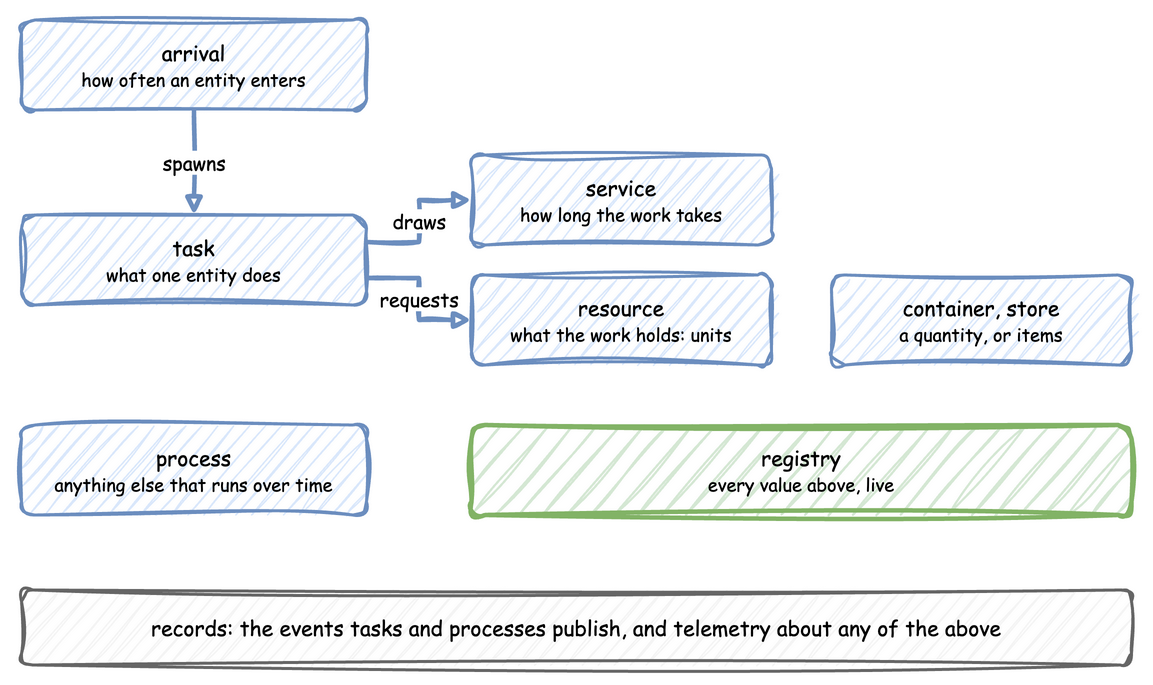
An entity is the thing that flows through a model: an order, a visitor, a support call. It enters through an arrival and does the work its task describes. While it works, it holds a resource, and it may take from or add to a store or container. Then it goes on to the next task. What Is DES? explains discrete-event simulation, the kind of simulation these blocks build. Look at how the blocks connect:
| Block | What it models | YAML | Builder | Low-level | Page |
|---|---|---|---|---|---|
| Arrival | how often an entity enters, and what it starts with | arrivals |
add_arrival, @app.arrival_loop |
a process that waits for a drawn gap | Arrivals and Services |
| Service | how long a piece of work takes | services |
add_service |
a DistributionConfig drawn with a Sampler |
Arrivals and Services |
| Task | what one entity does, with its events | tasks |
@app.task |
a SimPy process | Tasks and Processes |
| Resource | packers, benches, lanes: whole units held by a task | resources |
add_resource |
DynamicResource |
Resources |
| Container | an amount, such as a stock of boxes, that tasks take and add | containers |
add_container |
DynamicContainer |
Stores and Containers |
| Store | items, such as parcels on a shelf, that tasks put and get | stores |
add_store |
DynamicStore |
Stores and Containers |
| Task flow | the task that follows a finished one, and what the entity carries | next, attributes, set |
next=, attributes=, set= |
Router, Entity |
Task Flow |
| Process | anything else that runs over time: a break, a drift, a schedule | processes |
add_process |
env.process |
Tasks and Processes |
| Statistics | what the run measures about itself | stats |
with_stats |
env.setup_stats, env.stats |
Statistics |
| Variable | any other live value, such as a speed | variables |
add_variable |
SimParameter(variables=...) |
Live Parameters |
The shop tutorial, in the Learn section, puts them together one at a time, in a small shop.
How to Use It
A model declares its blocks, and its tasks use them by name. A task names its service and its resource, and an arrival names the task it starts. The table above gives each block's YAML key, builder call and low-level class. Writing a Model shows a whole model in each form.
How It Works
When the run starts, run() builds the environment, registers every block's parameters in the registry, builds the resources, stores and containers, and starts the arrivals and processes. What run() Does lists the steps in order. From then on, each block reads its live values from the registry: a distribution reads its parameters at each draw, and a resource follows its capacity path.