Multi-Resource Handoffs
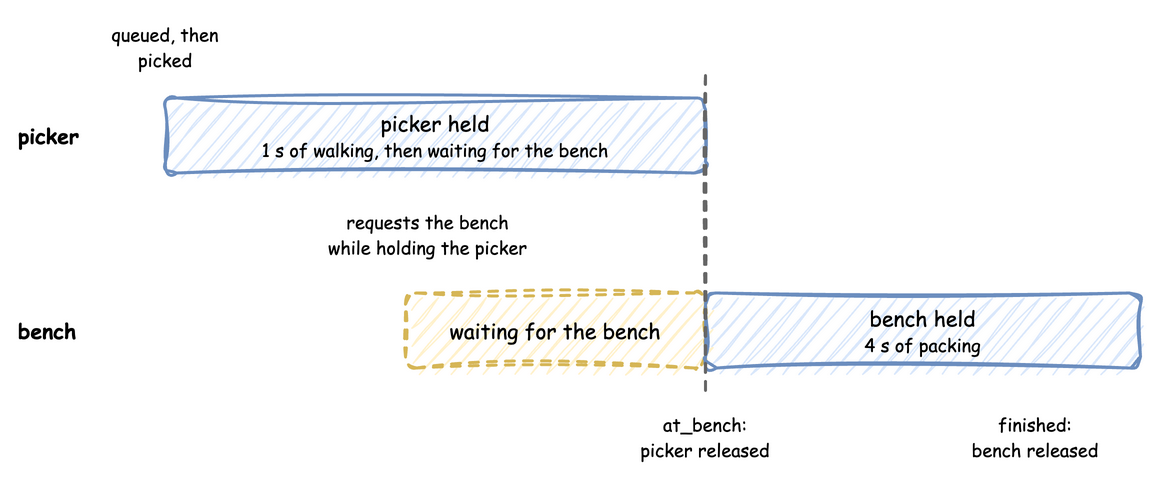
A handoff passes an order from one resource to the next without letting go of the first too early. Here a picker carries each order to a packing bench. The order keeps the picker until the bench is free, so for a moment it holds both, and then it releases the picker.
@app.task requests one resource, holds it for the service time and releases it. An order that holds two resources at once, and releases them at different times, needs a task written as a generator that you start with context.spawn.
Example
docs/snippets/guides/multi_resource_handoffs.py
import logging

from desflow import ConsoleEgress, SimulationContext

logging.basicConfig(level=logging.INFO)

WALK = 1.0  # seconds the picker takes to carry an order to the packing bench
PACKING = 4.0  # seconds of packing per order

app = (
    SimulationContext(sim_id="Shop", factor=1.0)
    .add_resource("picker", current_cap=1, max_cap=1)
    .add_resource("bench", current_cap=1, max_cap=1)
    .add_arrival("orders", dist="exponential", rate=1.0)
    .add_egress(ConsoleEgress())
)


def handoff_worker(context: SimulationContext, order_id: int):
    picker = context.get_resource("picker")
    bench = context.get_resource("bench")
    key = f"task-{order_id}"
    context.env.publish_event(key, {"status": "queued"})

    # The picker is released by hand below, not by a `with` block, because the
    # handoff happens in the middle of the bench's block.
    yield picker.request()
    context.env.publish_event(key, {"status": "picked"})
    yield context.env.timeout(WALK)

    # Ask for the bench while still holding the picker.
    with bench.request() as bench_req:
        yield bench_req
        context.env.publish_event(key, {"status": "at_bench"})
        picker.release()  # the order is on the bench, so the picker is free
        yield context.env.timeout(PACKING)
        context.env.publish_event(key, {"status": "finished"})


@app.arrival_loop("orders")
def arrival_loop(context: SimulationContext):
    order_id = 0
    while True:
        yield context.wait_for_arrival("orders")
        context.spawn(handoff_worker(context, order_id))
        order_id += 1


if __name__ == "__main__":
    app.run(until=30.0)
Save it as multi_resource_handoffs.py and run python multi_resource_handoffs.py. It runs for 30 seconds in real time (factor=1.0) and prints each event.
How It Works
handoff_workeris one order. It publishesqueued, waits for the picker, publishespickedand spendsWALKseconds on the way to the bench.- Asking for the bench happens inside the picker's hold: the order waits for the bench while it still has the picker. When it gets the bench it publishes
at_benchand callspicker.release(), so the next order can use the picker. It is packed forPACKINGseconds, publishesfinishedand releases the bench when itswithblock ends. picker.request()is not in awithblock, because awithblock would release the picker at its end, after the packing. The picker is released by hand instead.arrival_loopstarts ahandoff_workerfor each arriving order. Orders arrive about once a second and packing takes 4 seconds, so the bench is the bottleneck. An order that waits for the bench keeps the picker, and the orders behind it wait for the picker.