A Flow of Tasks
Until now an order was one task: it was packed and left. A real order is picked from the shelves, packed and shipped; sometimes an item is out of stock, and sometimes a parcel fails its check and is packed again. This page asks: how do orders move through pick, pack and ship? It answers with two shares: how many orders go to backorder, and how many parcels are packed again.
What You Add
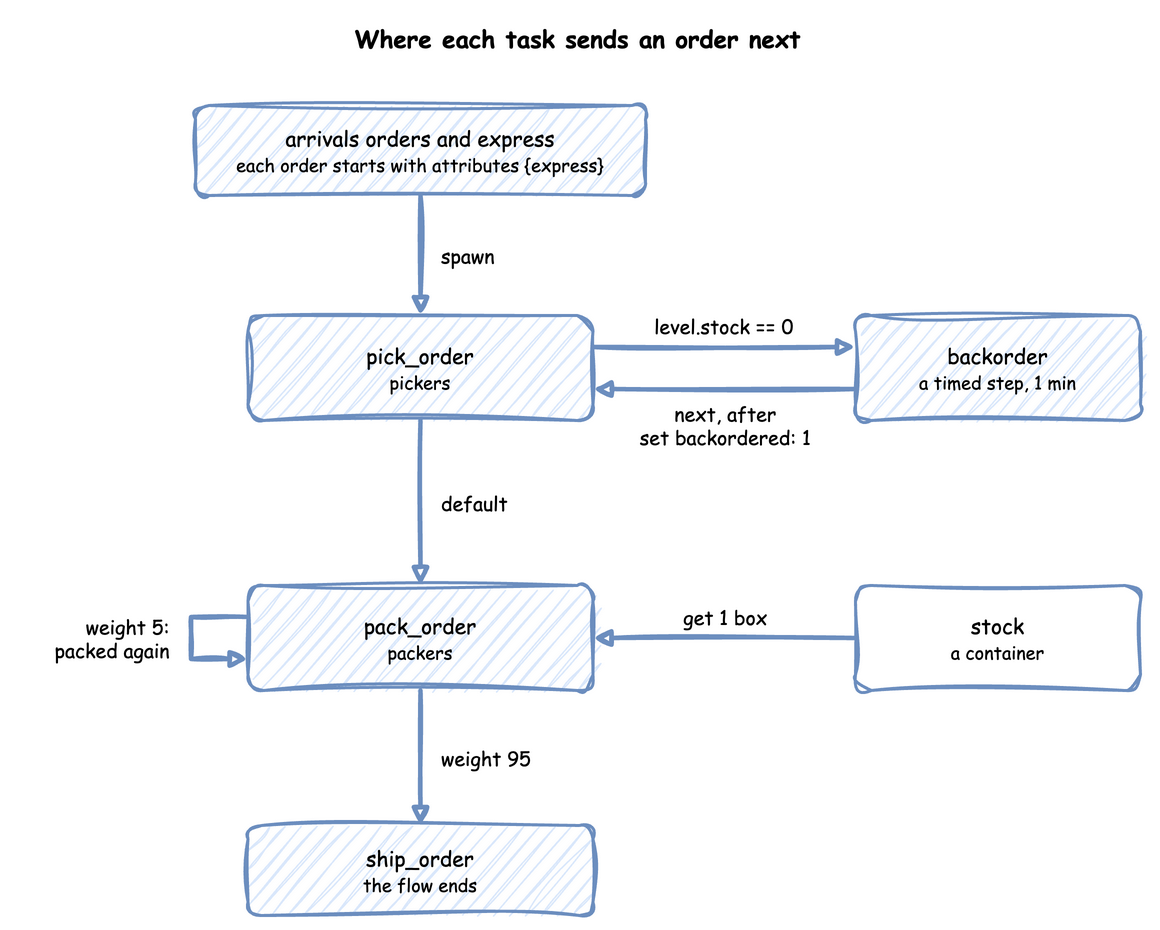
Three tasks in a row, pick_order, pack_order and ship_order; a backorder delay for an order picked while the shelf of boxes from Stock is empty; and an express attribute that each order carries. The shop has two pickers and two packers, orders at 0.4 a second and express orders at 0.1, and a delivery of 53 boxes every 100 seconds, a little more than orders take. It runs for an hour.
Look at the flow first:
Chain the Tasks
Choosing where an entity goes next is called routing. In desflow a task, which Tasks and Processes describes, names what follows it with next. next is a task name, which always leads there; a list of when rules, each a condition and a task, where the first rule that holds wins and default catches the rest; or weights, below. A task with no next ends the order's flow.
# The first rule that holds wins; default catches the rest
@app.task(
service_id="picking",
resource_id="pickers",
next={
"when": [{"condition": "level.stock == 0", "task": "backorder"}],
"default": "pack_order",
},
)
def pick_order(task_id: int, context: SimulationContext):
return {"event_type": "order_picked"}
# The first rule that holds wins; default catches the rest
"pick_order": Router(
{
"when": [{"condition": "level.stock == 0", "task": "backorder"}],
"default": "pack_order",
}
),
A Router takes the same rules as next and returns the name of the task to start. When a task finishes, its process asks the router and starts the next task as a new process, with the same entity:
entity.attributes.update(SETS.get(name, {}))
upstream = Upstream(task_id, entity.key, entity.attributes, finished)
following = ROUTES[name].choose(upstream, env, levels={"stock": shop["stock"]})
if following is None:
env.stats.flow_finished(entity.arrival) # the order leaves the shop
return
instance = next(counters[following])
env.process(task(env, sampler, shop, following, entity, instance, counters))
In SimPy terms, a process that starts another process with env.process(...) is how one step leads to the next. SimPy and desflow describes processes.
The rule reads level.stock, the level of the container stock, at the moment picking finishes; Stores and Containers describes containers. Each name in a condition says where its value comes from: level. for a store or container, attr. for the entity's attributes, payload. for the finished task's payload, and registry["..."] for a live parameter. Task Flow lists everything a condition can use.
Every event of every task carries the order's key, orders-1, so one order can be followed through its whole flow; task names the task, and instance numbers its runs. Each task has one counter, shared by its arrivals and by next, so a re-pick after a backorder gets a new id. In the full builder file the arrival loops take the id from context.next_instance("pick_order"); the low-level file keeps one counters entry per task.
Out of Stock
An order picked while the shelf is empty waits for the supplier for a minute, then is picked again. The wait uses no picker or packer, so backorder has a service and no resource: a timed step. It publishes started at once, with no queued event, waits the sampled time, and publishes its finished event:
# A timed step: a service and no resource, so it starts at once. `set` is applied
# to the order's attributes when the step finishes.
@app.task(service_id="supplying", set={"backordered": 1}, next="pick_order")
def backorder(task_id: int, context: SimulationContext):
return {"event_type": "order_backordered"}
next: pick_order sends the order back to an earlier task. A route back is allowed anywhere in a flow.
Rework
One parcel in 20 fails its check and is packed again. Sending work back to a task it has passed is called rework. weights chooses the next task at random, in proportion to the weights, from a random stream of the routing task's own, route.pack_order, so a seeded run repeats and the choice does not change any other draw:
# One parcel in 20 fails its check and is packed again
@app.task(
service_id="packing",
resource_id="packers",
get={"container": "stock", "amount": 1},
next={"weights": {"ship_order": 95, "pack_order": 5}},
)
def pack_order(task_id: int, context: SimulationContext):
return {"event_type": "order_packed"}
# One parcel in 20 fails its check and is packed again; the generator is set
# in run below
"pack_order": Router({"weights": {"ship_order": 95, "pack_order": 5}}),
The low-level router needs a generator to draw from: ROUTES["pack_order"].rng = sampler.generator("route.pack_order") in run, the stream the builder uses.
Carry Attributes
An order is an entity with attributes: values it carries from task to task, such as whether it is express. The arrival gives each new entity its starting attributes, and set on a task changes them when the task finishes, as backorder does with backordered: 1:
# Each order starts with the attributes given here, read as attr.<name>
ATTRIBUTES = {"orders": {"express": 0}, "express": {"express": 1}}
Entity(key, arrival, attributes) is the order, created by the arrival process; the full file below shows it.
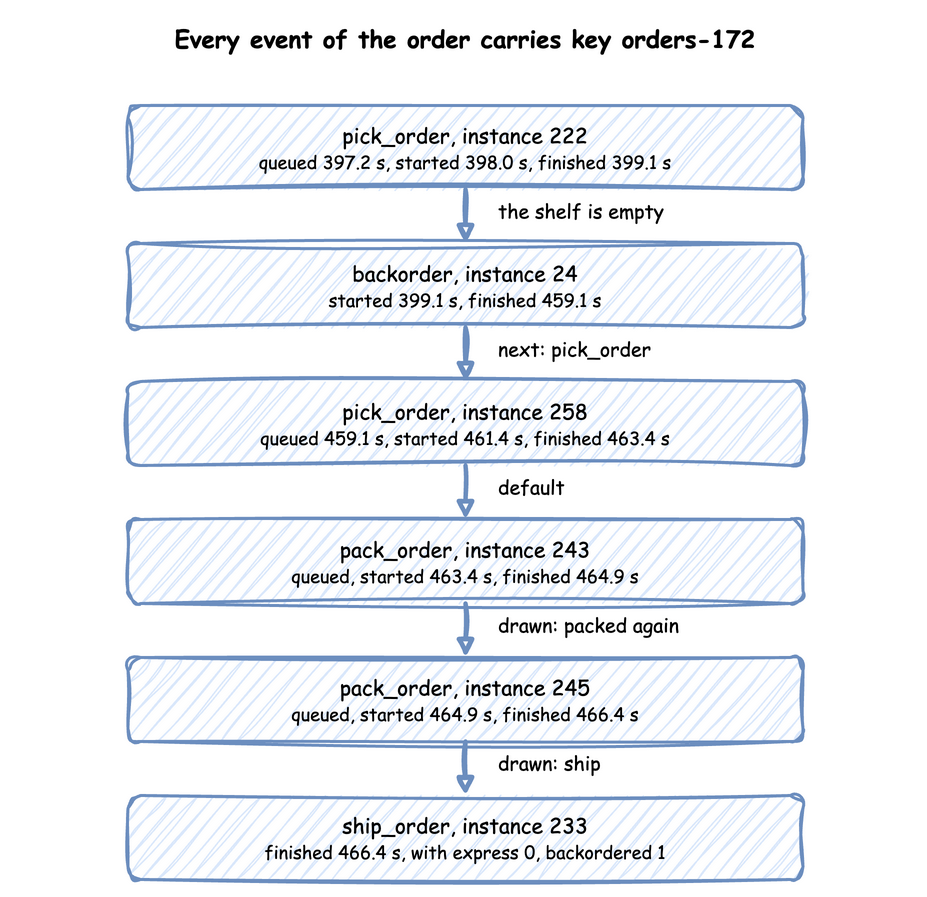
Attributes are not published. A condition reads them as attr.express, and a payload includes them only when it asks: ship_order names express and backordered, so its finished event carries both. This is orders-172, which was picked while the shelf was empty, backordered, picked again and packed twice:
[EVT] {'sim_ts': 397.158, 'timestamp': '...', 'key': 'orders-172', 'task': 'pick_order', 'instance': 222, 'value': {'path_id': 'Shop.service.picking', 'status': 'queued'}}
[EVT] {'sim_ts': 398.017, 'timestamp': '...', 'key': 'orders-172', 'task': 'pick_order', 'instance': 222, 'value': {'path_id': 'Shop.service.picking', 'status': 'started'}}
[EVT] {'sim_ts': 399.138, 'timestamp': '...', 'key': 'orders-172', 'task': 'pick_order', 'instance': 222, 'value': {'event_type': 'order_picked'}}
[EVT] {'sim_ts': 399.138, 'timestamp': '...', 'key': 'orders-172', 'task': 'backorder', 'instance': 24, 'value': {'path_id': 'Shop.service.supplying', 'status': 'started'}}
[EVT] {'sim_ts': 459.138, 'timestamp': '...', 'key': 'orders-172', 'task': 'backorder', 'instance': 24, 'value': {'event_type': 'order_backordered'}}
[EVT] {'sim_ts': 459.138, 'timestamp': '...', 'key': 'orders-172', 'task': 'pick_order', 'instance': 258, 'value': {'path_id': 'Shop.service.picking', 'status': 'queued'}}
[EVT] {'sim_ts': 461.427, 'timestamp': '...', 'key': 'orders-172', 'task': 'pick_order', 'instance': 258, 'value': {'path_id': 'Shop.service.picking', 'status': 'started'}}
[EVT] {'sim_ts': 463.376, 'timestamp': '...', 'key': 'orders-172', 'task': 'pick_order', 'instance': 258, 'value': {'event_type': 'order_picked'}}
[EVT] {'sim_ts': 463.376, 'timestamp': '...', 'key': 'orders-172', 'task': 'pack_order', 'instance': 243, 'value': {'path_id': 'Shop.service.packing', 'status': 'queued'}}
[EVT] {'sim_ts': 463.376, 'timestamp': '...', 'key': 'orders-172', 'task': 'pack_order', 'instance': 243, 'value': {'path_id': 'Shop.service.packing', 'status': 'started'}}
[EVT] {'sim_ts': 464.876, 'timestamp': '...', 'key': 'orders-172', 'task': 'pack_order', 'instance': 243, 'value': {'event_type': 'order_packed'}}
[EVT] {'sim_ts': 464.876, 'timestamp': '...', 'key': 'orders-172', 'task': 'pack_order', 'instance': 245, 'value': {'path_id': 'Shop.service.packing', 'status': 'queued'}}
[EVT] {'sim_ts': 464.876, 'timestamp': '...', 'key': 'orders-172', 'task': 'pack_order', 'instance': 245, 'value': {'path_id': 'Shop.service.packing', 'status': 'started'}}
[EVT] {'sim_ts': 466.376, 'timestamp': '...', 'key': 'orders-172', 'task': 'pack_order', 'instance': 245, 'value': {'event_type': 'order_packed'}}
[EVT] {'sim_ts': 466.376, 'timestamp': '...', 'key': 'orders-172', 'task': 'ship_order', 'instance': 233, 'value': {'event_type': 'order_shipped', 'express': 0, 'backordered': 1}}
Result
How do orders move through pick, pack and ship? Most go straight through, and a few go to backorder or are packed again. The run publishes the finished count of every task at the end, with stats: basic:
| Task | Finished in the hour |
|---|---|
pick_order |
1,857 |
backorder |
80 |
pack_order |
1,849 |
ship_order |
1,775 |
4.3% of picks led to backorder (80 of 1,857), and 4.0% of parcels were packed again (74 of 1,849 packs did not lead to a shipment). The weights ask for 5%; the run drew a few less.
Why It Works
In a flow, each task's arrival rate follows from the rates into it and the routing weights: this is flow balance. Every pack leads to a shipment with probability 0.95, so each order is packed 1 ÷ 0.95 = 1.05 times on average, and the packers see 5% more work than there are orders. A rework loop raises utilisation in the same way, which is why it belongs in the load you work out before running. Task Flow describes routing in full.
Full Files
Full files
# The A Flow of Tasks tutorial: orders are picked, packed and shipped.
# Run it with: desflow run flow_of_tasks.yaml
simulation:
sim_id: Shop
factor: 0
random_seed: 42
resources:
pickers: {current_cap: 2, max_cap: 4}
packers: {current_cap: 2, max_cap: 4}
containers:
# Boxes on the shelf, restocked with 53 every 100 seconds
stock: {current_cap: 200, max_cap: 200, level: 50}
services:
picking: {dist: uniform, low: 1 s, high: 3 s}
packing: {dist: constant, value: 1.5 s}
# The supplier takes a minute to send an item that is out of stock
supplying: {dist: constant, value: 1 min}
arrivals:
# Each order starts with the attributes given here, read as attr.<name>
orders: {dist: exponential, rate: 0.4, spawn: pick_order, attributes: {express: 0}}
express: {dist: exponential, rate: 0.1, spawn: pick_order, attributes: {express: 1}}
deliveries: {dist: constant, value: 100 s, spawn: restock}
tasks:
pick_order:
  service: picking
  resource: pickers
  payload: {event_type: order_picked}
  # The first rule that holds wins; default catches the rest
  next:
    when:
      - {condition: "level.stock == 0", task: backorder}
    default: pack_order
backorder:
# A timed step: a service and no resource, so it starts at once
service: supplying
payload: {event_type: order_backordered}
# Applied to the order's attributes when the step finishes
set: {backordered: 1}
next: pick_order
pack_order:
service: packing
resource: packers
get: {container: stock, amount: 1}
payload: {event_type: order_packed}
# One parcel in 20 fails its check and is packed again
next:
weights: {ship_order: 95, pack_order: 5}
ship_order:
payload: {event_type: order_shipped}
# A payload includes attributes only when it names them
attributes: [express, backordered]
restock:
put: {container: stock, amount: 53}
payload: {event_type: stock_delivered}
# Finished counts of every task and flow, at the end
stats: {level: basic, interval: 1 h}
egress:
- type: Console
run:
until: 1 h
"""The A Flow of Tasks tutorial: orders are picked, packed and shipped, builder.
Two pickers, two packers and a shelf of boxes restocked every 100 seconds. An order
picked while the shelf is empty goes to backorder for a minute and is picked again,
and one parcel in 20 is packed again. Every record is printed to the terminal.
"""
import logging
from desflow import ConsoleEgress, SimulationContext
logging.basicConfig(
level=logging.INFO, format="%(levelname)s [%(asctime)s] %(message)s"
)
app = (
SimulationContext(sim_id="Shop", factor=0, random_seed=42)
.add_resource("pickers", current_cap=2, max_cap=4)
.add_resource("packers", current_cap=2, max_cap=4)
# Boxes on the shelf, restocked with 53 every 100 seconds
.add_container("stock", current_cap=200, max_cap=200, level=50)
.add_service("picking", dist="uniform", low=1, high=3)
.add_service("packing", dist="constant", value=1.5)
# The supplier takes a minute to send an item that is out of stock
.add_service("supplying", dist="constant", value=60)
.add_arrival("deliveries", dist="constant", value=100)
# Finished counts of every task and flow, at the end
.with_stats("basic", interval=3600)
.add_egress(ConsoleEgress())
)
# Each order starts with the attributes given here, read as attr.<name>
app.add_arrival("orders", dist="exponential", rate=0.4, attributes={"express": 0})
app.add_arrival("express", dist="exponential", rate=0.1, attributes={"express": 1})
# The first rule that holds wins; default catches the rest
@app.task(
    service_id="picking",
    resource_id="pickers",
    next={
        "when": [{"condition": "level.stock == 0", "task": "backorder"}],
        "default": "pack_order",
    },
)
def pick_order(task_id: int, context: SimulationContext):
    return {"event_type": "order_picked"}
# A timed step: a service and no resource, so it starts at once. `set` is applied
# to the order's attributes when the step finishes.
@app.task(service_id="supplying", set={"backordered": 1}, next="pick_order")
def backorder(task_id: int, context: SimulationContext):
return {"event_type": "order_backordered"}
# One parcel in 20 fails its check and is packed again
@app.task(
service_id="packing",
resource_id="packers",
get={"container": "stock", "amount": 1},
next={"weights": {"ship_order": 95, "pack_order": 5}},
)
def pack_order(task_id: int, context: SimulationContext):
return {"event_type": "order_packed"}
@app.task()
def ship_order(task_id: int, context: SimulationContext, entity):
# A payload includes attributes only when it asks for them
return {
"event_type": "order_shipped",
"express": entity.attributes.get("express"),
"backordered": entity.attributes.get("backordered"),
}
@app.task(put={"container": "stock", "amount": 53})
def restock(task_id: int, context: SimulationContext):
return {"event_type": "stock_delivered"}
def spawn(arrival, task, name):
def loop(context: SimulationContext):
while True:
entity = yield context.wait_for_arrival(arrival)
# One counter per task, shared by both order arrivals and by next
context.spawn(task(context.next_instance(name), context, entity=entity))
return loop
app.arrival_loop("orders")(spawn("orders", pick_order, "pick_order"))
app.arrival_loop("express")(spawn("express", pick_order, "pick_order"))
app.arrival_loop("deliveries")(spawn("deliveries", restock, "restock"))
if __name__ == "__main__":
app.run(until="1 h")
"""The A Flow of Tasks tutorial: orders are picked, packed and shipped, low-level.
Two pickers, two packers and a shelf of boxes restocked every 100 seconds. An order
picked while the shelf is empty goes to backorder for a minute and is picked again,
and one parcel in 20 is packed again. Every record is printed to the terminal.
"""
import contextlib
import itertools
import logging
from desflow import (
CapacityConfig,
ConsoleEgress,
ContainerConfig,
DistributionConfig,
DynamicContainer,
DynamicRealtimeEnvironment,
DynamicResource,
Entity,
Router,
Sampler,
SimParameter,
Upstream,
)
logging.basicConfig(
level=logging.INFO, format="%(levelname)s [%(asctime)s] %(message)s"
)
PARAMS = SimParameter(
sim_id="Shop",
arrival={
"orders": DistributionConfig(dist="exponential", rate=0.4),
"express": DistributionConfig(dist="exponential", rate=0.1),
"deliveries": DistributionConfig(dist="constant", value=100),
},
service={
"picking": DistributionConfig(dist="uniform", low=1, high=3),
"packing": DistributionConfig(dist="constant", value=1.5),
# The supplier takes a minute to send an item that is out of stock
"supplying": DistributionConfig(dist="constant", value=60),
},
resources={
"pickers": CapacityConfig(current_cap=2, max_cap=4),
"packers": CapacityConfig(current_cap=2, max_cap=4),
},
# Boxes on the shelf, restocked with 53 every 100 seconds
containers={"stock": ContainerConfig(current_cap=200, max_cap=200, level=50)},
)
# Each order starts with the attributes given here, read as attr.<name>
ATTRIBUTES = {"orders": {"express": 0}, "express": {"express": 1}}
# Each task's service and resource; None for a timed step or a task that takes no time
TASKS = {
"pick_order": ("picking", "pickers"),
"backorder": ("supplying", None),
"pack_order": ("packing", "packers"),
"ship_order": (None, None),
}
EVENTS = {
"pick_order": "order_picked",
"backorder": "order_backordered",
"pack_order": "order_packed",
}
ROUTES = {
# The first rule that holds wins; default catches the rest
"pick_order": Router(
    {
        "when": [{"condition": "level.stock == 0", "task": "backorder"}],
        "default": "pack_order",
    }
),
"backorder": Router("pick_order"),
# One parcel in 20 fails its check and is packed again; the generator is set
# in run below
"pack_order": Router({"weights": {"ship_order": 95, "pack_order": 5}}),
"ship_order": Router(None),
}
# Applied to the order's attributes when the step finishes
SETS = {"backorder": {"backordered": 1}}
def payload(name, entity):
if name == "ship_order":
# A payload includes attributes only when it asks for them
return {
"event_type": "order_shipped",
"express": entity.attributes.get("express"),
"backordered": entity.attributes.get("backordered"),
}
return {"event_type": EVENTS[name]}
def task(env, sampler, shop, name, entity, task_id, counters):
"""Runs one task for an order, then starts the task its router chooses."""
service, resource = TASKS[name]
path_id = f"Shop.service.{service}"
def publish(value):
env.publish_event(entity.key, value, task=name, instance=task_id)
if resource is not None:
publish({"path_id": path_id, "status": "queued"})
env.stats.task_queued(name, task_id)
unit = shop[resource].request() if resource else contextlib.nullcontext()
with unit as request:
if request is not None:
yield request
if name == "pack_order":
yield shop["stock"].get(1)
if service is not None:
publish({"path_id": path_id, "status": "started"})
env.stats.task_started(name, task_id)
finished = payload(name, entity)
if service is not None:
yield env.timeout(sampler.sample(env.registry.get_config(path_id)))
publish(finished)
env.stats.task_finished(name, task_id)
entity.attributes.update(SETS.get(name, {}))
upstream = Upstream(task_id, entity.key, entity.attributes, finished)
following = ROUTES[name].choose(upstream, env, levels={"stock": shop["stock"]})
if following is None:
    env.stats.flow_finished(entity.arrival)  # the order leaves the shop
    return
instance = next(counters[following])
env.process(task(env, sampler, shop, following, entity, instance, counters))
def order_generator(env, sampler, shop, arrival, counters):
"""Starts an order for every arrival, keyed orders-1, express-1 and so on."""
gap = env.registry.get_config(f"Shop.arrival.{arrival}")
for number in itertools.count(1):
yield env.timeout(sampler.sample(gap))
entity = Entity(f"{arrival}-{number}", arrival, dict(ATTRIBUTES[arrival]))
instance = next(counters["pick_order"])
env.process(task(env, sampler, shop, "pick_order", entity, instance, counters))
def delivery_generator(env, sampler, shop):
gap = env.registry.get_config("Shop.arrival.deliveries")
for number in itertools.count(1):
yield env.timeout(sampler.sample(gap))
yield shop["stock"].put(53)
value = {"event_type": "stock_delivered"}
env.publish_event(
f"deliveries-{number}", value, task="restock", instance=number - 1
)
env.stats.task_finished("restock", number - 1)
env.stats.flow_finished("deliveries")
def run(until=3600, factor=0.0):
env = DynamicRealtimeEnvironment(factor=factor)
env.registry.register_sim_parameter(PARAMS)
env.setup_egress([ConsoleEgress()])
# Finished counts of every task and flow, at the end
env.setup_stats("Shop", "basic", interval=3600)
shop = {
"pickers": DynamicResource(env, "Shop", "pickers"),
"packers": DynamicResource(env, "Shop", "packers"),
"stock": DynamicContainer(env, "Shop", "stock"),
}
sampler = Sampler(seed=42)
# Weights draw from the routing task's own sequence, as the builder's do
ROUTES["pack_order"].rng = sampler.generator("route.pack_order")
# One counter per task, shared by the arrivals and the rules
counters = {name: itertools.count() for name in TASKS}
for arrival in ("orders", "express"):
env.process(order_generator(env, sampler, shop, arrival, counters))
env.process(delivery_generator(env, sampler, shop))
try:
env.run(until=until)
finally:
env.teardown()
return env
if __name__ == "__main__":
run()
This is the last page of the tutorial for now. Task Flow and the rest of the User Guide describe each part of desflow in full.