Trusting Results
Measuring a Run read five numbers from one run of the busy hour. The run started with an empty shop: no orders waiting and every packer free. A real shop at that hour is never empty, so the first orders of the run wait less than they would. This page asks: is one run enough? It answers the first part of that question: how much of the start to leave out.
What You Add
A warmup on the run. The shop is the busy hour from Measuring a Run, unchanged.
Plot the Start
Some runs have a natural start and end, such as a shop that opens empty at 9:00 and closes at 17:00; these are terminating runs, and the empty start is part of what they measure. Others stand for a system that keeps going, such as the shop in the middle of its busy hour; these are steady-state runs, and the empty start is a distortion called initialisation bias. The busy hour is a steady-state run.
To see how long the distortion lasts, plot an output over time and look for where it stops trending. Publish the statistics every 10 seconds: wait_mean is then the mean wait of every order so far, and queue_length is the queue at that moment.
# wait_mean every 10 seconds is the mean wait so far: plot it against sim_ts
env.setup_stats("Shop", "typical", interval=10)
# The warm-up is set with the sinks: none receives a record before it, and the
# statistics start again when it ends
env.setup_egress([ConsoleEgress()], warmup=warmup)
Plot the two against sim_ts for the first 15 minutes:
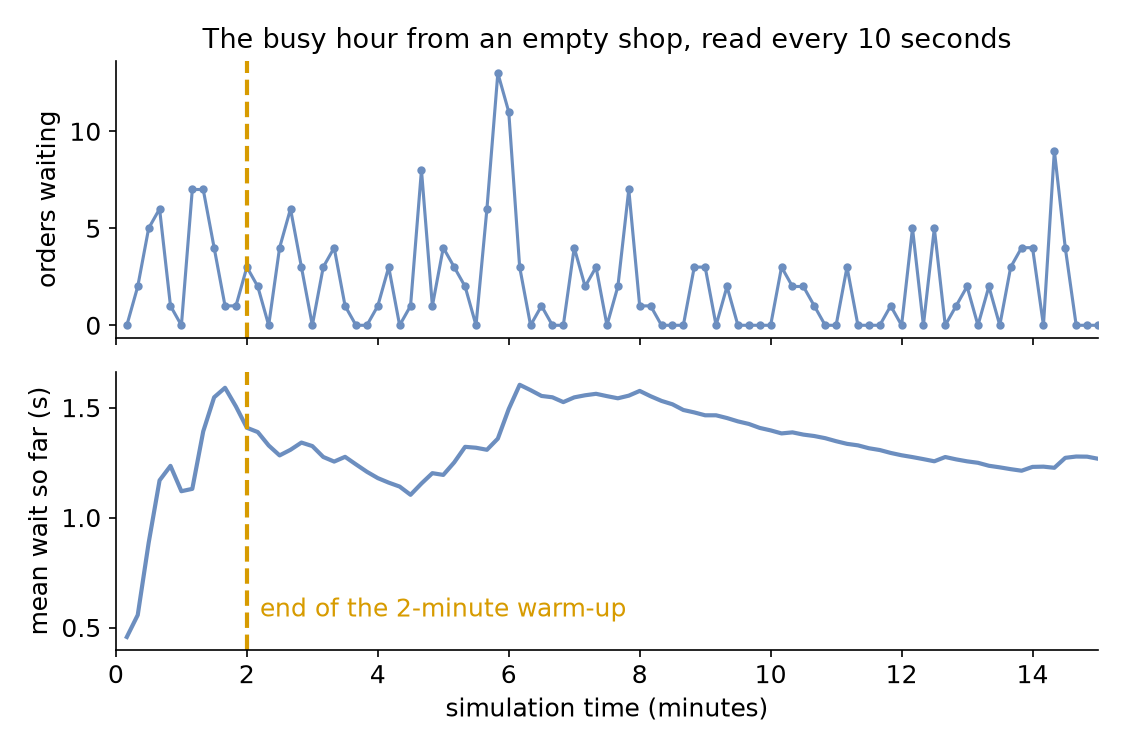
The queue reaches its usual range within the first minute. The mean wait so far climbs for about a minute and a half, because the first orders found free packers, then moves up and down with no trend. 2 minutes covers the climb with a margin, so that is the warm-up.
Leave Out the Start
A warmup time leaves the start out of everything the run reports:
# Records and statistics start after the first 2 minutes; None keeps everything
WARMUP = 120.0 # seconds, passed to setup_egress in run below
In the low-level API the warm-up is an argument of env.setup_egress, as the plot step above shows, because it is the sinks that leave the records out.
A run has one warm-up, in simulation time. Every sink leaves out the records and telemetry stamped before it, and the built-in statistics start again from zero at that moment, so they describe the rest of the run only. An order that queued before the warm-up ended and started after it counts with its whole wait. The warm-up is not go_live_at, which sends early records to one sink and later ones to another and drops nothing; Time and Pacing compares the two.
Run the hour without and with the warm-up. WARMUP=0 desflow run trusting_results.yaml runs the YAML version without it; the Builder and Low-level scripts print both:
Result
Is one run enough? Its start does not distort it: read from the plot, the busy hour needs a 2-minute warm-up. With it the mean wait is 1.381 seconds, against 1.382 seconds without it. For this shop and this run, the empty start changes the answer by less than 0.1%: the shop fills within a minute or two, and one hour is long enough that those minutes hardly count. A shorter run, or a start further from the usual state, such as a shop that opens with a backlog of orders, needs the warm-up much more.
So one run of the busy hour is long enough not to be distorted by its start. Whether one run is enough at all, when another seed gives another answer, is the second half of the question, which the next release answers with replications.
Why It Works
Initialisation bias fades as the model forgets how it started: here the queue that the first orders found empty is full again within a minute. The warmed-up numbers still pass the check from Measuring a Run. 6,024 orders were packed in the 3,480 seconds after the warm-up, 1.73 a second, and 1.73 × 1.381 seconds = 2.39, which is the queue_length_avg of 2.40 that the same statistics report. Statistics describes how the reset works.
Full Files
Full files
# The Trusting Results tutorial: the busy hour, measured after a warm-up.
# Run it with: desflow run trusting_results.yaml
# Without the warm-up: WARMUP=0 desflow run trusting_results.yaml
simulation:
sim_id: Shop
factor: 0
random_seed: 42
# Records and statistics start after the first 2 minutes; 0 keeps everything
warmup: ${WARMUP:-2 min}
resources:
packers: {current_cap: 3, max_cap: 10}
arrivals:
orders: {dist: exponential, rate: 1.8, spawn: pack_order}
services:
# The 40 packing times measured at the bench, in seconds
packing:
dist: empirical
values: [1.5, 2.5, 2.4, 1.2, 1.3, 1.2, 1.8, 1.4, 2.0, 0.7,
2.7, 1.4, 1.9, 1.4, 1.3, 1.8, 2.0, 1.4, 1.4, 1.9,
1.1, 0.8, 1.7, 1.1, 0.7, 1.1, 1.2, 0.9, 0.8, 1.5,
2.1, 1.3, 1.1, 1.7, 1.9, 1.3, 1.8, 2.2, 1.4, 1.1]
tasks:
pack_order:
service: packing
resource: packers
payload: {event_type: order_packed}
# wait_mean every 10 seconds is the mean wait so far: plot it against sim_ts
stats: {level: typical, interval: 10}

egress:
  - type: Console
run:
until: 1 h
"""The Trusting Results tutorial: the busy hour, measured after a warm-up, builder.
Three packers, orders at 1.8 a second and the measured packing times. Every record is
printed to the terminal, and the script prints the mean wait without and with the
warm-up at the end: python trusting_results.py 2>/dev/null shows only those lines.
"""
import logging
from desflow import ConsoleEgress, SimulationContext
logging.basicConfig(
level=logging.INFO, format="%(levelname)s [%(asctime)s] %(message)s"
)
# The 40 packing times measured at the bench, in seconds
MEASURED = [
1.5, 2.5, 2.4, 1.2, 1.3, 1.2, 1.8, 1.4, 2.0, 0.7,
2.7, 1.4, 1.9, 1.4, 1.3, 1.8, 2.0, 1.4, 1.4, 1.9,
1.1, 0.8, 1.7, 1.1, 0.7, 1.1, 1.2, 0.9, 0.8, 1.5,
2.1, 1.3, 1.1, 1.7, 1.9, 1.3, 1.8, 2.2, 1.4, 1.1,
] # fmt: skip
def shop(warmup="2 min") -> SimulationContext:
"""The busy hour; records and statistics start after `warmup`."""
app = (
# Records and statistics start after the first 2 minutes; None keeps everything
SimulationContext(sim_id="Shop", factor=0, random_seed=42, warmup=warmup)
.add_resource("packers", current_cap=3, max_cap=10)
.add_arrival("orders", dist="exponential", rate=1.8)
.add_service("packing", dist="empirical", values=MEASURED)
# wait_mean every 10 seconds is the mean wait so far: plot it against sim_ts
.with_stats("typical", interval=10)
.add_egress(ConsoleEgress())
)
@app.task(service_id="packing", resource_id="packers")
def pack_order(task_id: int):
return {"event_type": "order_packed"}
@app.arrival_loop("orders")
def order_generator(context: SimulationContext):
task_id = 0
while True:
order = yield context.wait_for_arrival("orders")
context.spawn(pack_order(task_id, entity=order))
task_id += 1
return app
def mean_wait(warmup) -> float:
"""Runs the busy hour and returns the mean wait it measured."""
app = shop(warmup)
app.run(until="1 h")
return app.env.stats.readings()["Shop.stats.tasks.pack_order.wait_mean"]
if __name__ == "__main__":
print(f"without a warm-up: mean wait {mean_wait(None):.3f} s")
print(f"with a 2 min warm-up: mean wait {mean_wait('2 min'):.3f} s")
"""The Trusting Results tutorial: the busy hour, measured after a warm-up, low-level.
Three packers, orders at 1.8 a second and the measured packing times. Every record is
printed to the terminal, and the script prints the mean wait without and with the
warm-up at the end: python trusting_results_low_level.py 2>/dev/null shows only
those lines.
"""
import logging
from desflow import (
CapacityConfig,
ConsoleEgress,
DistributionConfig,
DynamicRealtimeEnvironment,
DynamicResource,
Sampler,
SimParameter,
)
logging.basicConfig(
level=logging.INFO, format="%(levelname)s [%(asctime)s] %(message)s"
)
# The 40 packing times measured at the bench, in seconds
MEASURED = [
1.5, 2.5, 2.4, 1.2, 1.3, 1.2, 1.8, 1.4, 2.0, 0.7,
2.7, 1.4, 1.9, 1.4, 1.3, 1.8, 2.0, 1.4, 1.4, 1.9,
1.1, 0.8, 1.7, 1.1, 0.7, 1.1, 1.2, 0.9, 0.8, 1.5,
2.1, 1.3, 1.1, 1.7, 1.9, 1.3, 1.8, 2.2, 1.4, 1.1,
] # fmt: skip
PARAMS = SimParameter(
sim_id="Shop",
arrival={"orders": DistributionConfig(dist="exponential", rate=1.8)},
service={"packing": DistributionConfig(dist="empirical", values=MEASURED)},
resources={"packers": CapacityConfig(current_cap=3, max_cap=10)},
)
def pack_order(env, sampler, packers, key, task_id):
"""One order, which reports each step to the statistics."""
path_id = "Shop.service.packing"
def publish(value):
env.publish_event(key, value, task="pack_order", instance=task_id)
publish({"path_id": path_id, "status": "queued"})
env.stats.task_queued("pack_order", task_id)
with packers.request() as request:
yield request
publish({"path_id": path_id, "status": "started"})
env.stats.task_started("pack_order", task_id)
yield env.timeout(sampler.sample(env.registry.get_config(path_id)))
publish({"event_type": "order_packed"})
env.stats.task_finished("pack_order", task_id)
env.stats.flow_finished("orders") # the order leaves the shop
def order_generator(env, sampler, packers):
arrival = env.registry.get_config("Shop.arrival.orders")
task_id = 0
while True:
yield env.timeout(sampler.sample(arrival))
env.process(pack_order(env, sampler, packers, f"orders-{task_id + 1}", task_id))
task_id += 1
# Records and statistics start after the first 2 minutes; None keeps everything
WARMUP = 120.0 # seconds, passed to setup_egress in run below
def run(warmup=WARMUP, until=3600, factor=0.0):
env = DynamicRealtimeEnvironment(factor=factor)
env.registry.register_sim_parameter(PARAMS)
# wait_mean every 10 seconds is the mean wait so far: plot it against sim_ts
env.setup_stats("Shop", "typical", interval=10)
# The warm-up is set with the sinks: none receives a record before it, and the
# statistics start again when it ends
env.setup_egress([ConsoleEgress()], warmup=warmup)
packers = DynamicResource(env, "Shop", "packers")
env.process(order_generator(env, Sampler(seed=42), packers))
try:
env.run(until=until)
finally:
env.teardown()
return env
def mean_wait(warmup) -> float:
"""Runs the busy hour and returns the mean wait it measured."""
return run(warmup).stats.readings()["Shop.stats.tasks.pack_order.wait_mean"]
if __name__ == "__main__":
print(f"without a warm-up: mean wait {mean_wait(None):.3f} s")
print(f"with a 2 min warm-up: mean wait {mean_wait(WARMUP):.3f} s")
Next, Stock asks what happens when the shop runs out of boxes.