Low-level API
This page writes a simulation with SimPy and the environment directly: a packing team with a stock of boxes and a store of packed orders, every step written by hand. It builds on SimPy and desflow, which describes the SimPy constructs, and on Builder API, which writes the same kind of model for you.
Use the low-level API when you need what the builder does not do: several resources held at once, as in Multi-Resource Handoffs; resources created while the run goes on, as in Dynamic Topology; or events of your own shape. A builder or blueprint model can also start a low-level process with add_process, as Tasks and Processes shows.
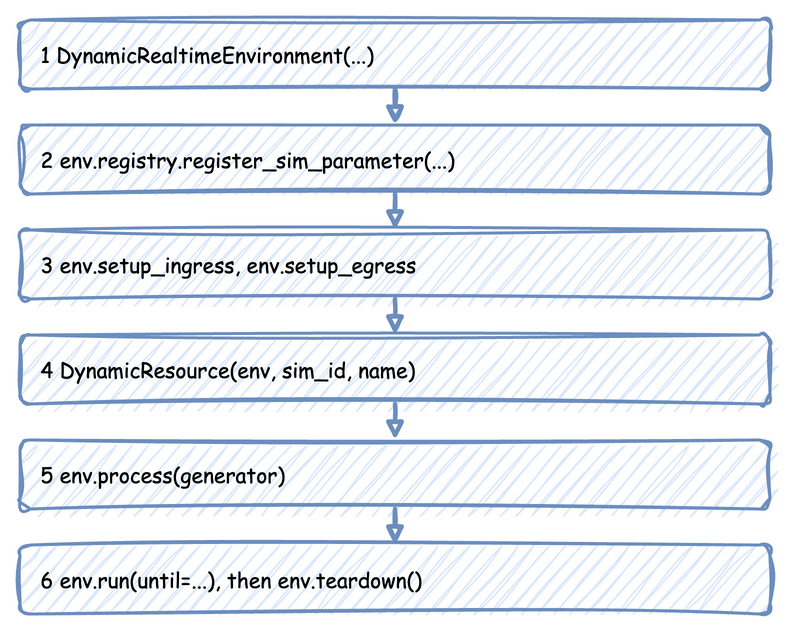
A low-level script takes these steps, in this order:
Create the Environment
import logging

from desflow import (
    CapacityConfig,
    ConsoleEgress,
    ContainerConfig,
    DistributionConfig,
    DynamicContainer,
    DynamicRealtimeEnvironment,
    DynamicResource,
    DynamicStore,
    Sampler,
    SimParameter,
    time_to_seconds,
)
env = DynamicRealtimeEnvironment(factor=0.0) # unpaced; 1.0 follows the wall clock
factor sets the pacing: 1.0 follows the wall clock, and 0.0 runs as fast as possible. logical_start_time and go_live_at work as Time and Pacing describes.
Register the Parameters
env.registry.register_sim_parameter(
    SimParameter(
        sim_id="Shop",
        arrival={"orders": DistributionConfig(dist="exponential", rate=0.5)},
        service={"packing": DistributionConfig(dist="normal", mean=1.5, std=0.3)},
        resources={"packers": CapacityConfig(current_cap=1, max_cap=3)},
        containers={"boxes": ContainerConfig(current_cap=100, max_cap=100, level=100)},
        stores={"finished": CapacityConfig(current_cap=50, max_cap=50)},
        variables={"boxes_per_order": 1.0},
    )
)
One SimParameter holds every parameter of one simulation under its sim_id. Registering it gives each value a path, such as Shop.arrival.orders.rate, and only the registered paths exist. Live Parameters lists the paths.
Attach the Connectors
env.setup_egress([ConsoleEgress()])  # starts the egress thread
# env.setup_ingress([KafkaIngress(...)]) would start the ingress thread
env.setup_stats("Shop", "basic", interval=60)  # readings and counts every minute
setup_egress starts the egress thread, which writes every record the processes publish. setup_ingress starts the ingress thread for parameter changes from outside, and setup_stats switches on the built-in statistics. Egress lists the arguments of setup_egress, including a warm-up and labels sinks.
Create Resources, Containers and Stores
packers = DynamicResource(env, "Shop", "packers")  # reads Shop.resources.packers.*
boxes = DynamicContainer(env, "Shop", "boxes")  # starts at its level, 100
finished = DynamicStore(env, "Shop", "finished")
sampler = Sampler(seed=42)  # a random stream per distribution, from one seed
Each reads its capacity from the registry when it is created, so the parameters must be registered first, and adds itself to the statistics. Sampler(seed=42) gives each registered distribution a random stream of its own, so a run repeats exactly, as Arrivals and Services describes.
Write the Processes
A process is a SimPy generator: it yields to wait, and publishes records as it goes. This one does what @app.task does in the builder, with a box from stock and a store for the result. It publishes each event with the entity key, the task's name and its instance id, and reports each step to the statistics:
def order(env, key, task_id):
    """One order: queue for a packer, take a box, pack, then store the result."""
    path_id = "Shop.service.packing"

    def publish(value):
        env.publish_event(key, value, task="pack_order", instance=task_id)

    publish({"path_id": path_id, "status": "queued"})
    env.stats.task_queued("pack_order", task_id)  # what @app.task reports for you
    with packers.request() as request:
        yield request
        count = env.registry.get("Shop.variables.boxes_per_order").value
        yield boxes.get(count)  # waits if the stock is too low
        publish({"path_id": path_id, "status": "started"})
        env.stats.task_started("pack_order", task_id)
        yield env.timeout(sampler.sample(env.registry.get_config(path_id)))
        yield finished.put({"order": key})
        publish({"event_type": "order_packed"})
    env.stats.task_finished("pack_order", task_id)
    env.stats.flow_finished("orders")
The service time is drawn once the order has a packer and a box, from the configuration the registry holds at that moment, so a change made while it waited still applies to it.
The arrival loop keeps the configuration object rather than a copy of the rate, so the next draw uses whatever rate the registry holds. It gives each order its key, orders-1, orders-2:
def arrivals(env):
    gap = env.registry.get_config("Shop.arrival.orders")  # the live config object
    task_id = 0
    while True:
        yield env.timeout(sampler.sample(gap))  # each draw reads the current rate
        env.process(order(env, f"orders-{task_id + 1}", task_id))  # the entity key
        task_id += 1
A reading of your own is a process that publishes at an interval; publish_telemetry uses the name exactly as given:
def telemetry(env):
    """A reading of your own, beside the built-in statistics."""
    while True:
        env.publish_telemetry("Shop.boxes_per_packer", boxes.level / packers.capacity)
        yield env.timeout(10.0)
A process can also change the simulation itself, through the registry, as a connector or a scenario would:
def refill_and_rush(env):
    """Refills boxes every minute, and doubles arrivals after five minutes."""
    while True:
        yield env.timeout(60.0)
        missing = boxes.capacity - boxes.level
        if missing > 0:  # SimPy refuses a put of 0
            yield boxes.put(missing)
        if env.now >= 300 and env.registry.get("Shop.arrival.orders.rate").value < 1.0:
            env.registry.update("Shop.arrival.orders.rate", 1.0)
            env.registry.update("Shop.resources.packers.current_cap", 2)
Start the Processes and Run
env.process(arrivals(env))
env.process(telemetry(env))
env.process(refill_and_rush(env))
logging.basicConfig(
    level=logging.INFO, format="%(levelname)s [%(asctime)s] %(message)s"
)
try:
    env.run(until=time_to_seconds("10 min"))  # until is in simulation seconds
finally:
    env.teardown()  # flushes the buffers and stops the threads
ConsoleEgress writes each record as a log line at INFO level, so logging is switched on first. env.run is SimPy's, so until is a number of simulation seconds; time_to_seconds converts a duration such as "10 min". teardown in finally publishes the last statistics, flushes the last records and stops both threads, even when the run stops with Ctrl+C or an error.
What It Does for You
Little: the environment paces the clock, holds the registry, writes records on the egress thread and keeps the statistics that setup_stats switches on. Everything else is your code. Builder API lists what SimulationContext.run() writes for you on top of the same steps.
Errors and Limits
Nothing is checked before the run as a whole. Each call checks only what it reads, when it runs:
- An unregistered path raises
KeyErrorwhen a resource, a process or aregistry.getasks for it, so register the parameters before creating anything that reads them. - A record without egress is dropped. Until
setup_egressruns,publish_eventandpublish_telemetrydo nothing, without an error. - A
Sampler()with no seed draws nothing at random. Every sample is the distribution's mean (for atruncated_normal, itsmeanor itslow, whichever is higher), so give it a seed.
The low-level API has no limits of its own: anything SimPy can model, a process can do.
Full Script
Full script
The complete file, which the documentation tests run:
"""A complete low-level simulation, as the Low-level API page explains it step by step.

One packing team with a stock of boxes and a store of packed orders. Run it with
`python low_level.py`: it runs unpaced for 10 simulation minutes and prints every record
to the terminal.
"""

import logging

from desflow import (
    CapacityConfig,
    ConsoleEgress,
    ContainerConfig,
    DistributionConfig,
    DynamicContainer,
    DynamicRealtimeEnvironment,
    DynamicResource,
    DynamicStore,
    Sampler,
    SimParameter,
    time_to_seconds,
)

env = DynamicRealtimeEnvironment(factor=0.0)  # unpaced; 1.0 follows the wall clock

env.registry.register_sim_parameter(
    SimParameter(
        sim_id="Shop",
        arrival={"orders": DistributionConfig(dist="exponential", rate=0.5)},
        service={"packing": DistributionConfig(dist="normal", mean=1.5, std=0.3)},
        resources={"packers": CapacityConfig(current_cap=1, max_cap=3)},
        containers={"boxes": ContainerConfig(current_cap=100, max_cap=100, level=100)},
        stores={"finished": CapacityConfig(current_cap=50, max_cap=50)},
        variables={"boxes_per_order": 1.0},
    )
)

env.setup_egress([ConsoleEgress()])  # starts the egress thread
# env.setup_ingress([KafkaIngress(...)]) would start the ingress thread
env.setup_stats("Shop", "basic", interval=60)  # readings and counts every minute

packers = DynamicResource(env, "Shop", "packers")  # reads Shop.resources.packers.*
boxes = DynamicContainer(env, "Shop", "boxes")  # starts at its level, 100
finished = DynamicStore(env, "Shop", "finished")
sampler = Sampler(seed=42)  # a random stream per distribution, from one seed


def order(env, key, task_id):
    """One order: queue for a packer, take a box, pack, then store the result."""
    path_id = "Shop.service.packing"

    def publish(value):
        env.publish_event(key, value, task="pack_order", instance=task_id)

    publish({"path_id": path_id, "status": "queued"})
    env.stats.task_queued("pack_order", task_id)  # what @app.task reports for you
    with packers.request() as request:
        yield request
        count = env.registry.get("Shop.variables.boxes_per_order").value
        yield boxes.get(count)  # waits if the stock is too low
        publish({"path_id": path_id, "status": "started"})
        env.stats.task_started("pack_order", task_id)
        yield env.timeout(sampler.sample(env.registry.get_config(path_id)))
        yield finished.put({"order": key})
        publish({"event_type": "order_packed"})
    env.stats.task_finished("pack_order", task_id)
    env.stats.flow_finished("orders")


def arrivals(env):
    gap = env.registry.get_config("Shop.arrival.orders")  # the live config object
    task_id = 0
    while True:
        yield env.timeout(sampler.sample(gap))  # each draw reads the current rate
        env.process(order(env, f"orders-{task_id + 1}", task_id))  # the entity key
        task_id += 1


def telemetry(env):
    """A reading of your own, beside the built-in statistics."""
    while True:
        env.publish_telemetry("Shop.boxes_per_packer", boxes.level / packers.capacity)
        yield env.timeout(10.0)


def refill_and_rush(env):
    """Refills boxes every minute, and doubles arrivals after five minutes."""
    while True:
        yield env.timeout(60.0)
        missing = boxes.capacity - boxes.level
        if missing > 0:  # SimPy refuses a put of 0
            yield boxes.put(missing)
        if env.now >= 300 and env.registry.get("Shop.arrival.orders.rate").value < 1.0:
            env.registry.update("Shop.arrival.orders.rate", 1.0)
            env.registry.update("Shop.resources.packers.current_cap", 2)


env.process(arrivals(env))
env.process(telemetry(env))
env.process(refill_and_rush(env))

if __name__ == "__main__":
    logging.basicConfig(
        level=logging.INFO, format="%(levelname)s [%(asctime)s] %(message)s"
    )
    try:
        env.run(until=time_to_seconds("10 min"))  # until is in simulation seconds
    finally:
        env.teardown()  # flushes the buffers and stops the threads
    assert (
        packers.capacity == 2
        and env.registry.get("Shop.arrival.orders.rate").value == 1.0
    )
    assert len(finished.items) > 0