Priorities
A quarter of the shop's orders are now express: the customer paid for speed. With one packer and 0.6 orders a second, every order waits about 5 seconds. This page asks: can express orders jump the queue? And what does that cost the others?
What You Add
An express arrival whose task has priority: 0, while regular orders keep priority: 1, and a packer that serves its queue by priority. The shop is the one from First Simulation, one packer and 1.5 seconds of packing, with regular orders at 0.45 a second and express orders at 0.15, run for an hour.
Order the Queue
Which waiting entity a resource serves next is its queue discipline. The usual one is first in, first out (FIFO); others are last in, first out (LIFO), and by priority. Look at four requests that join a queue while the packer is busy, and the order each discipline serves them in:
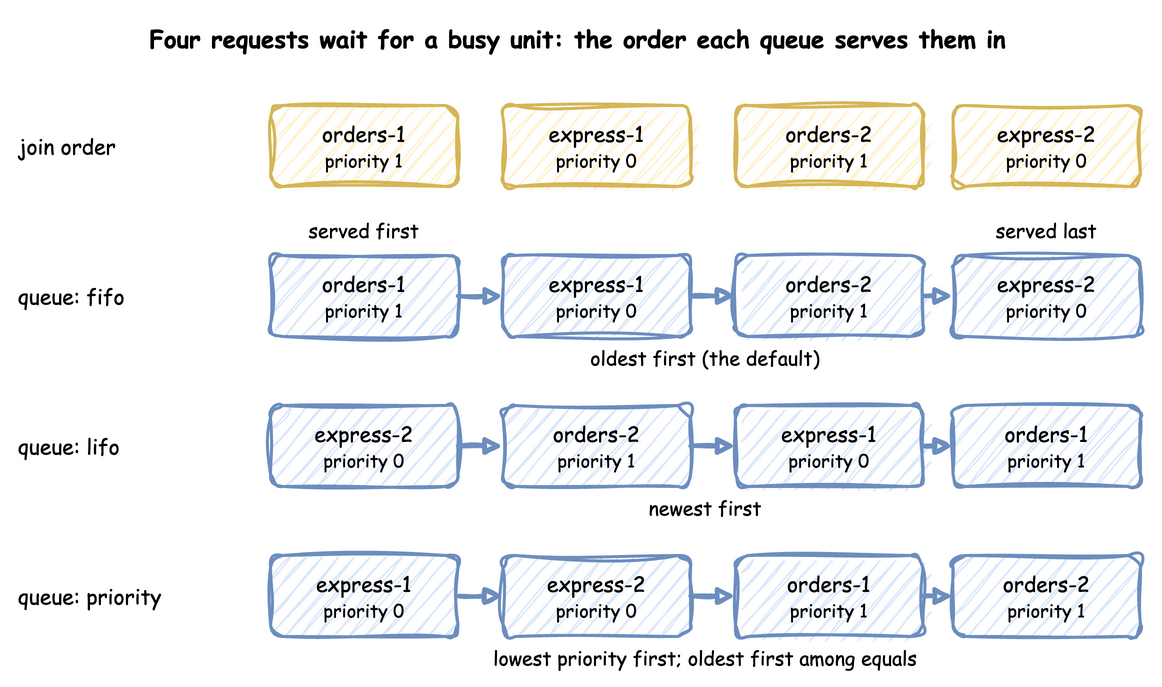
SimPy has a PriorityResource for the priority discipline, and a PriorityStore for items. In desflow every resource has a queue: fifo (the default), lifo or priority. Under priority the lowest number goes first, and requests with the same priority are served first in, first out:
Give Express Orders Priority
Each task gives its requests a priority. Express orders get 0, so they are served before any regular order that is waiting; regular orders get 1:
tasks:
pack_order:
service: packing
resource: packers
priority: 1
payload: {event_type: order_packed}
pack_express:
service: packing
resource: packers
priority: 0 # served before any regular order that is waiting
payload: {event_type: express_packed}
Here each task has a fixed number. A priority can also be an expression read from the entity's attributes, which Task Flow describes, such as priority: attr.priority, so each order gets its own. A priority on a task whose resource does not have queue: priority is refused when the file loads, so to run the shop under fifo, remove queue: priority and both priority lines.
@app.task(service_id="packing", resource_id="packers", priority=rank(1))
def pack_order(task_id: int):
return {"event_type": "order_packed"}
# Served before any regular order that is waiting
@app.task(service_id="packing", resource_id="packers", priority=rank(0))
def pack_express(task_id: int):
return {"event_type": "express_packed"}
rank gives each task its priority under priority and none under fifo, because a priority on a resource of another order is refused when the run starts. A task's priority can also be an expression such as priority="attr.tier", or a function of the task id and the entity's attributes, such as priority=lambda task_id, attributes: attributes["tier"], so each order gets its own; the attributes exist before the order joins the queue, while its payload does not.
# Express orders are served before any regular order that is waiting
TASKS = {"orders": ("pack_order", 1), "express": ("pack_express", 0)}
# Under fifo and lifo the priority is ignored
with packers.request(priority=priority) as request:
In the low-level API each request carries its priority. A resource whose queue is fifo or lifo ignores it, which is how the same code runs under both orders.
Both kinds of order use the same packer, so they share one queue. The built-in statistics, which Statistics describes, keep the mean wait of each task apart: Shop.stats.tasks.pack_express.wait_mean and Shop.stats.tasks.pack_order.wait_mean.
Starvation
Priority has a price. A regular order is served only when no express order is waiting, so every express order that arrives while it waits pushes it back. As the shop gets busier this grows quickly: with a quarter of orders express, the regular wait is 2.50 seconds at 0.5 orders a second in all, 3.98 at 0.55 and 6.94 at 0.6, while express orders wait less than a second at all three. If express orders alone kept the packer busy, regular orders would never be served at all: they would starve.
Result
Can express orders jump the queue? Yes, and the regular orders pay for it. The scripts print the mean wait of each kind of order under each queue order:
fifo pack_express mean wait 5.84 s
fifo pack_order mean wait 5.32 s
priority pack_express mean wait 0.84 s
priority pack_order mean wait 6.94 s
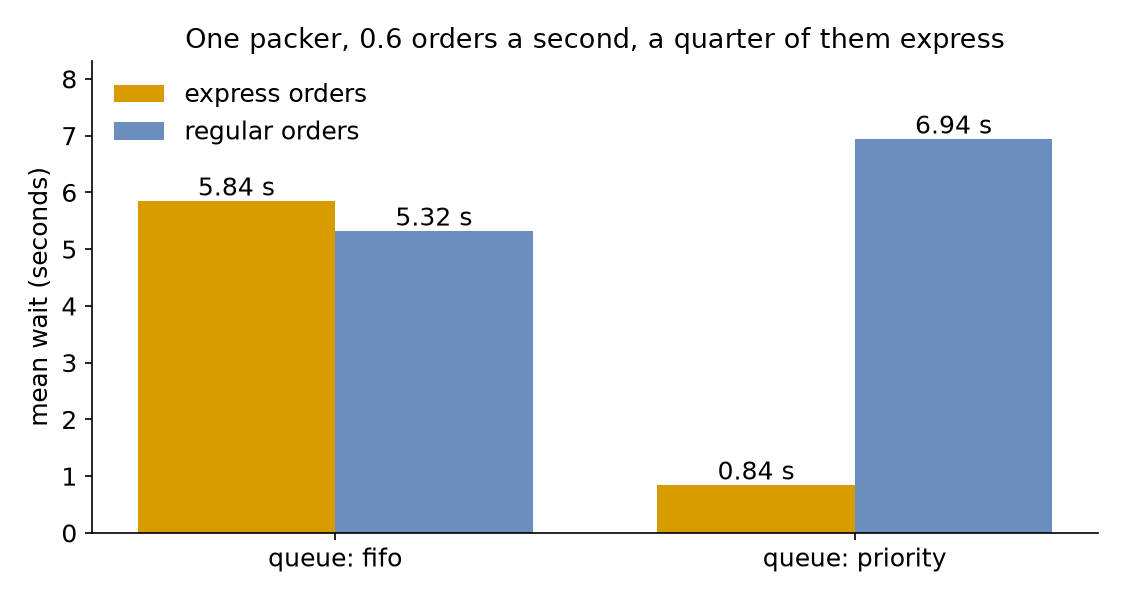
Under priority, express orders wait 0.84 seconds on average instead of 5.84. Regular orders pay for it: 6.94 seconds instead of 5.32.
Why It Works
Priority does not make the packer faster, so it cannot remove waiting; it only decides who waits. Weighted by how many orders of each kind arrive, the mean wait is 0.75 × 5.32 + 0.25 × 5.84 = 5.45 seconds under fifo and 0.75 × 6.94 + 0.25 × 0.84 = 5.41 seconds under priority: almost the same total, shared out differently. Resources describes how the queue orders requests.
Full Files
Full files
# The Priorities tutorial: express orders go before regular ones.
# Run it with: desflow run priorities.yaml
simulation:
sim_id: Shop
factor: 0
random_seed: 42
resources:
  # The packer serves the lowest priority first, the oldest first among equals
  packers: {current_cap: 1, max_cap: 4, queue: priority}
services:
packing: {dist: constant, value: 1.5 s}
arrivals:
# 0.6 orders a second in all, one in four of them express
orders: {dist: exponential, rate: 0.45, spawn: pack_order}
express: {dist: exponential, rate: 0.15, spawn: pack_express}
tasks:
pack_order:
service: packing
resource: packers
priority: 1
payload: {event_type: order_packed}
pack_express:
service: packing
resource: packers
priority: 0 # served before any regular order that is waiting
payload: {event_type: express_packed}
# The mean wait of each task at the end
stats: {level: typical, interval: 1 h}
egress:
- type: Console
run:
until: 1 h
"""The Priorities tutorial: express orders go before regular ones, builder.
One packer, regular orders at 0.45 a second and express orders at 0.15, and 1.5
seconds of packing. Every record is printed to the terminal, and the script prints
the mean wait of each kind of order under each queue order at the end:
python priorities.py 2>/dev/null shows only those lines.
"""
import logging
from desflow import ConsoleEgress, SimulationContext
logging.basicConfig(
level=logging.INFO, format="%(levelname)s [%(asctime)s] %(message)s"
)
def shop(queue: str = "priority") -> SimulationContext:
"""The shop with the packer's queue in `queue` order."""
def rank(value):
# A priority counts only under the priority order, and the other orders
# refuse one, so under fifo the tasks have none
return value if queue == "priority" else None
app = (
SimulationContext(sim_id="Shop", factor=0, random_seed=42)
.add_service("packing", dist="constant", value=1.5)
# 0.6 orders a second in all, one in four of them express
.add_arrival("orders", dist="exponential", rate=0.45)
.add_arrival("express", dist="exponential", rate=0.15)
.with_stats("typical", interval=3600) # the mean wait of each task
.add_egress(ConsoleEgress())
)
# The packer serves the lowest priority first, the oldest first among equals
app.add_resource("packers", current_cap=1, max_cap=4, queue=queue)
@app.task(service_id="packing", resource_id="packers", priority=rank(1))
def pack_order(task_id: int):
return {"event_type": "order_packed"}
# Served before any regular order that is waiting
@app.task(service_id="packing", resource_id="packers", priority=rank(0))
def pack_express(task_id: int):
return {"event_type": "express_packed"}
def loop(arrival, task):
def generator(context: SimulationContext):
task_id = 0
while True:
order = yield context.wait_for_arrival(arrival)
context.spawn(task(task_id, entity=order))
task_id += 1
return generator
app.arrival_loop("orders")(loop("orders", pack_order))
app.arrival_loop("express")(loop("express", pack_express))
return app
def mean_waits(queue: str) -> dict:
"""Runs one hour and returns the mean wait of each task."""
app = shop(queue)
app.run(until="1 h")
readings = app.env.stats.readings()
return {
task: readings[f"Shop.stats.tasks.{task}.wait_mean"]
for task in ("pack_express", "pack_order")
}
if __name__ == "__main__":
for queue in ("fifo", "priority"):
for task, wait in mean_waits(queue).items():
print(f"{queue:<8} {task:<12} mean wait {wait:5.2f} s")
"""The Priorities tutorial: express orders go before regular ones, low-level.
One packer, regular orders at 0.45 a second and express orders at 0.15, and 1.5
seconds of packing. Every record is printed to the terminal, and the script prints
the mean wait of each kind of order under each queue order at the end:
python priorities_low_level.py 2>/dev/null shows only those lines.
"""
import logging
from desflow import (
CapacityConfig,
ConsoleEgress,
DistributionConfig,
DynamicRealtimeEnvironment,
DynamicResource,
Sampler,
SimParameter,
)
logging.basicConfig(
level=logging.INFO, format="%(levelname)s [%(asctime)s] %(message)s"
)
PARAMS = SimParameter(
sim_id="Shop",
arrival={
# 0.6 orders a second in all, one in four of them express
"orders": DistributionConfig(dist="exponential", rate=0.45),
"express": DistributionConfig(dist="exponential", rate=0.15),
},
service={"packing": DistributionConfig(dist="constant", value=1.5)},
resources={"packers": CapacityConfig(current_cap=1, max_cap=4)},
)
# Express orders are served before any regular order that is waiting
TASKS = {"orders": ("pack_order", 1), "express": ("pack_express", 0)}
def pack(env, sampler, packers, arrival, key, task_id):
task, priority = TASKS[arrival]
path_id = "Shop.service.packing"
def publish(value):
env.publish_event(key, value, task=task, instance=task_id)
publish({"path_id": path_id, "status": "queued"})
env.stats.task_queued(task, task_id)
# Under fifo and lifo the priority is ignored
with packers.request(priority=priority) as request:
yield request
publish({"path_id": path_id, "status": "started"})
env.stats.task_started(task, task_id)
yield env.timeout(sampler.sample(env.registry.get_config(path_id)))
event = "express_packed" if arrival == "express" else "order_packed"
publish({"event_type": event})
env.stats.task_finished(task, task_id)
def order_generator(env, sampler, packers, arrival):
config = env.registry.get_config(f"Shop.arrival.{arrival}")
task_id = 0
while True:
yield env.timeout(sampler.sample(config))
key = f"{arrival}-{task_id + 1}"
env.process(pack(env, sampler, packers, arrival, key, task_id))
task_id += 1
def run(queue="priority", until=3600, factor=0.0):
env = DynamicRealtimeEnvironment(factor=factor)
env.registry.register_sim_parameter(PARAMS)
env.setup_egress([ConsoleEgress()])
env.setup_stats("Shop", "typical", interval=3600) # the mean wait of each task
# The packer serves the lowest priority first, the oldest first among equals
packers = DynamicResource(env, "Shop", "packers", queue=queue)
sampler = Sampler(seed=42)
env.process(order_generator(env, sampler, packers, "orders"))
env.process(order_generator(env, sampler, packers, "express"))
try:
env.run(until=until)
finally:
env.teardown()
return env
def mean_waits(queue: str) -> dict:
"""Runs one hour and returns the mean wait of each task."""
readings = run(queue).stats.readings()
return {
task: readings[f"Shop.stats.tasks.{task}.wait_mean"]
for task in ("pack_express", "pack_order")
}
if __name__ == "__main__":
for queue in ("fifo", "priority"):
for task, wait in mean_waits(queue).items():
print(f"{queue:<8} {task:<12} mean wait {wait:5.2f} s")
Next, A Flow of Tasks asks how orders move through picking, packing and shipping.