Randomness and Seeds
Run the busy shop twice and the records differ: orders arrive at other times and packing takes other times. That is what a stochastic model does, but it makes a result hard to check or to compare. This page asks: why does each run differ, and how is one repeated?
What You Add
A seed, then a second arrival. The shop is the busy hour from Queues and Capacity with its answer, 3 packers, and packing that now varies: 1.5 seconds on average, give or take 0.5, drawn from a normal distribution. The run is one minute long.
Run Twice
A simulation draws its random times from a random number stream: a long sequence of numbers that looks random but is computed from a starting value, the seed. The same seed gives the same sequence, and so the same run. A run without a seed takes a new seed each time, so two runs give two different sets of records.
desflow never runs without a seed. When you give none, it draws one, uses it, and logs it, so any run can be repeated afterwards:
Leave random_seed out of the simulation section and run the blueprint twice. Each run logs its seed with the command that repeats it:
Leave random_seed out of SimulationContext and run the script twice. Each run logs its seed with the argument that repeats it:
The low-level API never draws a seed for you: you pass one to Sampler. A Sampler() with no seed draws nothing at random, and every sample is the distribution's mean (for a truncated_normal, its mean or its low, whichever is higher), which suits a test that needs fixed times. To start from a new seed each run, draw one yourself, for example with secrets.randbelow(2**32), and print it.
Fix the Seed
Set the seed once, and every run draws the same numbers:
Repeating a run exactly is called reproducibility. It is what lets you check a result, show it to someone else, and see what a change to the model does on its own. Pick one order and follow it: the twelfth order, orders-12, has these events on every run with the seed 42:
[EVT] {'sim_ts': 5.993, 'timestamp': '...', 'key': 'orders-12', 'task': 'pack_order', 'instance': 11, 'value': {'path_id': 'Shop.service.packing', 'status': 'queued'}}
[EVT] {'sim_ts': 6.695, 'timestamp': '...', 'key': 'orders-12', 'task': 'pack_order', 'instance': 11, 'value': {'path_id': 'Shop.service.packing', 'status': 'started'}}
[EVT] {'sim_ts': 8.443, 'timestamp': '...', 'key': 'orders-12', 'task': 'pack_order', 'instance': 11, 'value': {'event_type': 'order_packed'}}
It is queued at 5.993, gets a packer at 6.695 and is packed at 8.443: a wait of 0.702 seconds.
Add Returns
Now add returned parcels: about one every 5 seconds, recorded as they arrive. They do not use the packers.
arrivals:
orders: {dist: exponential, rate: 1.8, spawn: pack_order}
# Returned parcels: about one every 5 seconds
returns: {dist: exponential, rate: 0.2, spawn: receive_return}
tasks:
# A return is recorded as it arrives; it does not use a packer
receive_return:
payload: {event_type: return_received}
# Returned parcels: about one every 5 seconds
app.add_arrival("returns", dist="exponential", rate=0.2)
@app.task()
def receive_return(task_id: int):
# A return is recorded as it arrives; it does not use a packer
return {"event_type": "return_received"}
@app.arrival_loop("returns")
def return_generator(context: SimulationContext):
task_id = 0
while True:
parcel = yield context.wait_for_arrival("returns")
context.spawn(receive_return(task_id, entity=parcel))
task_id += 1
# Returned parcels: about one every 5 seconds
PARAMS.arrival["returns"] = DistributionConfig(dist="exponential", rate=0.2)
def return_generator(env, sampler):
"""Records each return as it arrives; it does not use a packer."""
# Once registered, the config draws from sampler.generator("arrival.returns")
arrival = env.registry.get_config("Shop.arrival.returns")
task_id = 0
while True:
yield env.timeout(sampler.sample(arrival))
key = f"returns-{task_id + 1}"
value = {"event_type": "return_received"}
env.publish_event(key, value, task="receive_return", instance=task_id)
task_id += 1
Sampler(seed=SEED) makes one generator per name, sampler.generator("arrival.returns"), from the seed and the name. When the registry registers a distribution it names it by its path without the sim id, and sampler.sample(config) draws from the generator of that name. Your own code can take a sequence of its own the same way.
A task with no service and no resource, such as receive_return, takes no time: it publishes its payload as soon as the arrival starts it.
Run it with the seed 42. orders-12 has the same three events as before, at the same times. Adding an arrival changed nothing for the orders, because of how desflow hands out random numbers: each distribution draws from a stream of its own, named by its registry path without the sim id. The orders draw from arrival.orders, packing from service.packing, and the new returns from arrival.returns. Look at the two runs side by side:
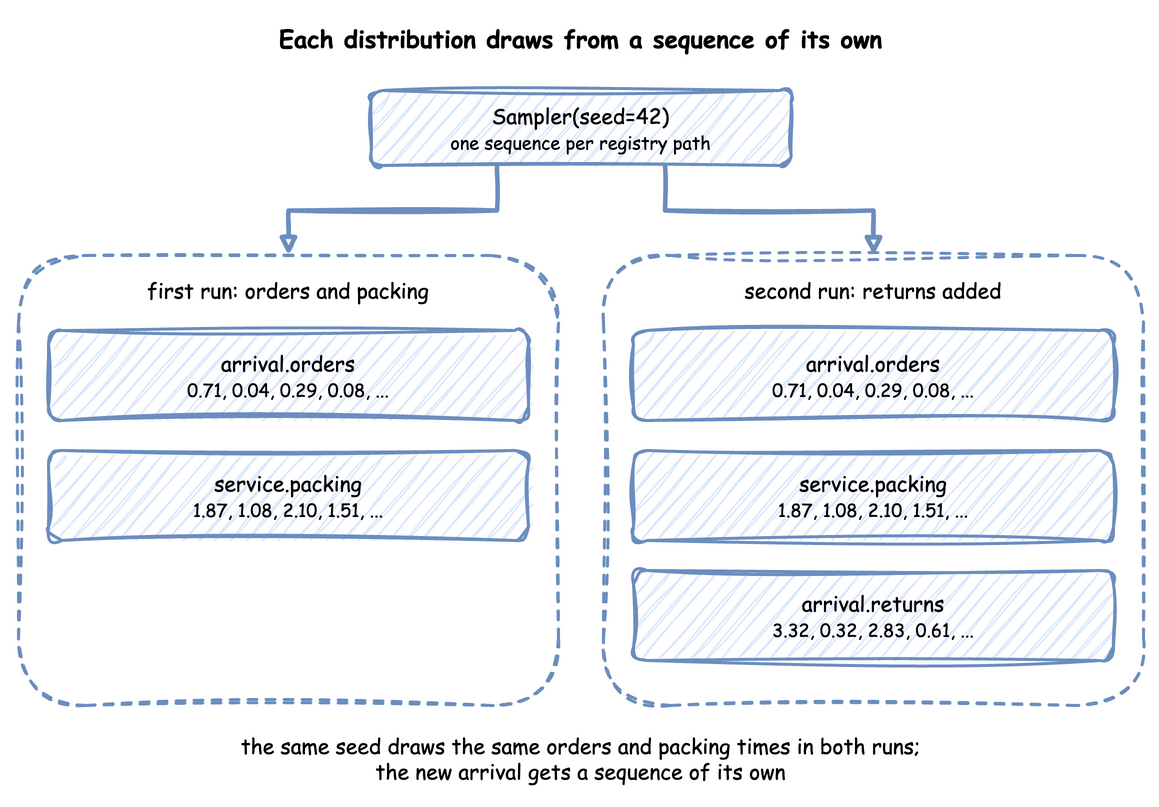
With one shared stream, the returns would take some of the numbers the orders and packing used to get, and every later time would shift.
Result
Why does each run differ, and how is one repeated? Each run differs because each run starts its random number streams from another seed. A run is repeated by giving the same seed: random_seed: 42 in the blueprint, random_seed=42 on SimulationContext, Sampler(seed=42) in the low-level API, or desflow run --seed 42. With it, the twelfth order waits 0.702 seconds on every run, and still 0.702 seconds after the returns are added.
Why It Works
One stream per input means that two versions of a model run with the same seed see the same arrivals and the same service times wherever they share them. A difference between their results then comes from the change, not from different random numbers. This is called common random numbers, and it is how two designs are compared fairly. Arrivals and Services describes how each stream is made, and Distributions lists every family with its parameters.
Full Files
Full files
# The Randomness and Seeds tutorial: the busy shop, seeded, with returns.
# Run it with: desflow run randomness_and_seeds.yaml
simulation:
sim_id: Shop
factor: 0
# The same random numbers on every run; leave it out to draw a new seed
random_seed: 42
resources:
packers: {current_cap: 3, max_cap: 10}
services:
# Packing varies: 1.5 seconds on average, give or take 0.5
packing: {dist: normal, mean: 1.5 s, std: 0.5 s}
arrivals:
orders: {dist: exponential, rate: 1.8, spawn: pack_order}
# Returned parcels: about one every 5 seconds
returns: {dist: exponential, rate: 0.2, spawn: receive_return}
tasks:
# A return is recorded as it arrives; it does not use a packer
receive_return:
payload: {event_type: return_received}
pack_order:
service: packing
resource: packers
payload: {event_type: order_packed}
egress:
- type: Console
run:
until: 1 min
"""The Randomness and Seeds tutorial: the busy shop, seeded, with returns, builder.
Orders arrive at 1.8 a second and three packers pack each in 1.5 seconds on average,
give or take 0.5. Returned parcels arrive about every 5 seconds and are recorded as
they arrive. Every record is printed to the terminal.
"""
import logging
from desflow import ConsoleEgress, SimulationContext
logging.basicConfig(
level=logging.INFO, format="%(levelname)s [%(asctime)s] %(message)s"
)
app = (
# The same random numbers on every run; leave it out to draw a new seed
SimulationContext(sim_id="Shop", factor=0, random_seed=42)
.add_resource("packers", current_cap=3, max_cap=10)
# Packing varies: 1.5 seconds on average, give or take 0.5
.add_service("packing", dist="normal", mean=1.5, std=0.5)
.add_arrival("orders", dist="exponential", rate=1.8)
.add_egress(ConsoleEgress())
)
@app.task(service_id="packing", resource_id="packers")
def pack_order(task_id: int):
return {"event_type": "order_packed"}
@app.arrival_loop("orders")
def order_generator(context: SimulationContext):
task_id = 0
while True:
order = yield context.wait_for_arrival("orders")
context.spawn(pack_order(task_id, entity=order))
task_id += 1
# Returned parcels: about one every 5 seconds
app.add_arrival("returns", dist="exponential", rate=0.2)
@app.task()
def receive_return(task_id: int):
# A return is recorded as it arrives; it does not use a packer
return {"event_type": "return_received"}
@app.arrival_loop("returns")
def return_generator(context: SimulationContext):
task_id = 0
while True:
parcel = yield context.wait_for_arrival("returns")
context.spawn(receive_return(task_id, entity=parcel))
task_id += 1
if __name__ == "__main__":
app.run(until="1 min")
"""The Randomness and Seeds tutorial: the busy shop, seeded, with returns, low-level.
Orders arrive at 1.8 a second and three packers pack each in 1.5 seconds on average,
give or take 0.5. Returned parcels arrive about every 5 seconds and are recorded as
they arrive. Every record is printed to the terminal.
"""
import logging
from desflow import (
CapacityConfig,
ConsoleEgress,
DistributionConfig,
DynamicRealtimeEnvironment,
DynamicResource,
Sampler,
SimParameter,
)
logging.basicConfig(
level=logging.INFO, format="%(levelname)s [%(asctime)s] %(message)s"
)
PARAMS = SimParameter(
sim_id="Shop",
arrival={"orders": DistributionConfig(dist="exponential", rate=1.8)},
# Packing varies: 1.5 seconds on average, give or take 0.5
service={"packing": DistributionConfig(dist="normal", mean=1.5, std=0.5)},
resources={"packers": CapacityConfig(current_cap=3, max_cap=10)},
)
# The same random numbers on every run, passed to Sampler(seed=SEED) in run below
SEED = 42
def pack_order(env, sampler, packers, key, task_id):
path_id = "Shop.service.packing"
def publish(value):
env.publish_event(key, value, task="pack_order", instance=task_id)
publish({"path_id": path_id, "status": "queued"})
with packers.request() as request:
yield request
publish({"path_id": path_id, "status": "started"})
yield env.timeout(sampler.sample(env.registry.get_config(path_id)))
publish({"event_type": "order_packed"})
def order_generator(env, sampler, packers):
arrival = env.registry.get_config("Shop.arrival.orders")
task_id = 0
while True:
yield env.timeout(sampler.sample(arrival))
env.process(pack_order(env, sampler, packers, f"orders-{task_id + 1}", task_id))
task_id += 1
# Returned parcels: about one every 5 seconds
PARAMS.arrival["returns"] = DistributionConfig(dist="exponential", rate=0.2)


def return_generator(env, sampler):
    """Records each return as it arrives; it does not use a packer."""
    # Once registered, the config draws from sampler.generator("arrival.returns")
    arrival = env.registry.get_config("Shop.arrival.returns")
    task_id = 0
    while True:
        yield env.timeout(sampler.sample(arrival))
        key = f"returns-{task_id + 1}"
        value = {"event_type": "return_received"}
        env.publish_event(key, value, task="receive_return", instance=task_id)
        task_id += 1
def run(until=60, factor=0.0):
env = DynamicRealtimeEnvironment(factor=factor)
env.registry.register_sim_parameter(PARAMS)
env.setup_egress([ConsoleEgress()])
packers = DynamicResource(env, "Shop", "packers")
sampler = Sampler(seed=SEED)
env.process(order_generator(env, sampler, packers))
env.process(return_generator(env, sampler))
try:
env.run(until=until)
finally:
env.teardown()
return env
if __name__ == "__main__":
run()
Next, Choosing Inputs asks which distribution fits packing times.