Airflow DAGs from S3
The airflow profile runs airflow standalone in one container against odctl's PostgreSQL. It reads DAG files from s3://airflow/dags on SeaweedFS, so you deploy a DAG by uploading it. No volume or sync container is involved. The steps below come from the end-to-end tests.
The web UI is at http://127.0.0.1:8085, with user user and password password.
Upload a DAG
Any S3 client pointed at http://127.0.0.1:8333 with key user and secret password can upload. This uses boto3 inside the Airflow container:
docker exec -i airflow python - <<'PY'
import boto3
body = '''
from airflow.sdk import DAG
from airflow.providers.standard.operators.bash import BashOperator
import pendulum

with DAG(
    dag_id="hello",
    start_date=pendulum.datetime(2026, 1, 1, tz="UTC"),
    schedule=None,
    catchup=False,
):
    BashOperator(task_id="say_hello", bash_command="echo hello")
'''
boto3.client("s3", endpoint_url="http://seaweed:8333").put_object(
    Bucket="airflow", Key="dags/hello.py", Body=body.encode())
PY
Airflow checks the bucket every 15 seconds and then parses the new file.
Run it
New DAGs start paused. Wait until the DAG is listed, then unpause and trigger it:
docker exec airflow airflow dags list | grep hello
docker exec airflow airflow dags unpause hello
docker exec airflow airflow dags trigger hello
docker exec airflow airflow dags list-runs hello
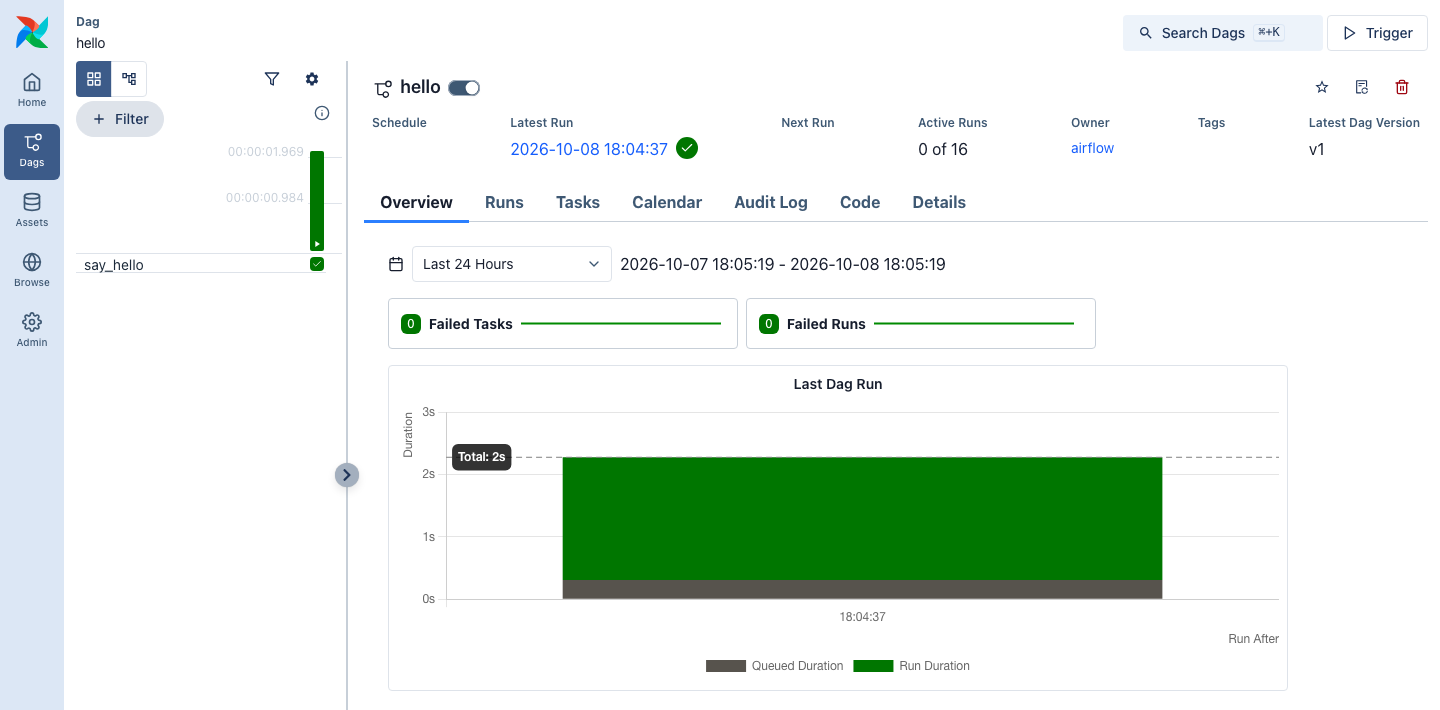
The DAG page shows the run and the say_hello task.
Plugins and packages
Plugins are copied from s3://airflow/plugins when the container starts, because Airflow loads plugins only once. Run odctl restart airflow after changing one.
To install extra Python packages, set _AIRFLOW_PIP_DEPS in .odctl/.env, for example _AIRFLOW_PIP_DEPS="scikit-learn", and run odctl recreate airflow. Tasks already have the MLflow and Feast clients, and MLFLOW_TRACKING_URI points at the mlflow profile.