Valkey
The valkey profile runs the Valkey Bundle image as one container named valkey. The registry describes it as a cache and data store with JSON, Bloom and vector search capabilities. The commands below come from the end-to-end tests, which run them on every release, with the names changed.
| Setting | Value |
|---|---|
| Address from the host | 127.0.0.1:6379 |
Address inside the odctl network |
valkey:6379 |
| User | user, password password |
| Memory limit | 512 MB |
Users and permissions
The unauthenticated default user is turned off, so every client logs in as user. That user has every command, every key pattern and every Pub/Sub channel. Channels are a separate permission in Valkey, and the profile grants them explicitly, so PUBLISH and SUBSCRIBE work as well as key commands.
Write and read keys
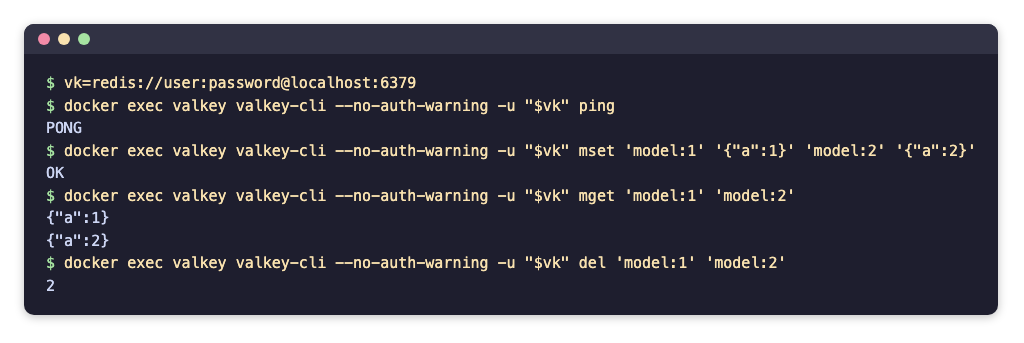
valkey-cli is in the container. Log in with a URL that carries the user and password:
vk=redis://user:password@localhost:6379
docker exec valkey valkey-cli --no-auth-warning -u "$vk" ping
docker exec valkey valkey-cli --no-auth-warning -u "$vk" mset 'model:1' '{"a":1}' 'model:2' '{"a":2}'
docker exec valkey valkey-cli --no-auth-warning -u "$vk" mget 'model:1' 'model:2'
docker exec valkey valkey-cli --no-auth-warning -u "$vk" del 'model:1' 'model:2'
--no-auth-warning stops valkey-cli printing a warning about the password on the command line. ping answers PONG. mset writes both keys in one command, and mget reads them back in one round trip, which is how product-recommender stores and loads its models.
Persistence
Valkey writes an append-only file and saves a snapshot every 60 seconds when at least one key has changed. Both files are inside the container, so a restart keeps the data and odctl down removes it.
From another container
Inside the odctl network, connect to valkey:6379 with the same user and password, for example redis://user:password@valkey:6379 for a Redis client. Feast's online store uses this address, as Feast with Iceberg shows.