Catalogue a database with OpenMetadata
The metadata profile runs OpenMetadata: the server with its UI and REST API, Elasticsearch for search, and an ingestion container, an Airflow that runs the ingestion pipelines the server deploys. Its own tables are in the omt database on PostgreSQL. The commands below come from the end-to-end tests, with the names changed.
| Endpoint | Address |
|---|---|
| UI and REST API from the host | http://127.0.0.1:8585 |
UI and REST API inside the odctl network |
http://openmetadata-server:8585 |
| Ingestion Airflow from the host | http://127.0.0.1:8087 |
Log in as admin@open-data.local with the password admin. The domain is open-data.local, not the upstream default, and a wrong domain fails with an invalid password error.
Get a token
The login API takes the password base64-encoded and returns a JWT:
TOKEN=$(curl -s -H 'Content-Type: application/json' \
  -d "{\"email\":\"admin@open-data.local\",\"password\":\"$(printf admin | base64)\"}" \
  http://127.0.0.1:8585/api/v1/users/login \
  | python3 -c 'import json,sys; print(json.load(sys.stdin)["accessToken"])')
AUTH="Authorization: Bearer $TOKEN"
Register PostgreSQL as a database service
PostgreSQL is already running, so it serves as the source. The server reaches it by its container name:
SVC=$(curl -s -X PUT -H "$AUTH" -H 'Content-Type: application/json' \
  -d '{"name":"demo_pg","serviceType":"Postgres","connection":{"config":{"type":"Postgres","scheme":"postgresql+psycopg2","username":"user","authType":{"password":"password"},"hostPort":"postgres:5432","database":"omt"}}}' \
  http://127.0.0.1:8585/api/v1/services/databaseServices \
  | python3 -c 'import json,sys; print(json.load(sys.stdin)["id"])')
Run a metadata ingestion
Create a pipeline, deploy it as a DAG into the ingestion Airflow, and trigger it:
PIPE=$(curl -s -X POST -H "$AUTH" -H 'Content-Type: application/json' \
  -d "{\"name\":\"demo_pg_metadata\",\"pipelineType\":\"metadata\",\"service\":{\"id\":\"$SVC\",\"type\":\"databaseService\"},\"sourceConfig\":{\"config\":{\"type\":\"DatabaseMetadata\"}},\"airflowConfig\":{\"startDate\":\"2026-01-01T00:00:00.000Z\"}}" \
  http://127.0.0.1:8585/api/v1/services/ingestionPipelines \
  | python3 -c 'import json,sys; print(json.load(sys.stdin)["id"])')

curl -s -X POST -H "$AUTH" http://127.0.0.1:8585/api/v1/services/ingestionPipelines/deploy/$PIPE
curl -s -X POST -H "$AUTH" http://127.0.0.1:8585/api/v1/services/ingestionPipelines/trigger/$PIPE
Airflow has to parse the new DAG file before the trigger works, so repeat the trigger every few seconds until it answers that the pipeline has been triggered. Then read the run's state:
curl -s -H "$AUTH" \
  "http://127.0.0.1:8585/api/v1/services/ingestionPipelines/name/demo_pg.demo_pg_metadata?fields=pipelineStatuses"
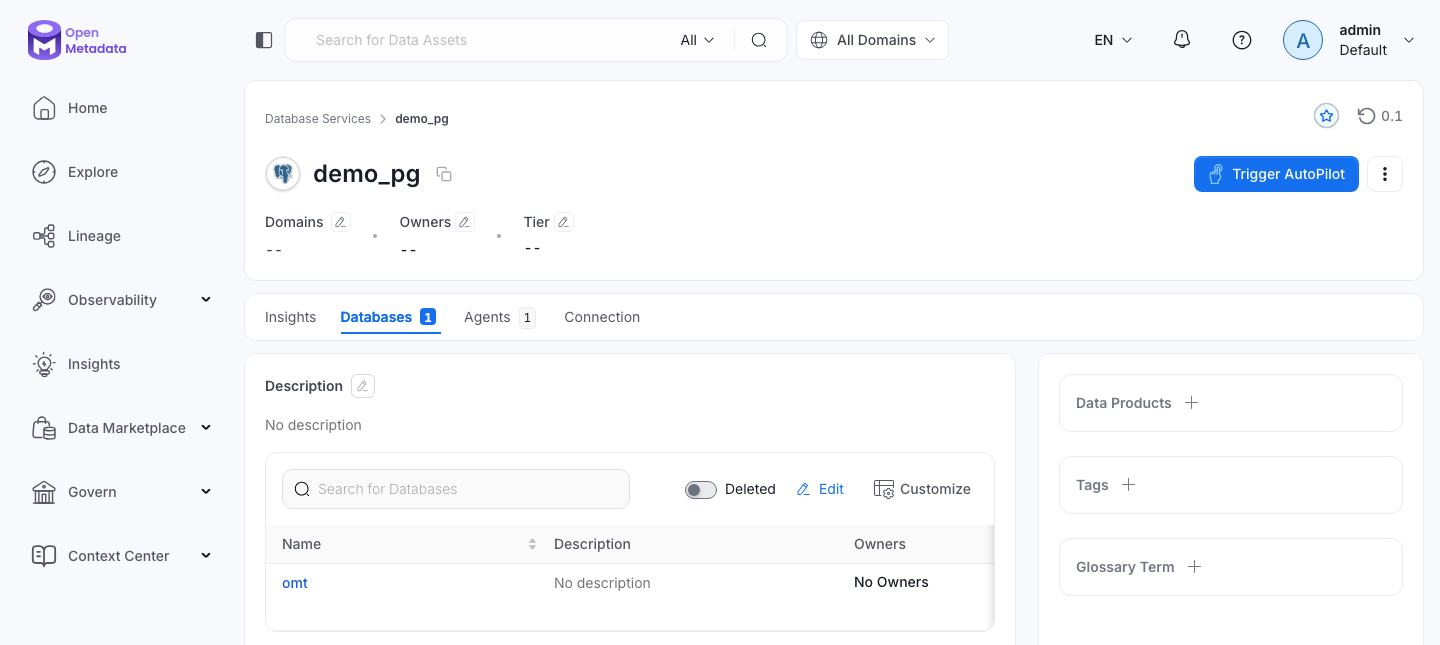
The first entry of pipelineStatuses reaches success when the tables are catalogued. They then appear in the UI under the demo_pg service.
Search the catalogue
Rebuild the search index, then query it:
curl -s -X POST -H "$AUTH" http://127.0.0.1:8585/api/v1/apps/trigger/SearchIndexingApplication
curl -s -H "$AUTH" "http://127.0.0.1:8585/api/v1/search/query?q=*&index=table_search_index&size=1"
hits.total.value counts the searchable tables.
From another container
Inside the odctl network, call the API at http://openmetadata-server:8585. The server also answers the Model Context Protocol at http://127.0.0.1:8585/mcp with the same token.