Feast with Iceberg
The feast profile runs the Feast UI and the online feature server. Feast stores no feature values of its own. Feature definitions live in a SQL registry in PostgreSQL, offline values come from Iceberg tables through the REST catalog, and online values are served from Valkey. You run feast apply and the other client commands from your own environment. The steps below come from the end-to-end tests.
Point the clients at the stack
PyIceberg, which Feast uses to read Iceberg, takes its catalog settings from the environment:
export PYICEBERG_CATALOG__ODCTL__TYPE=rest
export PYICEBERG_CATALOG__ODCTL__URI=http://127.0.0.1:8181
export PYICEBERG_CATALOG__ODCTL__WAREHOUSE=s3://warehouse/
export PYICEBERG_CATALOG__ODCTL__S3__ENDPOINT=http://127.0.0.1:8333
export PYICEBERG_CATALOG__ODCTL__S3__ACCESS_KEY_ID=user
export PYICEBERG_CATALOG__ODCTL__S3__SECRET_ACCESS_KEY=password
export PYICEBERG_CATALOG__ODCTL__S3__PATH_STYLE_ACCESS=true
export PYICEBERG_CATALOG__ODCTL__S3__REGION=us-east-1
Create an Iceberg table
import datetime, pyarrow as pa
from pyiceberg.catalog import load_catalog

cat = load_catalog("odctl")
cat.create_namespace_if_not_exists("demo")
schema = pa.schema([
    pa.field("driver_id", pa.int64(), nullable=False),
    pa.field("event_timestamp", pa.timestamp("us", tz="UTC"), nullable=False),
    pa.field("conv_rate", pa.float32(), nullable=False),
])
t = cat.create_table("demo.driver_stats", schema=schema)
now = datetime.datetime.now(datetime.timezone.utc).replace(microsecond=0)
t.append(pa.Table.from_pydict({
    "driver_id": [1001, 1002],
    "event_timestamp": [now - datetime.timedelta(hours=1)] * 2,
    "conv_rate": [0.5, 0.75],
}, schema=schema))
Define the feature repository
feature_repo/feature_store.yaml:
project: demo
provider: local
registry:
  registry_type: sql
  path: postgresql+psycopg://user:password@127.0.0.1:5432/feast
offline_store:
  type: duckdb
online_store:
  type: redis
  connection_string: "127.0.0.1:6379,username=user,password=password"
entity_key_serialization_version: 3
feature_repo/definitions.py:
from datetime import timedelta
from feast import Entity, FeatureView, Field
from feast.types import Float32
from feast.infra.data_sources.contrib.iceberg_catalog.iceberg_source import IcebergSource

driver = Entity(name="driver", join_keys=["driver_id"])
src = IcebergSource(
    warehouse="", namespace="demo", table="driver_stats",
    catalog_type="rest", catalog_name="odctl",
    endpoint="http://127.0.0.1:8181",
    timestamp_field="event_timestamp",
)
fv = FeatureView(
    name="driver_stats", entities=[driver], ttl=timedelta(days=365),
    schema=[Field(name="conv_rate", dtype=Float32)], source=src, online=True,
)
Pass warehouse="" and catalog_name="odctl". Feast's REST client puts the warehouse into the URL path, and the catalog serves its API with no prefix, so a real warehouse value fails with HTTP 400.
Register and materialise
feast -c feature_repo apply
feast -c feature_repo materialize-incremental "$(date -u +%Y-%m-%dT%H:%M:%S)"
FeatureStore(repo_path="feature_repo").get_historical_features(...) now takes a point-in-time join from Iceberg through DuckDB, and get_online_features(...) reads the materialised values from Valkey.
Serve from the stack
The UI at http://127.0.0.1:8890 and the online feature server at http://127.0.0.1:6566 load their repository from s3://feast/repo. To serve your features, upload the repository there with container addresses in its feature_store.yaml: postgres:5432, valkey:6379 and http://catalog:8181. The services check that prefix every 15 seconds and restart Feast when it changes.
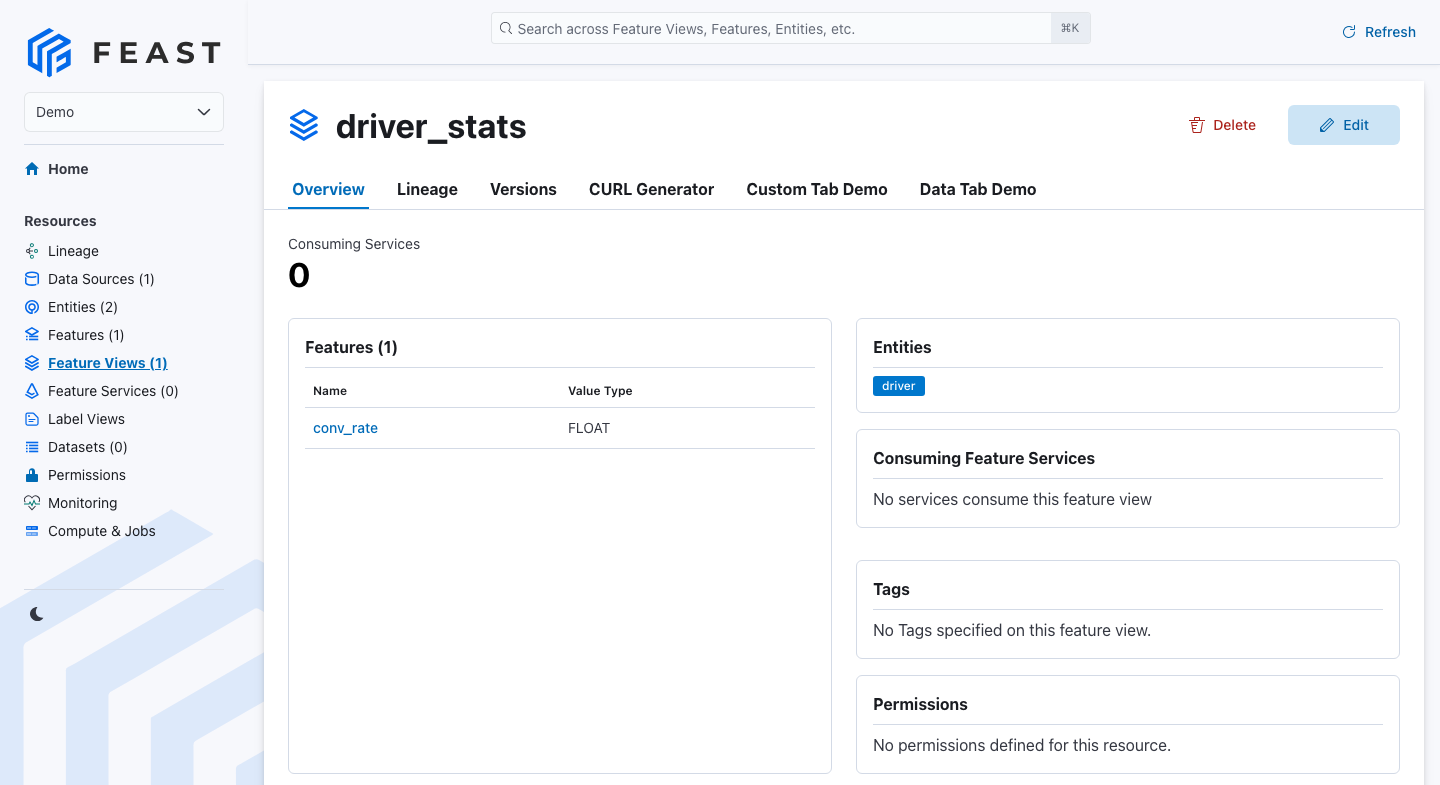
Once the repository is uploaded, the UI lists the project and its feature views: