MLflow tracking and model serving
The mlflow profile runs two containers. mlflow is the tracking server and model registry, with runs on PostgreSQL and artifacts on SeaweedFS under s3://mlflow. mlflow-serve scores a registered model over HTTP. The commands below come from the end-to-end tests, with the names changed.
| Endpoint | Address |
|---|---|
| Tracking UI and API from the host | http://127.0.0.1:5004 |
Tracking API inside the odctl network |
http://mlflow:5000 |
| Model server from the host | http://127.0.0.1:5003/invocations |
Model server inside the odctl network |
http://mlflow-serve:5003/invocations |
The server runs MLflow 3.16.1, so install the same client version on the host.
Log a run with an artifact
import pathlib
import mlflow

mlflow.set_tracking_uri("http://127.0.0.1:5004")
mlflow.set_experiment("demo")

p = pathlib.Path("notes.txt")
p.write_text("hello")
with mlflow.start_run() as run:
    mlflow.log_param("k", "v")
    mlflow.log_metric("m", 1.0)
    mlflow.log_artifact(str(p))

print(mlflow.get_run(run.info.run_id).info.artifact_uri)
print([f.path for f in mlflow.MlflowClient().list_artifacts(run.info.run_id)])
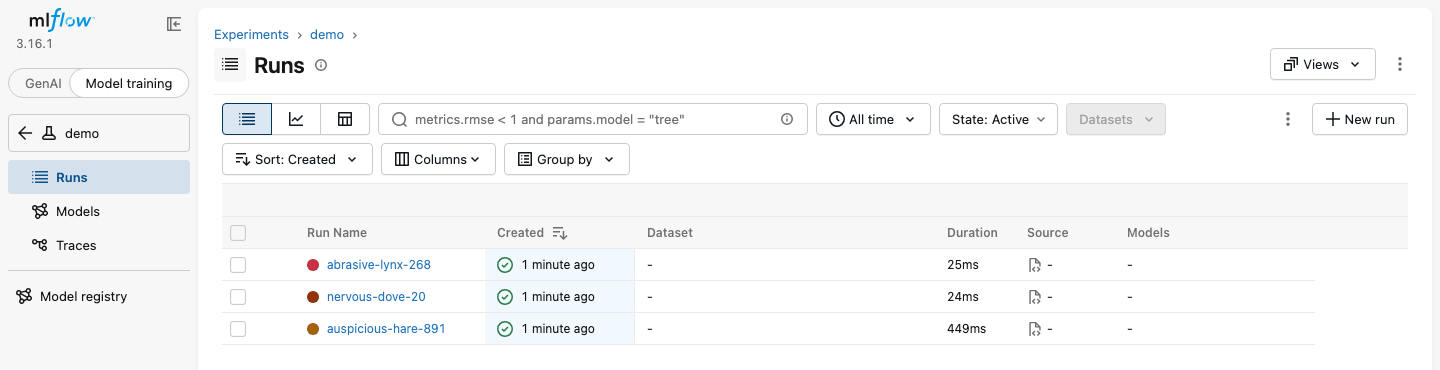
The artifact URI starts with mlflow-artifacts:/. The server proxies artifacts, so the client uploads through the tracking server and needs no S3 address or keys. The run and its artifact appear in the UI.
The runs are listed under the experiment in the Model training view:
Register a model
import mlflow, numpy as np, xgboost as xgb
from mlflow import MlflowClient

mlflow.set_tracking_uri("http://127.0.0.1:5004")
mlflow.set_experiment("demo-model")

X, y = np.array([[0.0], [1.0], [2.0], [3.0]]), np.array([0, 0, 1, 1])
with mlflow.start_run():
    model = xgb.XGBClassifier(n_estimators=5, max_depth=2).fit(X, y)
    mlflow.xgboost.log_model(model, name="model", registered_model_name="demo-model")

client = MlflowClient()
version = max(int(mv.version) for mv in client.search_model_versions("name='demo-model'"))
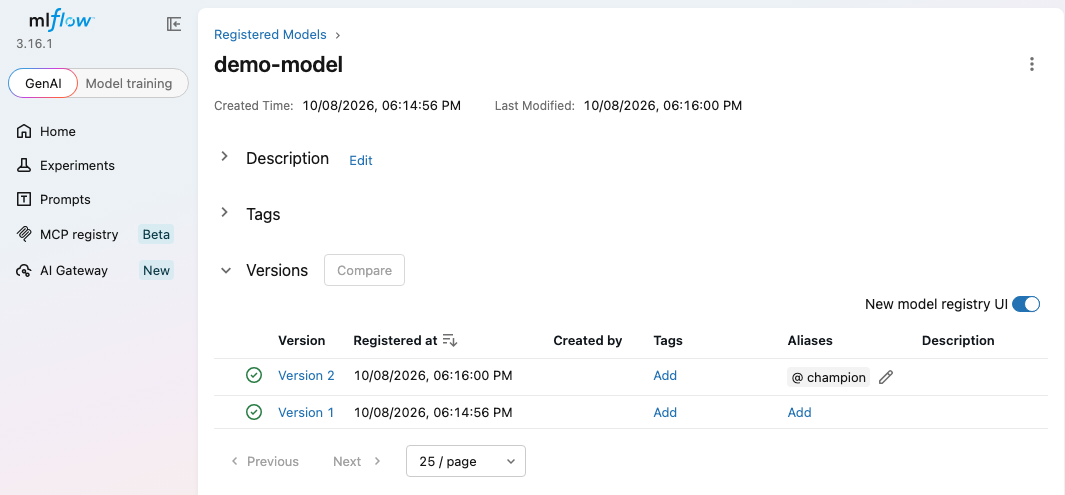
client.set_registered_model_alias("demo-model", "champion", version)
This needs XGBoost on the host. The model server has XGBoost 3.2, so install the same minor version to log a model it can load.
The registry lists each version, with the champion alias on the latest:
Serve the model
mlflow-serve starts with the profile and waits idle while MODEL_URI is empty. MODEL_URI is set in .odctl/.env, which odctl init writes. Change its line there to:
Then run odctl up mlflow again, so the container starts with the new value, and score two rows:
odctl up mlflow
curl -X POST http://127.0.0.1:5003/invocations \
  -H 'Content-Type: application/json' -d '{"inputs": [[0.0], [3.0]]}'
The response holds a predictions list, one per input row. Check the body rather than the status code, because the server answers 200 with an error payload when scoring fails. http://127.0.0.1:5003/ping answers once the model is loaded.
From Airflow or another container
Inside the odctl network, set the tracking URI to http://mlflow:5000 and score at http://mlflow-serve:5003/invocations. Extra Python packages for both MLflow containers go in _MLOPS_PIP_DEPS in .odctl/.env, followed by odctl recreate mlflow.