The shop now sells shirts in three sizes, small, medium and large. Shirts of every size go on one shelf, a shirt every 10 seconds on average, and an order every 10 seconds asks for one shirt of its own size. A customer cancels an order not filled within 10 minutes. Half the orders are medium, but only 4 shirts in 10 are. This page asks: which waiting order can use the shirt that arrives, and which orders go unfilled? It runs a working day of 8 hours.
What You Add
A shelf store, and a filter on the order's get that picks a shirt of the order's size. The order task has no resource: it waits only for its shirt, with the Patience of 10 minutes covering that wait.
One Shelf of Items
A store holds items, each a value of its own; here each shirt is a mapping such as {size: M}, put on the shelf by a restock task. Stores and Containers describes stores:
# Shirts of every size on one shelf, each item a mapping such as {"size": "M"}stores={"shelf":CapacityConfig(current_cap=1000,max_cap=1000)},
The shirts and the orders arrive from six arrivals, one per size, each with a size attribute. The YAML is below; the builder and low-level versions add the same six arrivals, and their full files are at the end of the page:
# A shirt every 10 seconds: 3 in 10 small, 4 medium, 3 largeshirts_s:{dist:exponential, rate:0.03, spawn:restock, attributes:{size:S}}shirts_m:{dist:exponential, rate:0.04, spawn:restock, attributes:{size:M}}shirts_l:{dist:exponential, rate:0.03, spawn:restock, attributes:{size:L}}# An order every 10 seconds: a quarter small, half medium, a quarter largeorders_s:{dist:exponential, rate:0.025, spawn:take_shirt, attributes:{size:S}}orders_m:{dist:exponential, rate:0.05, spawn:take_shirt, attributes:{size:M}}orders_l:{dist:exponential, rate:0.025, spawn:take_shirt, attributes:{size:L}}
Take the Right Item
A plain get takes the oldest item, whatever it is. A get with a filter takes the oldest item the filter accepts and waits while none does. In SimPy this is a FilterStore, whose get takes a function of the item. In desflow the filter is a condition in which item.<field> reads the item offered, beside the other names a condition reads, such as attr.size for the order's own size:
take_shirt:# Takes the oldest shirt of the order's own size; waits while there is noneget:{store:shelf, filter:item.size == attr.size}# A customer cancels an order not filled within 10 minutespatience:10 min# The shirt the get took, in the finished eventitem_field:shirtpayload:{event_type:order_filled}
item_field: shirt adds the shirt the get took to the finished event's payload under the key shirt, as id_field adds the task id under the key it names (YAML Format lists both).
@app.task(# Takes the oldest shirt of the order's own size; waits while there is noneget={"store":"shelf","filter":"item.size == attr.size"},# A customer cancels an order not filled within 10 minutespatience="10 min",)deftake_shirt(task_id:int,item):# `item` is the shirt the get tookreturn{"event_type":"order_filled","shirt":item}
The builder also takes a function of the item, such as "filter": lambda shirt: shirt["size"] == "M".
deftake_shirt(env,shelf,key,size,task_id):defpublish(value):env.publish_event(key,value,task="take_shirt",instance=task_id)publish({"status":"queued"})# Takes the oldest shirt of the order's own size; waits while there is noneget=shelf.get(filter=lambdashirt:shirt["size"]==size)# A customer cancels an order not filled within 10 minutesyieldget|env.timeout(PATIENCE)ifnotget.triggered:get.cancel()# out of the queue, so it never takes a shirt laterpublish({"status":"reneged"})returnpublish({"status":"started"})publish({"event_type":"order_filled","shirt":get.value})
shelf.get(filter=...) is SimPy's FilterStore.get. Cancelling a get that has not succeeded takes it out of the queue, so it never takes a shirt later.
When a shirt arrives, every waiting order is offered it in the order they started waiting, and the first that accepts it takes it. A medium order waiting at the front does not stop a small order behind it from taking a small shirt, as it would if all orders waited in one line for the next shirt.
patience covers the wait for the get, as it covers a wait for a resource. A get that gives up takes nothing later: the shirt that would have filled it stays on the shelf for the next order.
Result
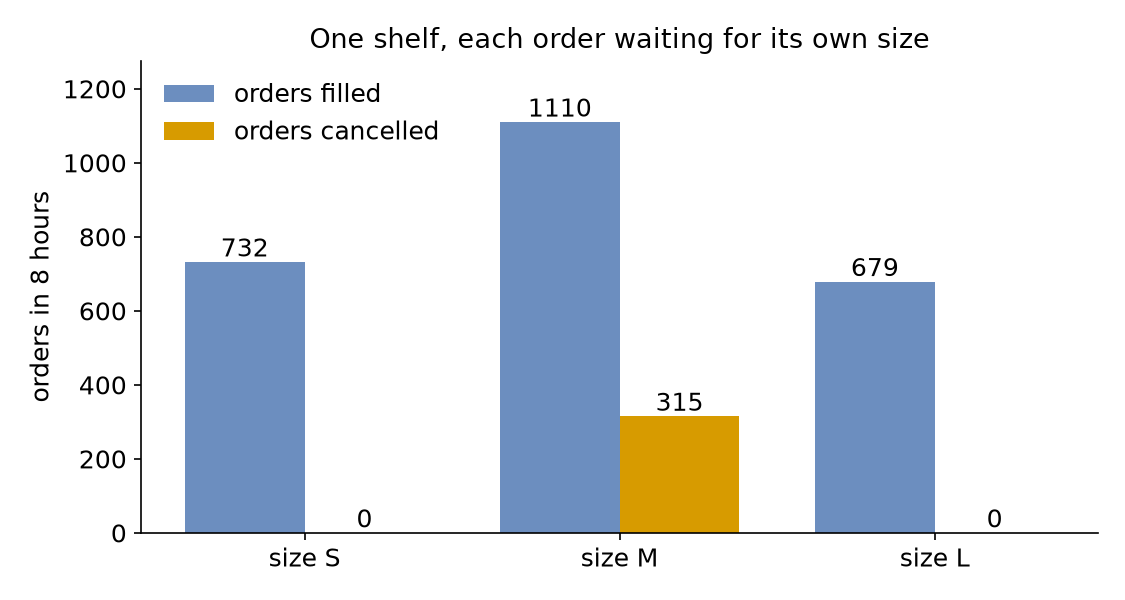
Which waiting order can use the shirt that arrives? The oldest order of the shirt's size, and no other. Over 8 hours, 315 medium orders are cancelled, and no small or large one, because medium orders are half the demand and medium shirts only 4 in 10:
The Builder and Low-level scripts print the counts:
A filtered store is one shelf with a queue per kind of item. Medium orders arrive at 0.05 a second and medium shirts at 0.04, so medium orders are short of shirts for the whole day and only the patience limit keeps their queue from growing without end. Small and large shirts arrive a little faster than their orders, so those orders are filled within their patience, and the shirts left over, 248 by the end of the day, wait on the shelf, which has room for 1,000. Stores and Containers describes filters and cancelled gets.
# The Filtered Inventory tutorial: each order waits for a shirt of its own size.# Run it with: desflow run filtered_inventory.yamlsimulation:sim_id:Shopfactor:0random_seed:42stores:# Shirts of every size on one shelf, each item a mapping such as {size: M}shelf:{current_cap:1000, max_cap:1000}arrivals:# A shirt every 10 seconds: 3 in 10 small, 4 medium, 3 largeshirts_s:{dist:exponential, rate:0.03, spawn:restock, attributes:{size:S}}shirts_m:{dist:exponential, rate:0.04, spawn:restock, attributes:{size:M}}shirts_l:{dist:exponential, rate:0.03, spawn:restock, attributes:{size:L}}# An order every 10 seconds: a quarter small, half medium, a quarter largeorders_s:{dist:exponential, rate:0.025, spawn:take_shirt, attributes:{size:S}}orders_m:{dist:exponential, rate:0.05, spawn:take_shirt, attributes:{size:M}}orders_l:{dist:exponential, rate:0.025, spawn:take_shirt, attributes:{size:L}}tasks:restock:# The shirt goes on the shelf, as a mapping with its sizeput:{store:shelf}payload:{}attributes:[size]take_shirt:# Takes the oldest shirt of the order's own size; waits while there is noneget:{store:shelf, filter:item.size == attr.size}# A customer cancels an order not filled within 10 minutespatience:10 min# The shirt the get took, in the finished eventitem_field:shirtpayload:{event_type:order_filled}egress:-type:Consolerun:until:8 h
"""The Filtered Inventory tutorial: each order waits for a shirt of its own size.Shirts of three sizes arrive on one shelf, and orders of three sizes take them.Every record is printed to the terminal, and the script prints, for each size, howmany orders were filled and how many were cancelled: python filtered_inventory.py2>/dev/null shows only those lines."""importloggingfromcollectionsimportCounterfromdesflowimportConsoleEgress,SimulationContextlogging.basicConfig(level=logging.INFO,format="%(levelname)s [%(asctime)s] %(message)s")# A shirt every 10 seconds: 3 in 10 small, 4 medium, 3 largeSHIRTS={"S":0.03,"M":0.04,"L":0.03}# An order every 10 seconds: a quarter small, half medium, a quarter largeORDERS={"S":0.025,"M":0.05,"L":0.025}defshop()->SimulationContext:"""The shop with one shelf of shirts and orders of three sizes."""app=SimulationContext(sim_id="Shop",factor=0,random_seed=42).add_egress(ConsoleEgress())# Shirts of every size on one shelf, each item a mapping such as {"size": "M"}app.add_store("shelf",current_cap=1000,max_cap=1000)forsize,rateinSHIRTS.items():name=f"shirts_{size.lower()}"app.add_arrival(name,dist="exponential",rate=rate,attributes={"size":size})forsize,rateinORDERS.items():name=f"orders_{size.lower()}"app.add_arrival(name,dist="exponential",rate=rate,attributes={"size":size})# The shirt goes on the shelf, as a mapping with its size@app.task(put={"store":"shelf"})defrestock(task_id:int,entity):return{"size":entity.attributes["size"]}@app.task(# Takes the oldest shirt of the order's own size; waits while there is noneget={"store":"shelf","filter":"item.size == attr.size"},# A customer cancels an order not filled within 10 minutespatience="10 min",)deftake_shirt(task_id:int,item):# `item` is the shirt the get tookreturn{"event_type":"order_filled","shirt":item}defspawn(arrival:str,task,name:str):defloop(context:SimulationContext):whileTrue:entity=yieldcontext.wait_for_arrival(arrival)context.spawn(task(context.next_instance(name),entity=entity))app.arrival_loop(arrival)(loop)forsizeinSHIRTS:spawn(f"shirts_{size.lower()}",restock,"restock")forsizeinORDERS:spawn(f"orders_{size.lower()}",take_shirt,"take_shirt")returnappclass_Outcomes:"""An egress that counts each order's outcome, by size, from its events."""def__init__(self):self.counts=Counter()asyncdefrun(self,egress_queue):importasyncioimportqueuetry:whileTrue:try:forrecordinegress_queue.get_nowait():count(self.counts,record)exceptqueue.Empty:awaitasyncio.sleep(0.01)exceptasyncio.CancelledError:passdefcount(counts:Counter,record:dict)->None:"""Counts a filled or cancelled order, by the size in its key."""ifrecord["stream_type"]!="event"orrecord["task"]!="take_shirt":returnsize=record["key"].split("-")[0][-1].upper()value=record["value"]ifvalue.get("event_type")=="order_filled":counts[(size,"filled")]+=1elifvalue.get("status")=="reneged":counts[(size,"cancelled")]+=1defoutcomes()->Counter:"""Runs eight hours and counts filled and cancelled orders by size."""app=shop()outcome=_Outcomes()app.add_egress(outcome)app.run(until="8 h")returnoutcome.countsif__name__=="__main__":counts=outcomes()forsizeinORDERS:print(f"size {size}: {counts[(size,'filled')]:4} filled, "f"{counts[(size,'cancelled')]:4} cancelled")
"""The Filtered Inventory tutorial: each order waits for a shirt of its own size.Shirts of three sizes arrive on one shelf, and orders of three sizes take them.Every record is printed to the terminal, and the script prints, for each size, howmany orders were filled and how many were cancelled:python filtered_inventory_low_level.py 2>/dev/null shows only those lines."""importitertoolsimportloggingfromcollectionsimportCounterfromdesflowimport(CapacityConfig,ConsoleEgress,DistributionConfig,DynamicRealtimeEnvironment,DynamicStore,Sampler,SimParameter,)logging.basicConfig(level=logging.INFO,format="%(levelname)s [%(asctime)s] %(message)s")# A shirt every 10 seconds: 3 in 10 small, 4 medium, 3 largeSHIRTS={"S":0.03,"M":0.04,"L":0.03}# An order every 10 seconds: a quarter small, half medium, a quarter largeORDERS={"S":0.025,"M":0.05,"L":0.025}PATIENCE=600# a customer cancels an order not filled within 10 minutesPARAMS=SimParameter(sim_id="Shop",arrival={**{f"shirts_{s.lower()}":DistributionConfig(dist="exponential",rate=r)fors,rinSHIRTS.items()},**{f"orders_{s.lower()}":DistributionConfig(dist="exponential",rate=r)fors,rinORDERS.items()},},# Shirts of every size on one shelf, each item a mapping such as {"size": "M"}stores={"shelf":CapacityConfig(current_cap=1000,max_cap=1000)},)defrestock(env,shelf,key,size,task_id):"""The shirt goes on the shelf, as a mapping with its size."""yieldshelf.put({"size":size})env.publish_event(key,{"size":size},task="restock",instance=task_id)deftake_shirt(env,shelf,key,size,task_id):defpublish(value):env.publish_event(key,value,task="take_shirt",instance=task_id)publish({"status":"queued"})# Takes the oldest shirt of the order's own size; waits while there is noneget=shelf.get(filter=lambdashirt:shirt["size"]==size)# A customer cancels an order not filled within 10 minutesyieldget|env.timeout(PATIENCE)ifnotget.triggered:get.cancel()# out of the queue, so it never takes a shirt laterpublish({"status":"reneged"})returnpublish({"status":"started"})publish({"event_type":"order_filled","shirt":get.value})defgenerator(env,sampler,shelf,arrival,size,task,ids):gap=env.registry.get_config(f"Shop.arrival.{arrival}")fornumberinitertools.count(1):yieldenv.timeout(sampler.sample(gap))env.process(task(env,shelf,f"{arrival}-{number}",size,next(ids)))class_Outcomes:"""An egress that counts each order's outcome, by size, from its events."""def__init__(self):self.counts=Counter()asyncdefrun(self,egress_queue):importasyncioimportqueuetry:whileTrue:try:forrecordinegress_queue.get_nowait():count(self.counts,record)exceptqueue.Empty:awaitasyncio.sleep(0.01)exceptasyncio.CancelledError:passdefcount(counts:Counter,record:dict)->None:"""Counts a filled or cancelled order, by the size in its key."""ifrecord["stream_type"]!="event"orrecord["task"]!="take_shirt":returnsize=record["key"].split("-")[0][-1].upper()value=record["value"]ifvalue.get("event_type")=="order_filled":counts[(size,"filled")]+=1elifvalue.get("status")=="reneged":counts[(size,"cancelled")]+=1defrun(until=8*3600,factor=0.0,sinks=()):env=DynamicRealtimeEnvironment(factor=factor)env.registry.register_sim_parameter(PARAMS)env.setup_egress([ConsoleEgress(),*sinks])shelf=DynamicStore(env,"Shop","shelf")sampler=Sampler(seed=42)restocks,takes=itertools.count(),itertools.count()forsizeinSHIRTS:arrival=f"shirts_{size.lower()}"env.process(generator(env,sampler,shelf,arrival,size,restock,restocks))forsizeinORDERS:arrival=f"orders_{size.lower()}"env.process(generator(env,sampler,shelf,arrival,size,take_shirt,takes))try:env.run(until=until)finally:env.teardown()returnenvdefoutcomes()->Counter:"""Runs eight hours and counts filled and cancelled orders by size."""outcome=_Outcomes()run(sinks=[outcome])returnoutcome.countsif__name__=="__main__":counts=outcomes()forsizeinORDERS:print(f"size {size}: {counts[(size,'filled')]:4} filled, "f"{counts[(size,'cancelled')]:4} cancelled")
Next, Changing Demand asks what a rush of orders does to waits.